
Build a Lead Nurturing Strategy That Turns Interest Into Revenue

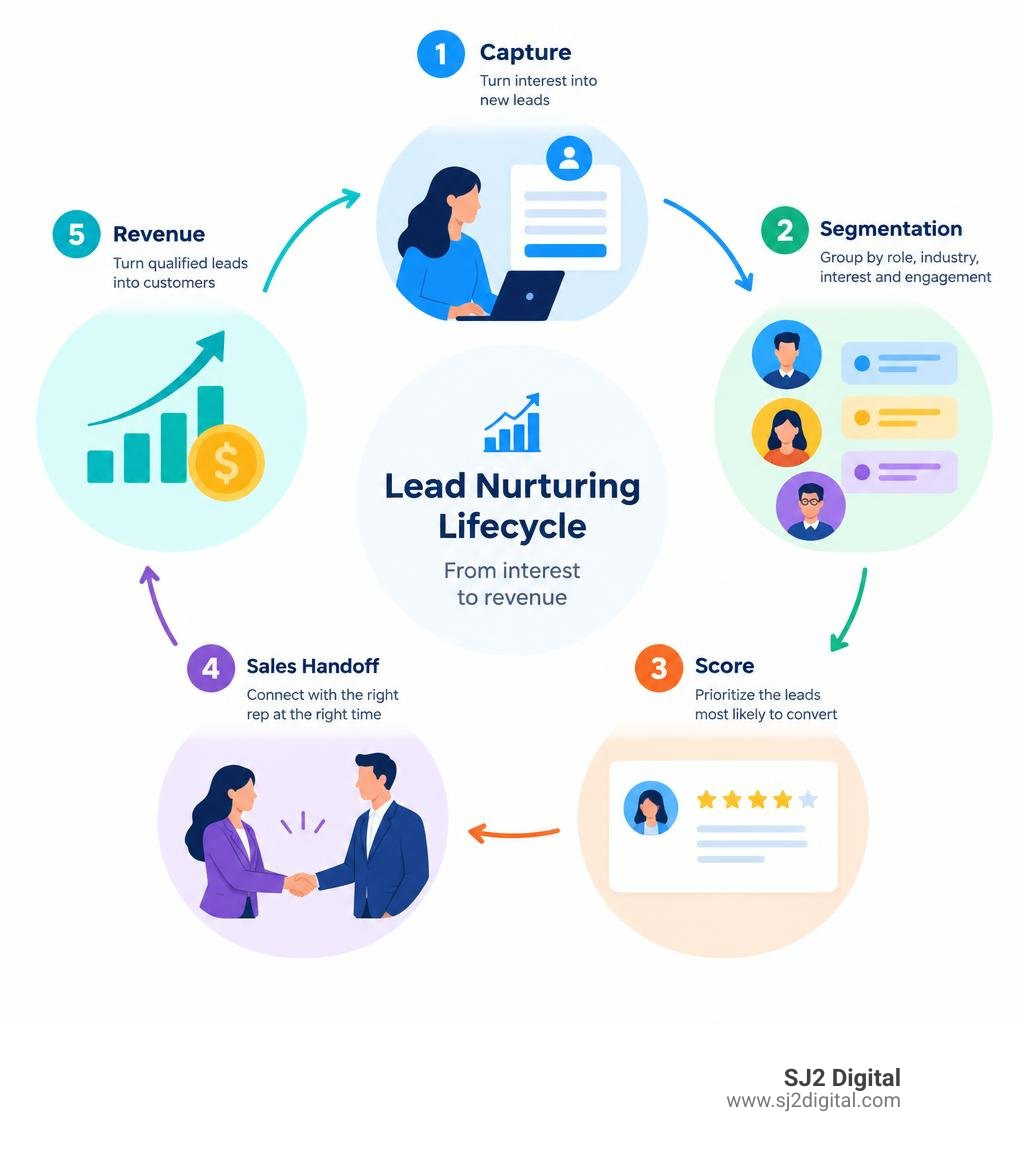
A strong lead nurturing strategy turns new inquiries into sales-ready conversations by delivering useful, timely follow-up based on each prospect's needs, actions, and buying stage.
Start with five essentials:
- Segment leads by role, organization type, interest, and engagement.
- Map content to awareness, consideration, and decision stages.
- Use behavior-based triggers for actions such as form fills, page visits, event registrations, and demo requests.
- Score engagement so sales teams focus on the leads most likely to move forward.
- Measure pipeline outcomes, not just email opens and clicks.
This matters because most new leads are not ready to buy immediately. In B2B, especially in senior living, decisions can involve several stakeholders, long research periods, and a need for clear proof of outcomes. Without relevant follow-up, hard-earned leads often go cold. With it, marketing can build trust, answer questions early, and help sales teams engage at the right moment.
Research has found that nurtured leads can create 20% more sales opportunities than non-nurtured leads, while leading nurture programs generate more sales-ready leads at a lower cost. The goal is not to send more messages. It is to make every touchpoint useful.
Foundations of B2B Lead Nurturing vs. Lead Generation
Many marketing teams pour substantial budget into acquiring new contacts, only to wonder why revenue metrics remain flat. The issue often lies in conflating demand capture with pipeline maturation.
Lead generation focuses strictly on top-of-funnel capture—earning the initial click, download, or form submission. In contrast, lead nurturing is the systematic, mid-funnel cultivation process that takes those raw inquiries and guides them through their evaluation journey until they reach genuine sales readiness.
| Core Dimension | Lead Generation (Top-of-Funnel) | Lead Nurturing (Mid-to-Bottom Funnel) |
|---|---|---|
| Primary Objective | Capture initial contact details and build database volume | Educate, build trust, and accelerate pipeline velocity |
| Channel Focus | Paid search, social ads, landing pages, webinars | Segmented email sequences, retargeting, dynamic workflows |
| Key Metrics | Cost Per Lead (CPL), form submissions, MQL volume | Conversion velocity, MQL-to-SQL rate, pipeline contribution |
| Prospect Mindset | Problem-aware; researching surface-level answers | Solution-aware; comparing vendors and justifying ROI |
| Primary Value | Identifies potential market interest | Prevents revenue leakage and maximizes deal size |
When we treat lead acquisition as the end goal rather than the starting line, we create an expensive leaky bucket. A robust lead nurturing workflow bridges the gap between initial discovery and a closed contract.
The Cost of Unnurtured Leads in 2026
The arithmetic behind ignoring lead follow-up is stark: roughly 80% of new leads never convert into closed sales without consistent, structured follow-up. Yet industry data reveals that 80% of prospects deemed unqualified today will purchase from someone within 24 months.
When sales reps follow up on fresh inquiries without contextual data, up to 70% of those contacts are simply not ready to engage with a representative. B2B buyers now spend over 80% of their journey researching independently before ever booking a demo, and enterprise committees frequently include six or more decision-makers.
Neglecting mid-funnel communication accelerates data decay—which erodes database quality by 20% to 30% annually—and forces sales teams to waste hours chasing cold contacts. Conversely, organizations running mature nurturing programs produce 50% more sales-ready leads at a 33% lower cost, while closing deals that carry a 47% higher average order value.
Core Pillars of an Effective Lead Nurturing Strategy
Building a predictable revenue engine requires shifting away from generic monthly newsletters toward dynamic, trigger-based communication.

A scalable framework relies on four foundational pillars:
- Ideal Customer Profile (ICP) Definition: Clear firmographic, demographic, and psychographic boundaries that dictate who enters specific nurture tracks.
- Progressive Profiling: Incrementally gathering deeper insights (such as team size, current software stack, or budget timeline) across multiple touchpoints rather than intimidating users with 10-field forms upfront.
- Behavioral Triggers: Launching tailored responses based on explicit user actions, such as visiting high-intent pricing pages, downloading technical specs, or attending live panels.
- Transparent Lead Scoring: Objective criteria combining fit (demographics) and intent (activity level) to ensure sales reps only spend time on high-probability opportunities.
Steps to Build a Scalable Lead Nurturing Strategy
To implement this framework, teams should follow a structured five-stage deployment process:
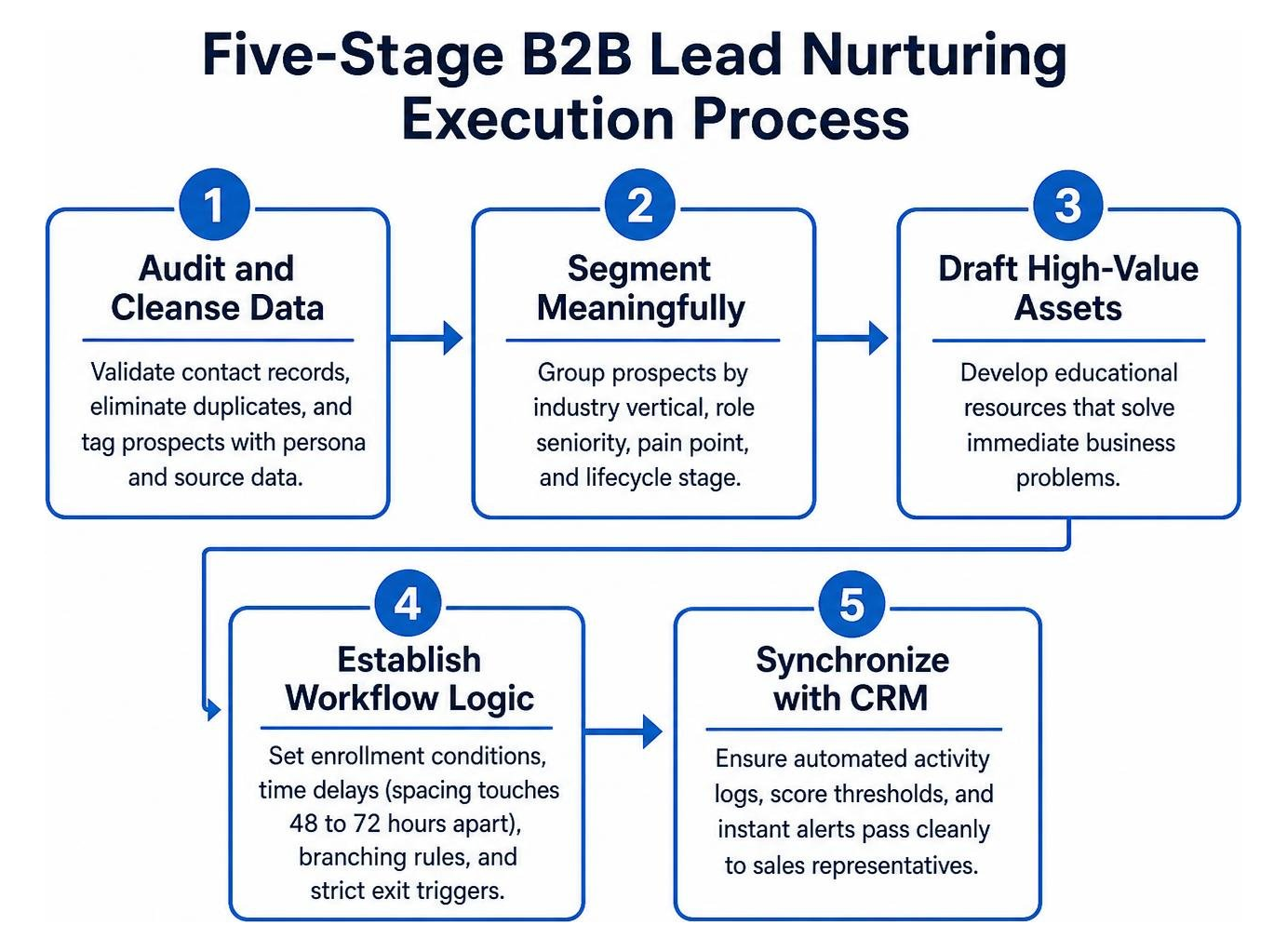
- Audit and Cleanse Data: Validate contact records, eliminate duplicates, and tag prospects with persona and source data.
- Segment Meaningfully: Group prospects by industry vertical, role seniority, pain point, and lifecycle stage.
- Draft High-Value Assets: Develop educational resources that solve immediate business problems rather than pitching product features prematurely.
- Establish Workflow Logic: Set enrollment conditions, time delays (spacing touches 48 to 72 hours apart), branching rules, and strict exit triggers.
- Synchronize with CRM: Ensure automated activity logs, score thresholds, and instant alerts pass cleanly to sales representatives.
Aligning Your Lead Nurturing Strategy with the Buyer's Journey
Every message must align with where the prospect stands in their research process:
- Awareness Stage (Top-of-Funnel): Prospects recognize a challenge and seek foundational education. Content should focus on industry trend reports, ungated guides, and diagnostic checklists that avoid hard sales pitches.
- Consideration Stage (Middle-of-Funnel): Prospects explore solutions and compare methodologies. Deliver detailed comparison sheets, webinars, ROI calculators, and specialized resources. For specialized verticals like our senior living marketing services, this involves sharing occupancy growth benchmarks and family journey playbooks.
- Decision Stage (Bottom-of-Funnel): Buyers evaluate vendors and validate outcomes. Provide deep-dive implementation blueprints, security documentation, customer testimonials, and direct links to schedule a strategy consultation.
Multi-Channel Execution and Marketing Automation Workflows
Relying exclusively on email is a common failure point. An effective nurture engine creates a cohesive multi-channel presence across digital touchpoints.

Integrating multiple channels ensures consistent engagement across channels:
- Targeted Email Sequencing: Value-first, plain-text or light-design messages that prioritize readability and direct replies over flashy graphics.
- AI-Personalized Video: Delivering personalized video messages for high-intent accounts, which can increase response rates by 2 to 3 times compared to standard plain-text outreach.
- Paid Social and Search Retargeting: Serving relevant case studies on platforms like LinkedIn based on the specific content tracks prospects read on your site.
- Direct Sales Alignment: Timing automated SDR outreach tasks precisely when engagement spikes on pricing or case-study pages.
Behavior-Based Workflow Automation and AI Personalization
Modern automation platforms allow teams to craft responsive experiences that adapt to prospect interactions in real time:
- Dynamic Content Swapping: Automatically adjusting case studies, imagery, and value propositions within an email based on the recipient's industry vertical.
- Branching Logic: Directing prospects who click high-intent links into product-focused workflows while routing inactive contacts into lower-frequency educational tracks.
- Exit Rules: Automatically removing prospects from educational sequences the instant they book a demo, reply to an outreach email, or make a purchase.
Setting up sophisticated triggers, behavioral filters, and database clean-up rules requires deep technical know-how. Deploying tailored custom email automations ensures that your nurture tracks remain agile, highly targeted, and free from awkward messaging overlaps.
High-Touch vs. Low-Touch Lead Scoring and Sales Handoff
Not all leads deserve equal manual attention from your sales team. A hybrid nurturing model balances marketing efficiency with high-touch sales outreach:
- Low-Touch Automation: Broad audience segments receive automated email sequences, periodic educational roundups, and programmatic retargeting ads to maintain brand awareness at scale.
- High-Touch Sales Engagement: Enterprise accounts, high-fit titles, and leads that cross defined scoring thresholds (e.g., 60+ points based on viewing pricing pages or attending live webinars) trigger instant SDR tasks for direct phone or personalized video follow-up.
- The 48-Hour Handoff Window: When a lead reaches Marketing Qualified Lead (MQL) status, routing that record to sales within 48 hours—or within 5 minutes for direct quote inquiries—dramatically increases connection and meeting-booked rates. Integrating proper CRM configurations can boost overall sales productivity by up to 29%.
Measuring Campaign Success and Common Pitfalls to Avoid
Tracking vanity metrics like open rates provides an incomplete view of campaign health. True revenue attribution focuses on pipeline velocity, opportunity creation, and acquisition cost efficiency.
Revenue-Driven Metrics and Performance Tracking
To gauge the real business impact of your campaigns, track these core Key Performance Indicators (KPIs):
- MQL-to-SQL Conversion Rate: The percentage of marketing-qualified leads accepted by sales as genuine opportunities (industry average hovers around 13%).
- Re-Conversion Rate: The percentage of inactive or closed-lost contacts re-engaged into active pipeline discussions via long-term nurturing.
- Sales Cycle Velocity: The reduction in total days required to move an opportunity from initial contact to a signed deal. Advanced automated workflows regularly cut sales cycles by upwards of 32%.
- Pipeline Influence: The total dollar value of won revenue that engaged with one or more nurture touchpoints.
See how targeted mid-funnel workflows drive measurable occupancy and pipeline gains in our digital marketing case study. For more examples of cross-channel architectures, review our broader marketing blog insights.
Frequently Asked Questions About Lead Nurturing
What is the main difference between lead generation and lead nurturing?
Lead generation captures top-of-funnel contact information through paid ads, content downloads, or events. Lead nurturing is the subsequent process of educating, qualifying, and building trust with those contacts through segmented multi-channel messaging until they are ready to purchase.
How many touchpoints are required to convert a B2B lead?
Most B2B prospects require an average of 8 or more touches across various channels before agreeing to an initial sales meeting. Active nurture sequences typically span 5 to 12 targeted touchpoints spaced over 30 to 60 days, followed by ongoing monthly value-adds for longer sales cycles.
How does marketing automation improve lead nurturing efficiency?
Marketing automation applies behavior-driven triggers, dynamic personalization, and branching logic to deliver relevant content at scale. It removes manual administrative overhead, syncs engagement data directly with your CRM, and ensures sales reps step in only when a lead shows verified buying intent.
Conclusion
A successful lead nurturing engine transforms passive inquiries into predictable, closed-won revenue. By ditching generic email blasts in favor of segmented, behavior-triggered communication, you can build trust, lower acquisition costs, and give your sales team higher-quality opportunities.
At SJ2 Digital, we operate on an "anti-agency" model: no rigid, long-term contracts, fully transparent live dashboards, and senior-level digital marketing experts who work hands-on within your budget. Whether you operate in senior living or B2B tech, we help you eliminate revenue leakage and accelerate conversions.
Ready to transform your buyer journey? Contact us to scale your revenue with custom email automations, or reach out to our team to design your custom pipeline strategy today.