
Programmatic Competitor Targeting: Smart Ways to Outsmart Industry Giants
What Is Competitor Conquesting Advertising and How Does It Work?

At its core, competitor conquesting is the deliberate practice of placing your ads directly in front of audiences who are actively researching, engaging with, or searching for your direct competitors. Rather than waiting for consumers to discover your brand organically or through broad informational searches, conquesting intercepts prospects at the exact moment they are evaluating rival solutions.
The mechanics vary across digital channels, but the underlying objective remains consistent: present a compelling alternative when buying intent is at its absolute peak.
In paid search, this involves bidding on a rival’s branded keywords so your text ad appears at the top of the search engine results page (SERP) when a user searches for that specific business. In display environments, programmatic technology allows advertisers to serve banners on web pages that review, compare, or feature rival brands. In e-commerce and retail environments, category conquesting, inline ad units, and overlay placements deliver context-aware promotions—such as higher cashback or exclusive introductory pricing—directly within digital shopping flows.
For industries with extended decision cycles and substantial customer lifetime value—such as senior living—leveraging structured Senior Living Pay Per Click strategies to intercept families researching regional alternatives can dramatically accelerate pipeline velocity. For broader context on how search advertising policies shape these tactics, see Google Ads policies.
Multi-Channel Formats: Search, Programmatic Display, and Geofencing
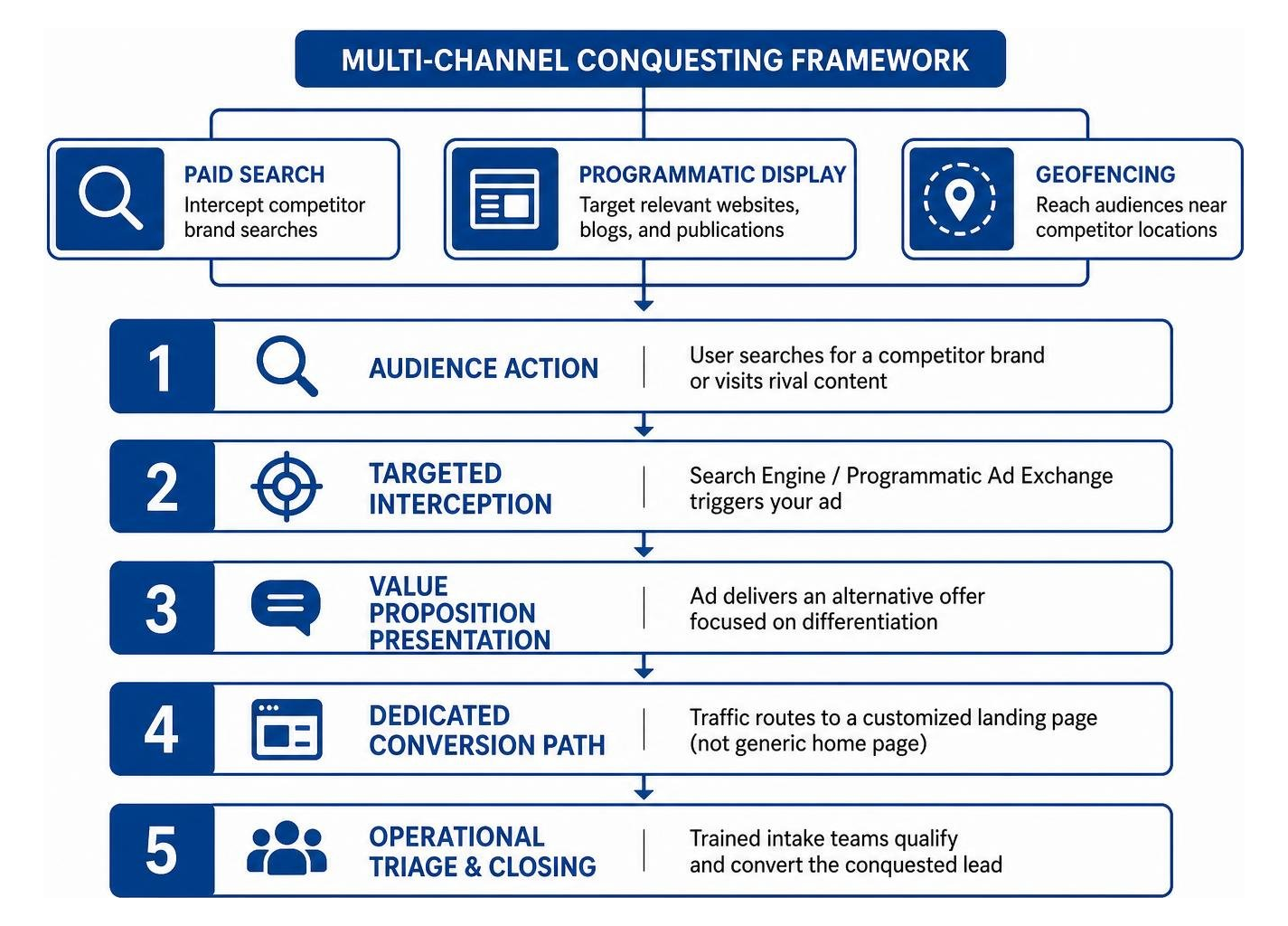
Conquesting is not a single tactic; it is an omni-channel acquisition framework. Modern digital campaigns leverage three primary formats:
- Paid Search Interception: Bidding on competitor brand names, product lines, and vanity terms. Search captures the highest intent because users are actively typing the competitor's name into Google or Bing.
- Programmatic Display & Contextual Targeting: Serving targeted rich-media banners across websites, industry blogs, comparison portals, and digital publications where competitors are reviewed or mentioned editorial-style.
- Location-Based Geofencing: Setting virtual geographical perimeters around a competitor’s physical locations (e.g., rival senior living communities, physical storefronts, or trade events) to capture mobile device IDs and serve display or social ads while prospects are on-site or shortly thereafter.
How It Differs From Standard Non-Brand Acquisition
Standard non-brand acquisition relies on generic keyword searches (e.g., "assisted living memory care near me" or "best accounting software"). These searchers are broad, exploratory, and located in the upper or middle stages of the buying funnel.
Competitor conquesting, by contrast, intercepts consumers in the late consideration and decision stages. These users have already completed their preliminary research, identified a potential solution, and are searching for a specific brand name to book an appointment, compare rates, or finalize a purchase.
Because brand loyalty is increasingly fluid, presenting a distinct value proposition at this critical juncture allows agile challengers to capture market share that would otherwise default to legacy industry players.
Weighing the Strategic Trade-offs of Brand Conquesting
Conquesting offers undeniable strategic advantages, but it is not without operational friction. Bidding on rival terms requires navigating lower initial conversion efficiencies and potential competitive pushback.
| Conquesting Format | Primary Marketing Goal | Buyer Intent Stage | Typical Channel | Key Performance Indicator |
|---|---|---|---|---|
| Paid Search Conquesting | Direct Lead Capture & Disruption | High (Bottom of Funnel) | Google Ads / Microsoft Ads | Cost per Booked Lead / ROAS |
| Programmatic Contextual | Brand Consideration & Awareness | Medium (Mid-Funnel) | Programmatic Display Ad Networks | Viewability & Incremental Reach |
| Physical Geofencing | Local Foot-Traffic Interception | Medium to High | Mobile Ad Networks & DSPs | Verified Location Visits / CTR |
| Category & Inline Placements | Direct Conversion & Switch Incentive | High (Point of Purchase) | Marketplaces & Browser Extensions | Conversion Rate & CPA |
Core Benefits of Competitor Conquesting Advertising for Emerging Brands
For emerging brands and growing operators, conquesting serves as an equalizer against legacy competitors with massive organic footprints and decades of accumulated brand equity.
- Capturing Pre-Educated, High-Intent Audiences: The competitor has already invested capital to educate the prospect on why they need the product or service. Conquesting allows you to step in at the final hour with a superior offer or better customer service.
- Immediate Market Visibility: Organic search rankings take months to establish. Conquesting campaigns can be deployed within hours, immediately positioning your brand alongside established industry giants.
- Driving Incremental Revenue: When managed efficiently, conquesting generates high-margin customer acquisitions that direct non-brand campaigns may miss entirely.
Our team has demonstrated how strategic targeting directly reshapes occupancy and customer acquisition metrics across competitive regional markets in our recent Case Study.
Key Risks and Operational Downsides of Competitor Conquesting Advertising
Despite its upside, running competitor campaigns without proper guardrails can lead to budget waste:
- Quality Score Depression: Google’s Quality Score algorithm evaluates expected click-through rate (CTR), ad relevance, and landing page experience. Because you cannot legally use a competitor's trademarked name in your ad headlines, and your landing page is focused on your brand, Quality Scores on competitor keywords are structurally lower (typically 1/10 to 4/10).
- Elevated Cost-Per-Click (CPC): Lower Quality Scores directly inflate the minimum bid required to achieve top-of-page visibility, making competitor clicks more expensive than standard non-brand search terms.
- Low Initial Click-Through Rates: A significant portion of searchers have strict navigational intent—they want the specific competitor's phone number or login portal—and will ignore alternative ads.
- Bidding Wars and Retaliation: Aggressive conquesting can provoke rival brands into bidding on your brand terms, escalating CPCs across the board.
Step-by-Step Execution and Operational Lead Handling
Executing a high-performing conquesting campaign requires tight coordination between ad configuration, landing page messaging, and intake operations.
- Campaign Isolation: Never mix competitor keywords into generic search ad groups. Create a dedicated campaign with isolated daily budgets and strict phrase or exact match keyword parameters. Avoid broad match bidding to prevent triggering impressions on irrelevant search queries.
- Dedicated Landing Page Optimization: Do not route conquest traffic to your homepage. Direct users to custom landing pages featuring transparent comparison charts, clear differentiators (e.g., staffing ratios, transparent pricing, flexible terms), and immediate calls-to-action.
- Synergistic Search Strategies: Pair conquesting with broad-spectrum Senior Living SEO so your brand dominates both organic organic SERP listings and targeted paid placements.
Aligning Sales Teams, CSRs, and Call Protocols
The single most common reason competitor conquesting campaigns fail is operational misalignment at the front desk or call center. Research shows that up to 83% of consumers prefer to call directly when contacting local service or care providers. In practice, conquesting is a phone conversion tactic disguised as a digital search tactic.
Incoming callers from conquest campaigns generally fall into distinct categories:
- The Non-Loyal Price/Feature Shopper: Highly convertible; open to hearing alternatives.
- The Urgent Need Prospect: Wants immediate availability; cares more about speed of service than the specific brand name.
- Existing Competitor Customers: Calling about billing, an existing warranty, or an open service ticket.
To maximize conversion and protect team morale:
- Deploy Call Whispers: Implement dynamic call-tracking whispers (e.g., "Conquest Campaign - Competitor A") so representatives know the caller's context before speaking.
- Use Neutral Greetings: Start with a warm, open greeting ("Thank you for calling our community team, how can we assist you today?") rather than barking your brand name, allowing representatives to identify the caller's intent before pitching.
- Implement Polite Deflection Protocols: Train staff to identify callers looking for existing account maintenance or warranty work and release them gracefully. Attempting to force an unconvertible customer into a sale damages brand reputation.
Ethical Standards, Platform Compliance, and Brand Defense
Navigating competitor advertising requires strict adherence to digital advertising policies and trademark laws:
- Ad Copy Restrictions: Major ad platforms allow you to bid on competitor brand terms as keywords, but strictly prohibit using trademarked competitor names within your actual ad copy or headlines (unless permitted under specific regional reseller policies).
- Misrepresentation & Deceptive Practices: Never craft ad text that implies you are affiliated with, endorsed by, or operating on behalf of the rival brand. Focus exclusively on your unique differentiators.
- Active Brand Defense: Assume your competitors will notice your campaigns. Safeguard your pipeline by running dedicated branded search campaigns on your own company name. Bidding on your own brand ensures you maintain high impression share, retain 10/10 Quality Scores, and lock down top SERP real estate at minimal cost.
Tracking ROI: Essential Metrics and Attribution Models
Traditional vanity metrics do not tell the true story of competitor conquesting performance. Because Quality Scores and CTRs are structurally suppressed, judging a campaign solely on cost-per-click or platform-reported conversion rates will lead to premature cancellations of profitable strategies.

When auditing conquesting performance, anchor your analysis to these key financial metrics:
- Cost Per Booked Qualified Lead (CPQL): The actual cost to generate an intake consultation, assessment, or on-site tour.
- Return on Ad Spend (ROAS): Revenue generated relative to total media spend over a 60-to-90-day window. Extended buying cycles require multi-touch attribution modeling rather than last-click attribution, ensuring initial touchpoints receive proper valuation.
- Net Move-In / Closed Deal Velocity: Tracking how quickly conquested prospects progress through the sales pipeline compared to cold organic or generic leads.
By combining multi-channel paid strategies with comprehensive Senior Living Marketing Services, operators achieve cross-channel synergy that sustains long-term customer acquisition.
Frequently Asked Questions about Competitor Conquesting
Is it legal to bid on competitor brand names in Google Ads?
Yes. Major search platforms, including Google and Microsoft Ads, explicitly permit bidding on competitor brand names and trademarks as search keywords. However, you cannot use their trademarked names, logos, or proprietary slogans in your visible ad copy or headlines. Ad copy must represent your own brand accurately without misleading consumers.
Why are Quality Scores and CTRs lower in conquesting campaigns?
Quality Scores are lower because Google's algorithm rewards tight relevance between the search query, the ad copy, and the destination URL. In a conquest campaign, the user searched for Brand A, but your ad and landing page are for Brand B. Because you cannot legally use Brand A's name in your copy, expected CTR and ad relevance metrics naturally decline, resulting in lower Quality Scores and higher CPCs.
How do you prevent aggressive competitor bidding retaliation?
Run proactive branded defense campaigns on your own company name and vanity keywords. Because your ad relevance and landing page experience for your own brand are near-perfect, your Quality Score will be high (typically 9/10 or 10/10) and your CPCs will be low. If a competitor attempts to conquest your brand, they will pay a significant financial premium to bid against you while your defensive ads retain top-of-page impression share.
Conclusion
Competitor conquesting is a precision acquisition strategy designed for ambitious brands ready to challenge established industry giants. When executed with clear value propositions, dedicated landing pages, and aligned operational intake protocols, conquesting intercepts pre-qualified prospects at the most critical stage of the decision-making process.
At SJ2 Digital, we operate on an anti-agency model with no long-term contracts, transparent live performance dashboards, and hands-on senior digital specialists who tailor campaigns to your exact growth objectives.
Explore how our specialized Programmatic Advertising Senior Living and paid acquisition frameworks can help your business capture market share and drive qualified leads today.