
The Modern Playbook for CRM Marketing Automation and Lead Syncing
Align CRM Marketing Automation and Lead Syncing

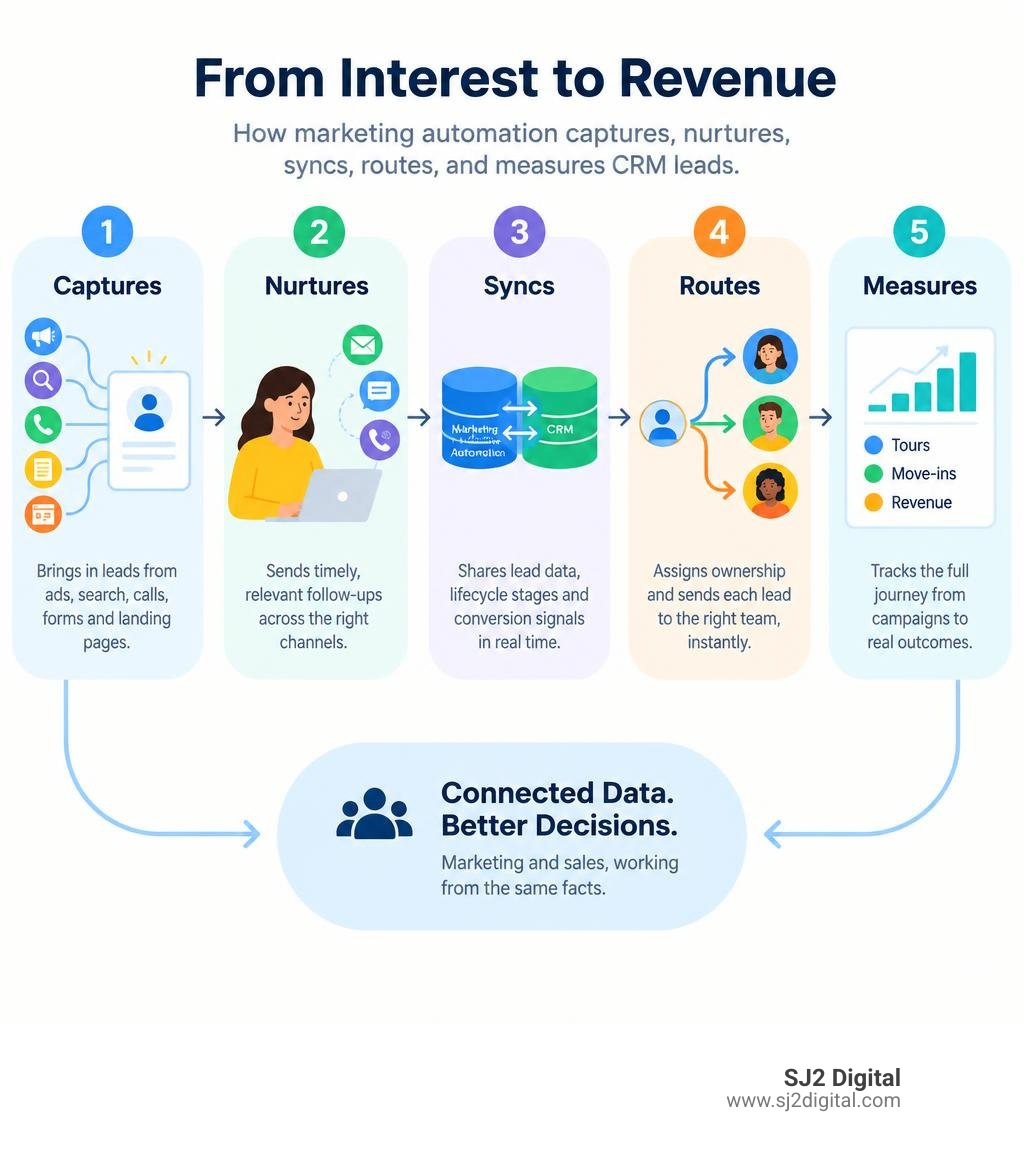
CRM marketing automation works when your marketing tools and CRM share the same lead data, lifecycle stages, and conversion signals. Marketing automation captures interest and sends timely follow-up. The CRM records each interaction, assigns ownership, tracks the sales process, and connects campaigns to real outcomes.
For a senior-living operator, the practical goal is simple: every inquiry from paid ads, organic search, calls, forms, and landing pages should reach the right team quickly - with source data, care needs, community preference, and engagement history intact.
Start by aligning these three things:
- Shared lead definitions: Agree on what makes an inquiry, marketing-qualified lead, and sales-qualified lead.
- Reliable lead syncing: Map fields, remove duplicates, and set rules for real-time routing and updates.
- Closed-loop reporting: Connect campaign spend and lead activity to tours, move-ins, and revenue where possible.
This matters more as acquisition gets more expensive. B2C customer acquisition costs have risen 60% over the past three years, while 45% of companies say automation is the main capability they want from a CRM. A disconnected stack can hide which campaigns create qualified leads. A connected one helps marketing and sales act on the same facts.
The rest of this guide explains how to build that connection, choose the right tools, avoid common sync failures, and measure the impact without relying on vague vanity metrics.
CRM vs. Marketing Automation: Defining Core Roles and Synergies
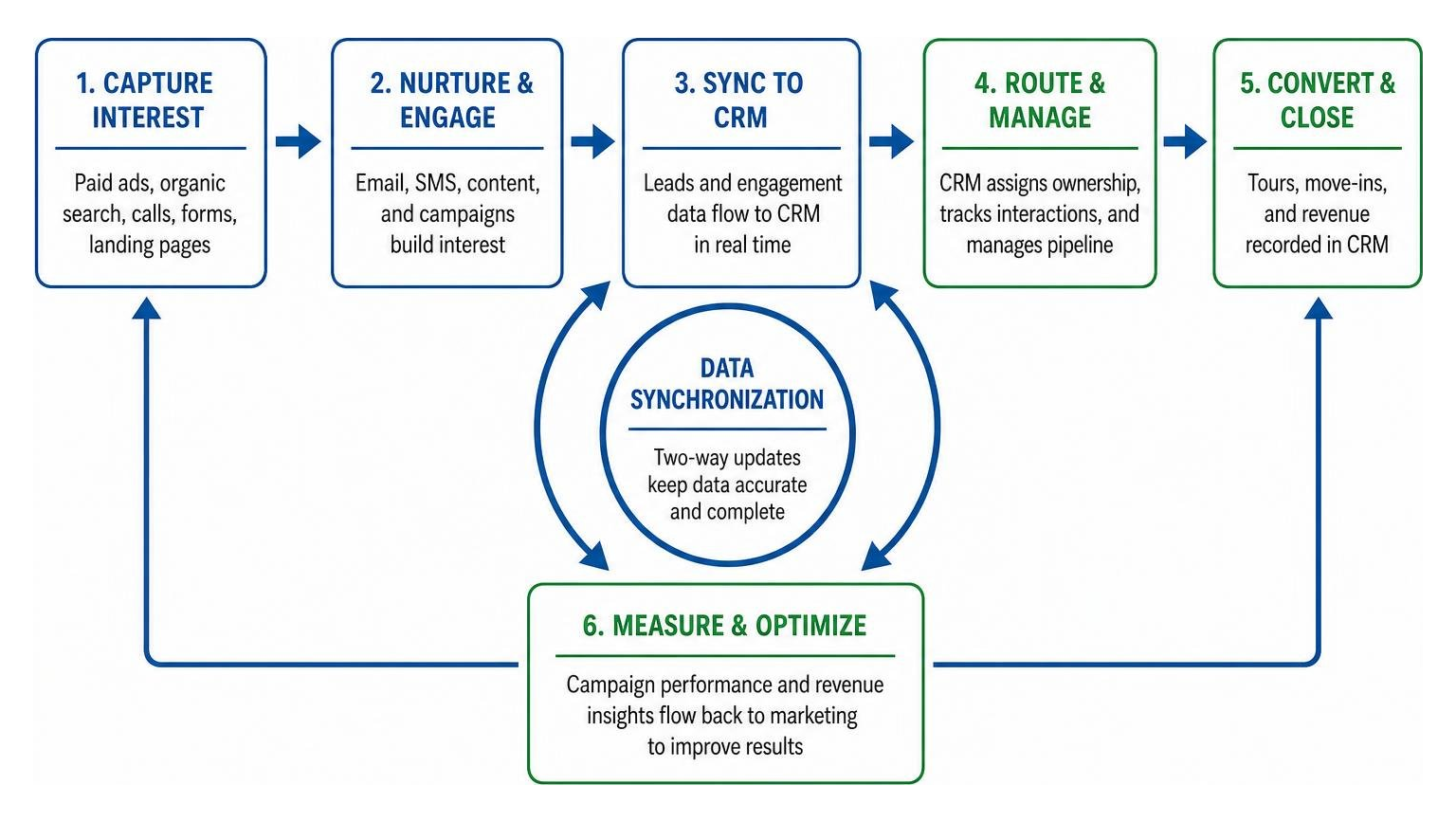
At their core, CRM (Customer Relationship Management) and marketing automation solve two halves of the exact same revenue puzzle. Marketing automation focuses on the top and middle of the funnel: capturing interest, tracking digital footprints, scoring intent, and orchestrating targeted communications across email, SMS, and advertising. The CRM serves as the single source of truth for direct sales interactions, pipeline stages, account ownership, and post-sale retention.
When these systems live in disconnected silos, leads slip through the cracks, customer experiences fragment, and attribution becomes pure guesswork. Bringing them together establishes a continuous operational loop where lead capture, pipeline tracking, and customer lifecycle insights feed into one another seamlessly.
The Harbor and the Lighthouse: Complementary Systems
To understand how these platforms complement one another, consider a maritime metaphor: marketing automation acts as the lighthouse, while the CRM is the safe harbor.
The lighthouse projects outward across digital channels. It tracks behavioral triggers—such as whitepaper downloads, pricing page visits, or email clicks—and beams the right contextual messages to guide prospects toward your brand.
Once a prospect signals sales readiness, the CRM harbor takes over. It docks the lead safely into an organized environment, logging contact histories, managing discovery calls, tracking contract negotiations, and alerting account executives to take immediate action. Without the lighthouse, prospects never find the harbor; without the harbor, ships drift aimlessly and sink before converting.
All-in-One vs. Best-in-Breed Solutions
When structuring your technology architecture in 2026, you face a strategic crossroads: deploy a unified all-in-one CRM suite or integrate specialized best-in-breed tools. Both approaches present unique operational trade-offs across flexibility, cost, and management overhead.
| Architectural Dimension | All-in-One CRM Suites | Best-in-Breed Integrated Stacks |
|---|---|---|
| Tech Stack Complexity | Low; single UI, unified underlying database, zero external connectors required. | Moderate to High; requires API connections, webhooks, or middleware (e.g., Zapier/Make). |
| Implementation Cost | Predictable upfront licensing; lower initial engineering expense. | Higher initial setup costs; licensing spread across multiple specialized vendors. |
| Workflow Flexibility | Standardized templates and native logic; bounded by platform guardrails. | Deeply specialized capabilities; unconstrained workflow design for complex funnels. |
| Platform Scalability | Scales cleanly for standard growth; can become rigid under highly custom enterprise data models. | Highly modular; swap out individual components as channel requirements evolve. |
| Data Synchronization | Instantaneous native data sharing; zero schema mismatch or sync lag. | Dependent on webhook stability, API rate limits, and continuous data hygiene management. |
Core Architecture of Modern CRM Marketing Automation

Modern marketing automation relies on an interconnected data foundation. A visual workflow builder allows marketing teams to map complex customer journeys using drag-and-drop nodes, combining multi-channel triggers, conditional branches, and delay timers.
Behind the interface, audience segmentation engines query unified contact records in real time. Rather than relying solely on static demographic data, modern engines incorporate real-time behavioral signals, such as video engagement, browsing velocity, and form submissions.
Furthermore, with strict privacy frameworks like GDPR and CCPA governing digital marketing, platform architectures must enforce consent management, unsubscribe handling, and role-based access control directly within customer records.
Essential Features for CRM Marketing Automation Platforms
When evaluating platforms for your marketing stack, ensure the software offers these core technical capabilities:
- Bidirectional Real-Time Synchronization: Updates made by sales reps in the CRM must immediately reflect in marketing segments, and marketing engagements must instantly appear on the CRM contact timeline.
- Dynamic Content Personalization: The ability to inject custom variables, predictive recommendations, and localized account data into emails, landing pages, and SMS campaigns.
- Unified Customer Profiles: Centralized event streams aggregating web tracking, direct interactions, transaction history, and support tickets into a single timeline.
- Extensible Webhooks & APIs: Robust webhooks that trigger downstream automations in external software the moment a customer record changes state.
- Built-In Compliance Controls: Native tools for managing cross-channel opt-ins, data privacy requests, and global communication limits to prevent brand fatigue.
AI, Agentic Workflows, and Predictive Intelligence
Marketing automation has evolved beyond basic static rules (e.g., "if clicked link, wait 2 days, send email"). The modern standard is agentic workflows and predictive intelligence.
Modern AI agents autonomously monitor customer signals, score purchase intent, and adjust campaign timing based on individual engagement patterns. Predictive algorithms analyze historical transaction data to forecast customer churn risk, determine optimal reorder windows, and recommend the exact channel—whether email, SMS, or paid retargeting—most likely to convert a specific prospect.
These autonomous workflows run in the background, freeing marketing teams from manual list building and allowing them to focus on high-level strategy and creative development.
Strategic Alignment: B2B, B2C, and Specialized Workflows
A common operational error is applying B2B automation playbooks to high-velocity B2C environments, or vice versa. Aligning your automation strategy with your business model is critical to maximizing conversion rates and customer lifetime value.
B2B vs. B2C CRM Marketing Automation Strategies
B2B sales cycles typically feature extended evaluation periods, higher contract values, and multiple decision-makers. Consequently, B2B automation emphasizes account-based marketing (ABM), lead scoring thresholds, educational content journeys, and sales enablement alerts.
In contrast, B2C automation focuses on speed, volume, and real-time triggers. B2C brands require platforms that process millions of events instantaneously to trigger abandoned cart reminders, flash-sale announcements, and loyalty rewards before buyer intent cools.
Specialized high-consideration consumer verticals, like senior housing, require a unique hybrid strategy. A family researching care options requires the empathy, personalization, and multi-touch educational nurturing of a B2B journey, paired with the rapid response times and multi-channel accessibility of modern B2C platforms. This is where dedicated senior living marketing services help bridge the gap between initial digital discovery and physical community tours.
High-Impact Automated Workflows Across Channels

Regardless of your industry, deploying these five automated workflows consistently drives measurable revenue:
- The Dynamic Welcome Series: Introduce new subscribers to your brand story, set communication expectations, and capture interest preferences through interactive progressive profiling forms.
- Behavioral Abandonment Recovery: Trigger automated SMS or email reminders when high-intent prospects abandon a checkout page, event registration, or consultation scheduler without completing the action.
- Post-Purchase & Onboarding Journeys: Deliver immediate value after a purchase or agreement by sending setup guides, FAQs, and support resources to reinforce buyer confidence and reduce churn.
- Smart Replenishment & Re-Engagement Reminders: Use predictive algorithms to estimate when a customer will exhaust a consumable product or reach a service renewal point, automatically sending a reorder prompt.
- RFM-Triggered Win-Back Campaigns: Segment inactive contacts using Recency, Frequency, and Monetary (RFM) modeling. Deliver targeted incentives to recapture dormant customers before they churn permanently.
Lead Syncing Infrastructure and Implementation Pitfalls
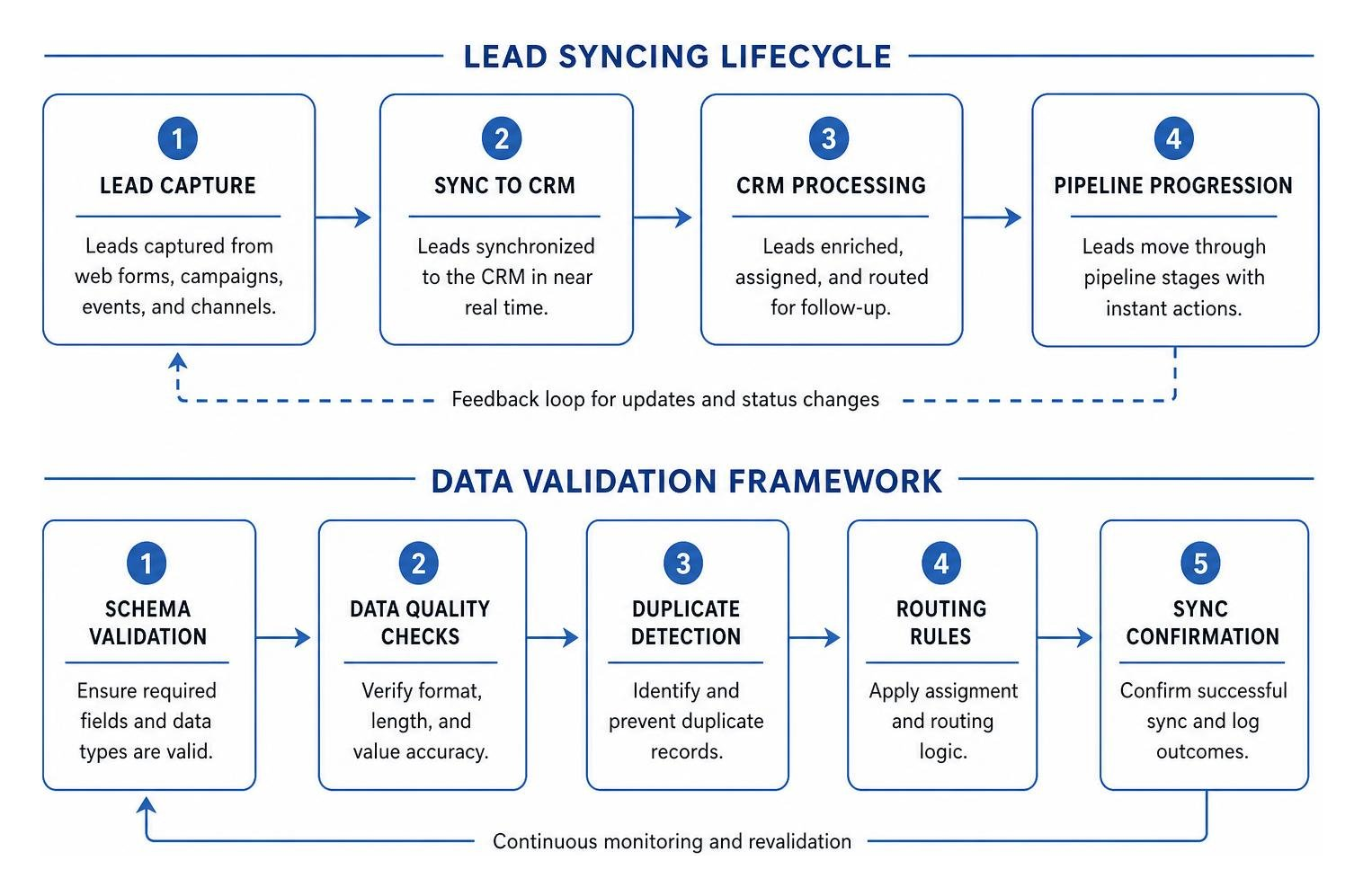
A marketing automation engine is only as effective as the underlying data plumbing connecting it to your CRM. When synchronization breaks down, sales reps end up chasing stale leads, marketing teams send irrelevant messages, and executives lose visibility into operational ROI.
Eliminating Integration Roadblocks and Data Silos
Integrating systems requires navigating several recurring technical challenges:
- API Rate Limits and Sync Throttling: High-volume event tracking can quickly overwhelm standard API thresholds. Ensure your middleware or native connectors utilize batch processing to prevent dropped records.
- Duplicate Records and Merging Conflicts: Establish a strict system of record for specific data points. For example, let the marketing platform govern engagement data, while the CRM remains the authority for contact ownership, account status, and lifecycle stage.
- Schema Mismatches and Field Mapping Errors: Validate that picklist values, date formats, and custom fields match perfectly across systems to avoid silent sync errors.
- Data Decay and Hygiene: Implement automated validation routines to scrub invalid email formats, standardize phone numbers, and archive inactive contacts on a regular schedule.
Unifying Multi-Channel Traffic and Paid Acquisition
To establish reliable multi-touch attribution, your CRM marketing automation setup must capture UTM parameters and tracking tokens from every acquisition source.
When running targeted senior living pay per click campaigns across search engines, your landing page forms should capture click IDs, campaign names, and keywords into hidden fields that pass directly into the CRM. Pairing this paid strategy with robust senior living SEO ensures that both organic and paid discovery channels feed clean attribution data into the same unified customer profiles.
Furthermore, integrating programmatic advertising for senior living allows you to sync CRM audience segments back into ad networks, automatically suppressing converted customers from top-of-funnel retargeting and reducing wasted ad spend.
Performance Metrics, Attribution, and Strategy Optimization
Tracking open rates and vanity clicks is no longer enough. To prove the business value of your CRM marketing automation strategy, you must measure performance through closed-loop pipeline metrics and financial return.
Essential KPIs and Reporting Dashboards
Structure your reporting dashboards around these core operational and financial metrics:
- Lead-to-Opportunity Velocity: The average time it takes for a newly captured inquiry to move through automated nurturing and convert into a sales-qualified opportunity.
- Customer Acquisition Cost (CAC) Reduction: Measuring how automated follow-ups and lead-scoring workflows reduce the manual sales hours required to close a deal.
- Revenue Attribution by Flow: Tying closed-won revenue directly back to the specific automated nurture sequences, abandonment workflows, or win-back campaigns that engaged the buyer.
- Click-to-Open Rate (CTOR): Evaluating content relevance and offer resonance among contacts who actively engage with your communications.
- List Health and Churn Rate: Monitoring unsubscribe rates, spam complaints, and bounce metrics to ensure long-term domain deliverability and sender reputation.
Continuous Testing and Closed-Loop Optimization
Marketing automation is not a set-it-and-forget-it project. Mature teams implement continuous testing frameworks to refine customer journeys over time:
- Split Testing Delivery Timing: Test predictive sending algorithms against fixed-time delivery windows to determine when your target audience is most receptive.
- Multivariate Content Experiments: Test emotional storytelling against direct, benefit-led copy across email subject lines and SMS calls to action.
- Conditional Journey Branching: Experiment with different workflow paths based on demographic or firmographic tiers, sending enterprise accounts down high-touch tracks while self-serve users receive automated product tours.
- Cohort Analysis: Track long-term retention and expansion revenue across customer cohorts to identify which onboarding automations correlate with higher lifetime value.
Frequently Asked Questions about CRM Marketing Automation
What is the difference between CRM and marketing automation?
Marketing automation software manages top-of-funnel engagement, automatically delivering multi-channel communications based on prospect behavior. A CRM system organizes sales pipelines, tracks direct interactions, manages account ownership, and maintains the central customer record.
Together, they bridge the gap between initial prospect attraction and long-term customer relationship management.
How do AI agents enhance modern marketing workflows in 2026?
AI agents go beyond basic rule-based automations by dynamically adapting workflows to individual user behavior. Modern agents can:
- Generate personalized copy variations tailored to specific buyer personas.
- Autonomously adjust send times and communication channels based on historical engagement patterns.
- Surface predictive lead scores and churn warnings by analyzing event data across multiple platforms.
- Route high-intent prospects to sales reps with contextual conversation summaries.
What are the most common mistakes during CRM integration?
The most common integration missteps include:
- Launching integrations without cleaning existing customer records, resulting in thousands of duplicate contacts.
- Failing to align sales and marketing leadership on lead stage definitions and qualification scoring.
- Neglecting to map custom fields properly, causing silent sync failures and missing attribution parameters.
- Over-automating communications without providing clear paths for prospects to speak with a live representative.
Building a Unified Revenue Engine
Aligning your marketing automation platform with your CRM transforms disconnected digital campaigns into a predictable revenue engine. By establishing clean data pipelines, deploying behavior-triggered workflows, and focusing on closed-loop attribution, your team can engage prospects with timely, relevant messaging while giving your sales force the context they need to close deals faster.
At SJ2 Digital, we reject one-size-fits-all playbooks and rigid agency constraints. Operating under our transparent "anti-agency" model, we provide businesses and senior-living operators with hands-on, senior-level expertise, no long-term contracts, and real-time reporting dashboards.
Whether you need to overhaul your lead syncing architecture, scale paid acquisition, or build high-converting email automations, our team helps you design, deploy, and optimize a CRM marketing automation engine built for sustainable growth. Ready to align your revenue stack? Contact our team today or learn more about us to get started.