
Customer Acquisition Agency Breakdown: When to Outsource Your Growth
When a Customer Acquisition Agency Is Worth Outsourcing

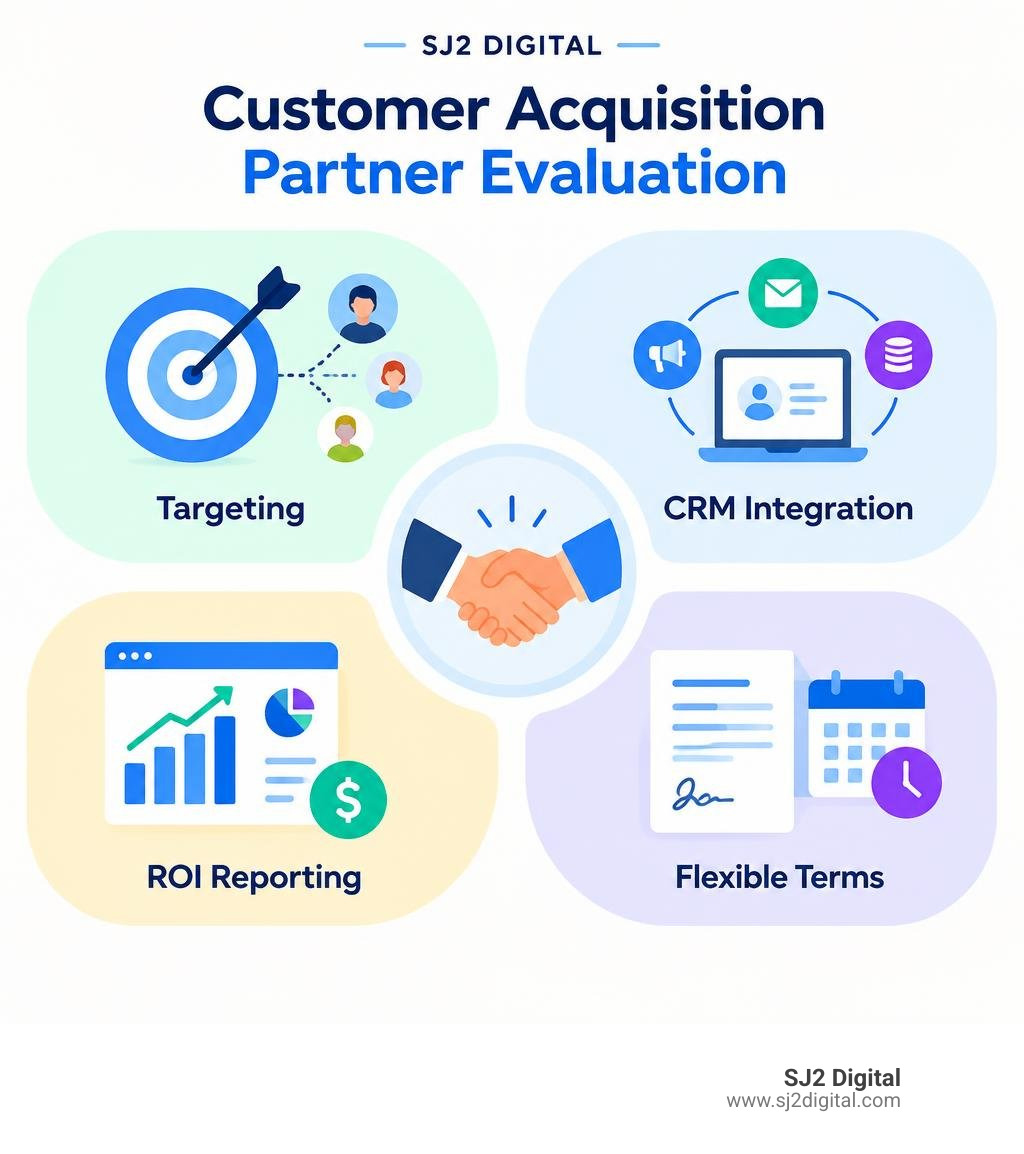
A customer acquisition agency is worth hiring when your team needs more qualified opportunities, clearer ROI, or faster campaign execution than it can produce in-house. Choose a partner that can:
- Target the right audience, not just generate high lead volume.
- Connect ads, landing pages, follow-up, and CRM reporting.
- Report on qualified leads, conversion rates, CAC, and revenue pipeline.
- Offer flexible terms and clear visibility into spend, data, and results.
For senior-living operators, the goal is not cheap clicks or a full inbox. It is a steady flow of prospects who fit your community, location, care offering, and occupancy goals.
Unlike a general marketing firm, an acquisition partner is accountable for moving people from first awareness to a verified sales opportunity. The best teams combine paid media, first-party data, lead qualification, and human follow-up so your sales staff can spend less time chasing poor-fit inquiries.
This guide compares the services, pricing models, metrics, and warning signs that matter when selecting an outsourced growth partner in 2026.
The Strategic Role of Acquisition Services in Business Scaling
Building a viable business without a predictable customer acquisition engine is a lot like building a house with thick walls and a sturdy roof, but forgetting to install doors and windows. You might have world-class operations and an exceptional product, but if prospective buyers cannot easily find their way inside, revenue stalls.
In today's landscape, customer acquisition is no longer a collection of disconnected marketing experiments. It is an integrated operational discipline designed to maintain pipeline velocity, shorten sales cycles, and maximize market penetration. Many internal sales teams find themselves spending up to 60% of their time chasing cold, unverified prospects who will never convert. This inefficiency inflates acquisition costs and burns out sales talent.
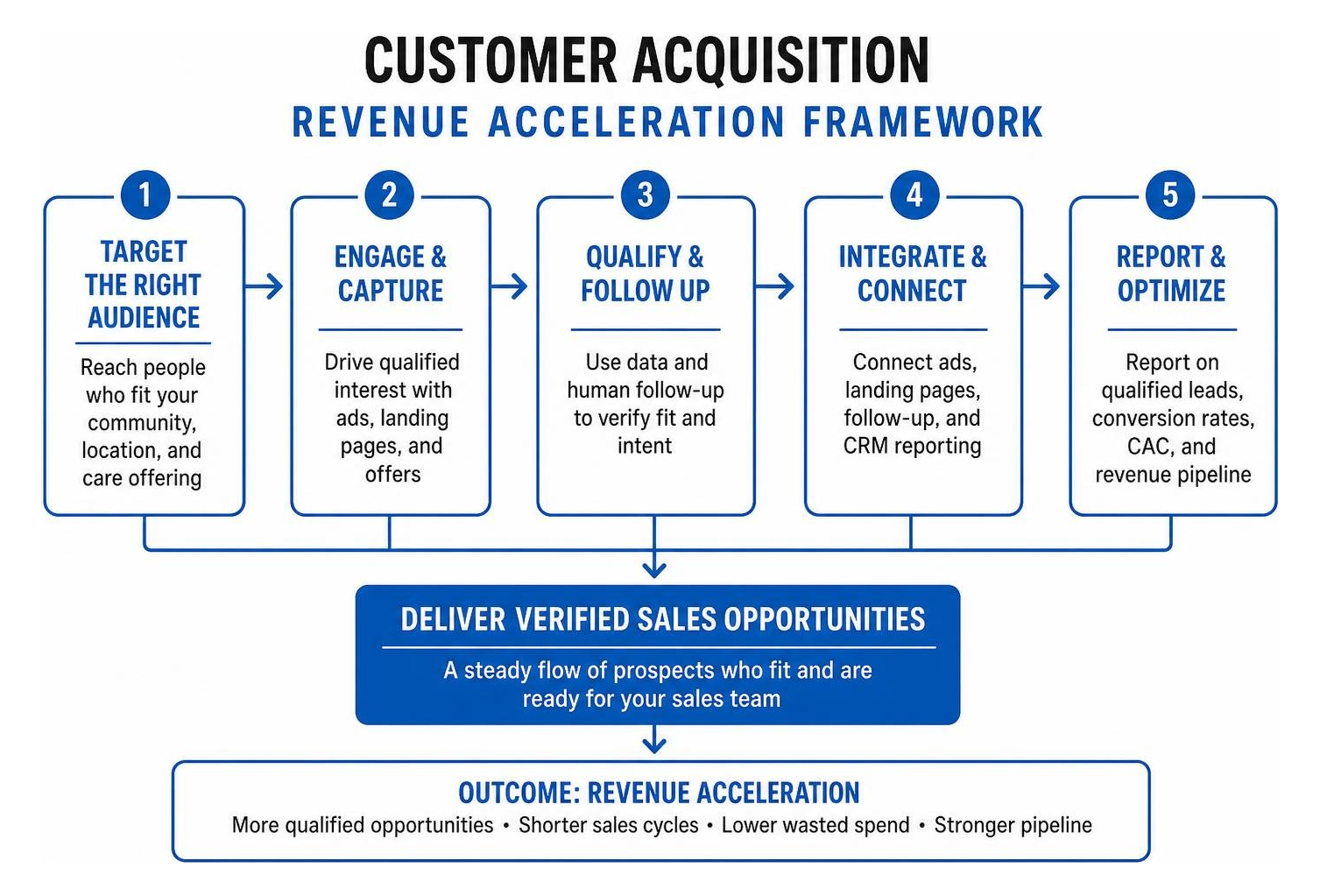
To scale sustainably, businesses need an orchestrated engine that continuously captures demand, filters out noise, and delivers verified pipeline straight to sales reps.
What Does a Modern Customer Acquisition Agency Do?
A modern acquisition agency operates as a specialized growth unit rather than a simple creative vendor. Instead of delivering vanity metrics like impressions or raw clicks, an acquisition partner focuses on revenue operations and commercial outcomes.
The core responsibilities of an acquisition team include:
- Full-Funnel Demand Generation: Crafting campaigns across search engines, programmatic channels, and targeted social marketing to capture high-intent buyers.
- Precision Targeting & Lead Qualification: Building enriched prospect lists based on verified buying signals, firmographics, or local demographic parameters.
- Conversion Rate Optimization (CRO): Designing custom landing pages, interactive forms, and direct response assets that turn passive traffic into active inquiries.
- Appointment Setting & Lead Routing: Screening incoming leads before they reach sales calendars to ensure they meet exact Ideal Customer Profile (ICP) criteria.
- CRM & Pipeline Integration: Connecting lead tracking directly into platforms like HubSpot, Salesforce, or industry-specific CRMs for full bi-directional visibility.
Specialized B2B and vertical agencies focus directly on pipeline metrics and return on investment, aligning ad spend directly with enterprise revenue goals.
Internal Marketing Team vs. Outsourced Customer Acquisition Agency
When leadership teams decide to accelerate growth, they often face a classic dilemma: recruit an internal team or partner with an external acquisition agency.
Building an in-house department requires hiring multiple specialized roles (media buyers, copywriters, data engineers, conversion specialists) and purchasing expensive software subscriptions. An outsourced partner provides an established tech stack, seasoned operators, and cross-channel infrastructure from day one.
| Strategic Capability | In-House Marketing Team | Outsourced Acquisition Agency |
|---|---|---|
| Time to Campaign Launch | 3 to 6 months (recruiting, onboarding, tool setup) | 2 to 4 weeks (plug-and-play infrastructure) |
| Technology & Tool Stack Cost | High ($3,000–$10,000+/month in software licenses) | Included within the agency partnership |
| Skill Diversity | Limited to 1–2 generalist hires within budget | Multidisciplinary team (PPC, SEO, Data, CRO, Outreach) |
| Campaign Scalability | Constrained by internal employee bandwidth | Dynamic allocation of resources based on demand |
| Accountability Focus | Broad operational tasks, brand upkeep, internal meetings | Direct commercial outcomes (CPA, CAC, Pipeline, ROI) |
| Contract & Overhead Risk | High (salaries, benefits, severance, hardware) | Low to Medium (flexible agreements, performance benchmarks) |
High-Impact Acquisition Strategies and Technology Frameworks
Acquiring customers efficiently in 2026 requires moving beyond single-channel playbooks. Relying exclusively on one ad platform creates fragility. Modern acquisition strategies use connected, cross-channel frameworks driven by first-party data.

By integrating programmatic channels with automated email workflows, brands can guide prospects through custom journeys. In fact, companies implementing multi-channel nurturing workflows routinely experience up to a 40% higher lead-to-customer conversion rate compared to single-channel funnels.
Combining Intent Data and Predictive AI
Artificial intelligence has shifted acquisition from speculative broad-targeting to precision targeting based on real-time buying signals. Modern agencies analyze first-party behavioral data, content consumption, and organizational changes to engage accounts actively looking for solutions.
Key advantages of deploying predictive data include:
- 25% Lower Customer Acquisition Cost: By identifying prospects showing high buying intent, marketing budgets focus exclusively on active buyers rather than cold audiences.
- Dynamic ICP Refinement: Machine learning algorithms continuously score incoming leads, prioritizing accounts with high conversion probabilities.
- Cross-Channel Personalization: Personalized user flows triggered by real-time actions help increase conversion rates significantly across platforms.
The Human-in-the-Loop Outreach Model
While automated systems and AI algorithms handle data processing, human expertise remains essential for high-value conversions. Pure automation often feels generic, while pure manual outreach fails to scale.
The most effective acquisition programs use a Human + AI framework:
- AI Signal Detection: Algorithms scan millions of data points to identify qualified prospects, trigger alerts, and draft hyper-relevant messaging angles.
- Senior Operator Review: Experienced strategists refine positioning, optimize deliverability, and adjust campaign messaging based on nuanced market feedback.
- Human Qualification & Relationship Building: Inbound replies and inquiries are personally reviewed, vetted, and engaged by real specialists before being passed to your sales team.
Combining automated data touchpoints with immediate, personalized human follow-up can double your overall pipeline velocity. Signal-based models demonstrate how real-time buying signals consistently outperform generic cold outreach.
Core Metrics, Cost Structures, and ROI Benchmarks
To manage an outsourced acquisition team effectively, leadership must focus on commercial metrics rather than superficial campaign activity.
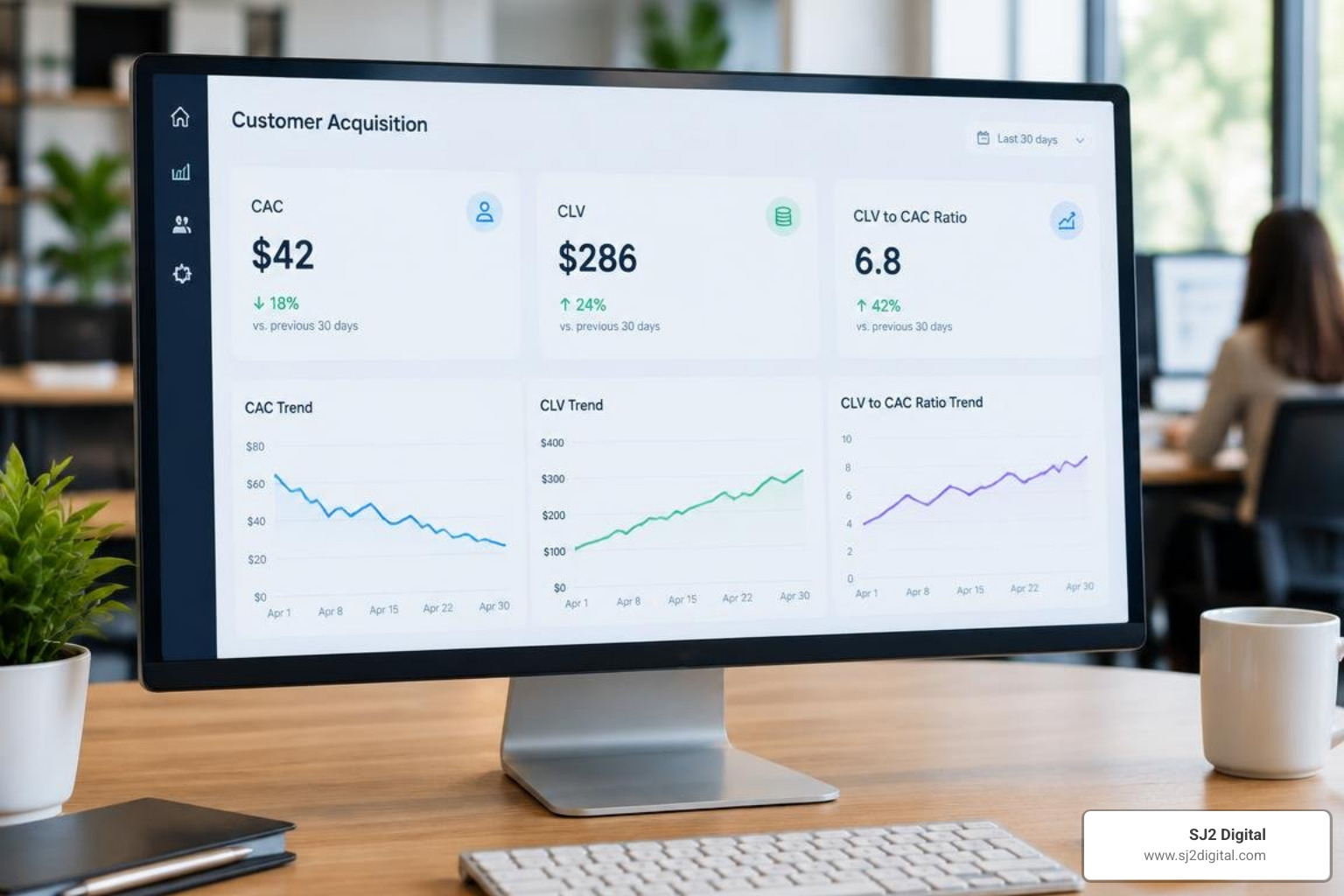
Key Metrics to Monitor
- Customer Acquisition Cost (CAC): Total sales and marketing spend divided by the number of new customers acquired during a given period.
- Customer Lifetime Value (CLV): The total projected revenue a single customer generates throughout their entire relationship with your organization.
- CLV-to-CAC Ratio: The ultimate measure of acquisition health. A sustainable benchmark is 3:1 or higher, indicating that customer value is triple the cost to acquire them.
- Cost Per Action (CPA) & Cost Per Install (CPI): Across mobile and digital platforms, benchmarks vary widely. For instance, the average CPI for iOS sits around $3.60 compared to $1.22 on Android, while acquiring users who complete specific transactions or in-app actions can range up to $87 depending on industry competition.
Pricing Models: Retainers, Performance, and Pay-Per-Lead
Acquisition agencies generally operate under three primary commercial structures:
- Monthly Retainers: A fixed monthly management fee covering campaign design, execution, optimization, and reporting. Ideal for omnichannel strategies requiring ongoing creative and strategic iteration.
- Pay-Per-Lead / Pay-Per-Opportunity: Clients pay exclusively for leads or scheduled meetings that meet strict ICP criteria. This lowers risk but requires clear upfront definitions of a "qualified lead."
- Hybrid / Performance Agreements: A baseline management fee combined with performance incentives tied to revenue milestones or qualified pipeline volume.
To evaluate how these pricing structures translate into measurable results, review our transparent performance case studies highlighting real-world client efficiency gains.
High-Growth Industries Benefiting from Outsourcing
While any company needing reliable lead volume can benefit from an acquisition agency, certain high-value industries gain exceptional ROI from specialized partners:
- Senior Living & Care Communities: Navigating long, emotional decision cycles requires high-trust local campaigns, reputation management, and automated follow-ups to maintain occupancy.
- B2B SaaS & Cloud Software: Complex sales processes benefit from account-based marketing (ABM), intent data monitoring, and demo pipeline acceleration.
- Healthcare & Specialized Medical Practices: Local patient acquisition requires strict data privacy, local credibility, and friction-free booking flows.
- Financial Services & Wealth Management: High-trust sectors where educational content and compliance-ready funnels are necessary to convert discerning clients.
How to Choose the Right Customer Acquisition Agency for Scalable Growth
Selecting an acquisition partner is an important strategic decision. The wrong agency burns capital on unvetted traffic, while the right partner serves as a scalable extension of your revenue team.
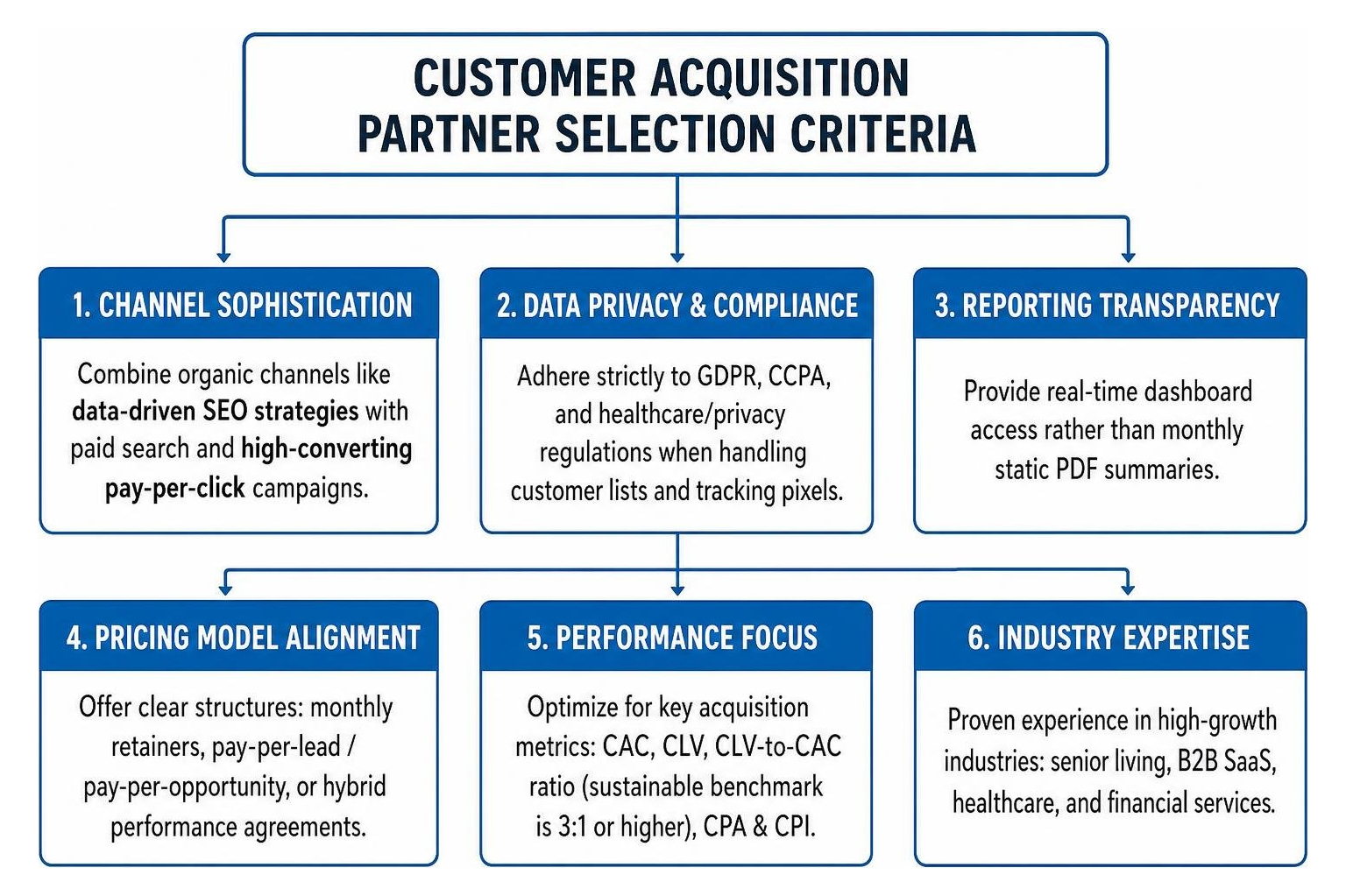
Evaluate potential agencies using these critical criteria:
- Channel Sophistication: Do they combine organic channels like data-driven SEO strategies with paid search and high-converting pay-per-click campaigns?
- Data Privacy & Compliance: Ensure the agency adheres strictly to GDPR, CCPA, and healthcare/privacy regulations when handling customer lists and tracking pixels.
- Reporting Transparency: Look for agencies that provide real-time dashboard access rather than monthly static PDF summaries.
Key Red Flags and Operational Pitfalls to Avoid
- Long-Term Contract Lock-Ins: Be cautious of agencies demanding 12-month rigid commitments before demonstrating baseline performance.
- The "Bait-and-Switch" Team Structure: Pitch meetings led by veteran executives who hand day-to-day campaign management off to junior account coordinators.
- Vanity Metric Reporting: Celebrating ad impressions, pageviews, and raw clicks while avoiding conversations about CAC, pipeline value, and closed revenue.
Integration with Existing Sales Pipelines and CRMs
An acquisition partner should never work in a silo. True growth requires seamless alignment between the agency's lead generation workflows and your internal CRM:
Bi-directional CRM integration ensures that sales feedback directly informs ad optimization. When an agency knows which leads actually close, they can adjust bidding algorithms to target higher-value opportunities.
Frequently Asked Questions About Hiring an Acquisition Agency
How does a customer acquisition agency differ from a general marketing agency?
A general marketing agency typically focuses on top-of-funnel brand awareness, creative design, social media posting, and public relations.
In contrast, a customer acquisition agency is held accountable to direct revenue metrics. Their core objective is driving qualified leads, lowering CAC, accelerating sales cycles, and creating measurable commercial pipeline through performance media, conversion optimization, and targeted outreach.
What is a healthy CLV to CAC ratio to target?
A healthy business model generally targets a 3:1 CLV-to-CAC ratio.
- A 1:1 ratio means you are losing money once operational delivery costs are factored in.
- A 3:1 ratio indicates efficient, sustainable growth.
- A 5:1 ratio or higher often suggests you are underinvesting in marketing and could aggressively capture more market share without sacrificing financial stability.
How quickly can an outsourced acquisition team deliver qualified opportunities?
Most professional acquisition programs require 30 to 60 days to establish proper technical infrastructure, warm domains, build landing pages, and optimize targeting models. Initial lead flow often begins within weeks 2 to 4, with mature pipeline velocity and consistent ROI achieved by months 2 and 3 as campaign data accumulates.
Conclusion: Selecting the Ideal Growth Partner
Outsourcing your customer acquisition should simplify your sales process, not make it more complicated. The goal is to build an efficient, scalable growth engine that frees your internal team to focus on closing deals and serving customers.
At SJ2 Digital, we believe in an "anti-agency" model:
- No Long-Term Contracts: We earn your partnership every single month through clear performance.
- Live, Transparent Dashboards: You see the exact metrics, spend, and lead quality we see—in real time.
- Senior-Level Operators: Your campaigns are managed directly by experienced growth professionals, not handed off to entry-level staff.
Whether you are scaling a regional healthcare brand or seeking comprehensive senior living marketing services, we build transparent acquisition pipelines tailored to your occupancy and revenue goals.
Ready to scale your pipeline with predictable acquisition systems? Contact our team today to review your growth strategy.