
Why Location Based Digital Advertising Drives More Footfall

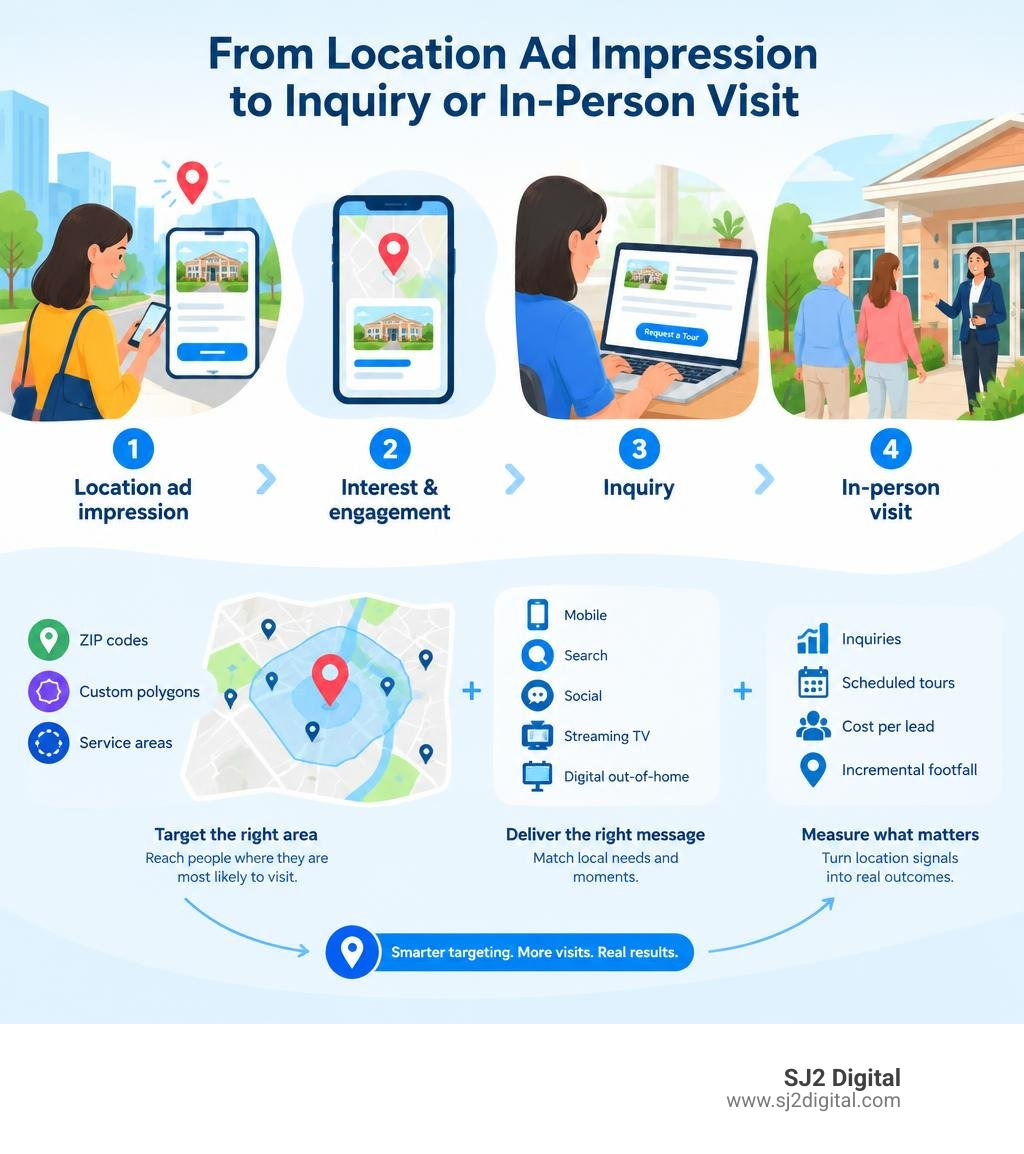
Location based digital advertising helps businesses reach people in the markets, neighborhoods, and moments most likely to lead to a visit. Start by defining the real trade area around each location, use privacy-compliant geographic targeting, tailor the message to local needs, and measure whether exposed audiences visit more often than a comparable control group.
For senior living operators, this can mean focusing budget around communities where qualified prospects and adult children live, then showing relevant messages across mobile, search, social, streaming TV, and digital out-of-home media.
The strongest campaigns do not rely on a tiny radius alone. They combine location with useful context:
- Target the right area using ZIP codes, custom polygons, or service-area boundaries.
- Match the message to local intent such as care options, availability, tours, or nearby family.
- Track real outcomes including inquiries, scheduled tours, cost per qualified lead, and incremental footfall.
Location data is now used by more than eight in ten marketers, but precision without a clear plan can waste budget. The goal is not to collect more location signals. It is to turn permissioned, aggregated signals into smarter local decisions and transparent ROI.
Understanding Location Based Digital Advertising: Core Concepts and Evolution
At its core, location based digital advertising bridges the gap between where consumers spend their time in the real world and what they see on their screens. Rather than casting a wide net across broad demographics, location-powered campaigns leverage geographic signals—such as GPS coordinates, Wi-Fi networks, cellular towers, and IP addresses—to deliver hyper-relevant marketing messages.
Where a person spends time is often the clearest indicator of their actual commercial intent. A user searching for "best assisted living" might be doing early research, but someone repeatedly visiting medical offices or specialized care clinics within a five-mile radius of a premier community is demonstrating real-world need.
Location advertising has evolved dramatically through four distinct waves:
- Early Mobile Reach: Broad banner ads served via mobile carrier IP addresses.
- Precision Tactics: The rise of point-radius geofencing, hardware beacons, and retargeting based on individual raw pings.
- Programmatic Scale & Omnichannel: Integrating location data into DSPs, connected television, and search engines.
- Privacy-First Location Intelligence (The Current Era): Focusing on consented, privacy-compliant, aggregated location intelligence that protects consumer identities while measuring incremental real-world lift.
Today, nearly 90% of digital marketers utilize location-based data to power their campaigns. To choose the right approach, marketers must understand how major platforms categorize geographic boundaries—such as learning how to target ads to geographic locations properly within search architectures.
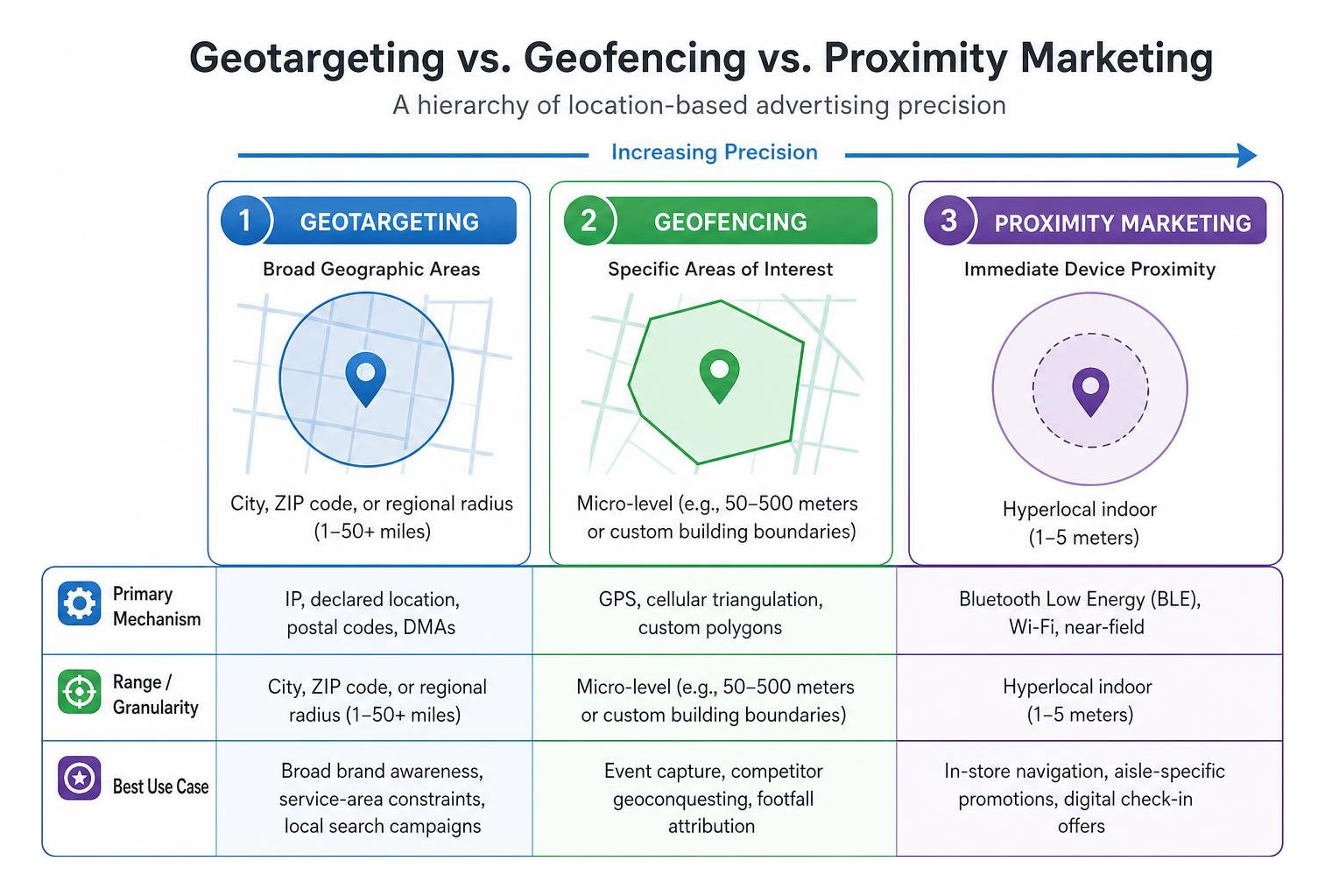
| Technique | Primary Mechanism | Range / Granularity | Best Use Case |
|---|---|---|---|
| Geotargeting | IP, declared location, postal codes, DMAs | City, ZIP code, or regional radius (1–50+ miles) | Broad brand awareness, service-area constraints, local search campaigns |
| Geofencing | GPS, cellular triangulation, custom polygons | Micro-level (e.g., 50–500 meters or custom building boundaries) | Event capture, competitor geoconquesting, footfall attribution |
| Proximity Beaconing | Bluetooth Low Energy (BLE), Wi-Fi, near-field | Hyperlocal indoor (1–5 meters) | In-store navigation, aisle-specific promotions, digital check-in offers |
Geotargeting vs. Geofencing vs. Proximity Marketing
While these terms are frequently used interchangeably, they serve distinct roles across the digital marketing funnel:
- Geotargeting: Focuses on serving digital ads within designated geographical markets, such as specific cities, postal codes, or radius parameters around a central business address. It balances broad reach with local relevance, making sure marketing budgets are never spent on audiences outside your operational footprint.
- Geofencing: Uses virtual perimeters built around specific geographic points of interest (POIs). When an opt-in mobile user crosses this virtual fence, ad impressions can be triggered across mobile apps, social media, or programmatic display networks.
- Proximity Marketing: Operates at the most granular level, often using hardware-free indoor positioning or Bluetooth Low Energy (BLE) beacons to engage devices inside a specific store, venue, or campus.
The Shift from Raw GPS Pings to Location Intelligence
Early location advertising relied heavily on raw, bidstream GPS pings, which were frequently plagued by signal degradation, spoofing, and inaccurate centroid plotting (such as dumping millions of impressions at the geometric center of a ZIP code).
Modern campaigns rely on location intelligence. This discipline filters raw location signals through machine learning models to remove fraudulent pings, verify dwell times, and analyze aggregated footfall patterns. Instead of relying on a single, isolated device ping, location intelligence examines historical visitation habits, frequency, and movement patterns to build high-intent audience segments.
Core Techniques in Location Based Digital Advertising
To move beyond generic digital campaigns and drive physical footfall, marketers must deploy advanced location-based tactics that combine spatial precision with behavioral context. Real-world visitation data often reflects customer intent better than basic search history.
Hyperlocal Polygon Geofencing and Geoconquesting
Simple circular radius targeting often leads to wasted spend by capturing unwanted foot traffic from adjacent highways, residential areas, or bodies of water. Advanced location advertising uses custom polygon geofencing to draw exact, multi-point boundaries around specific parcels of land, retail centers, hospital complexes, or competitor locations.
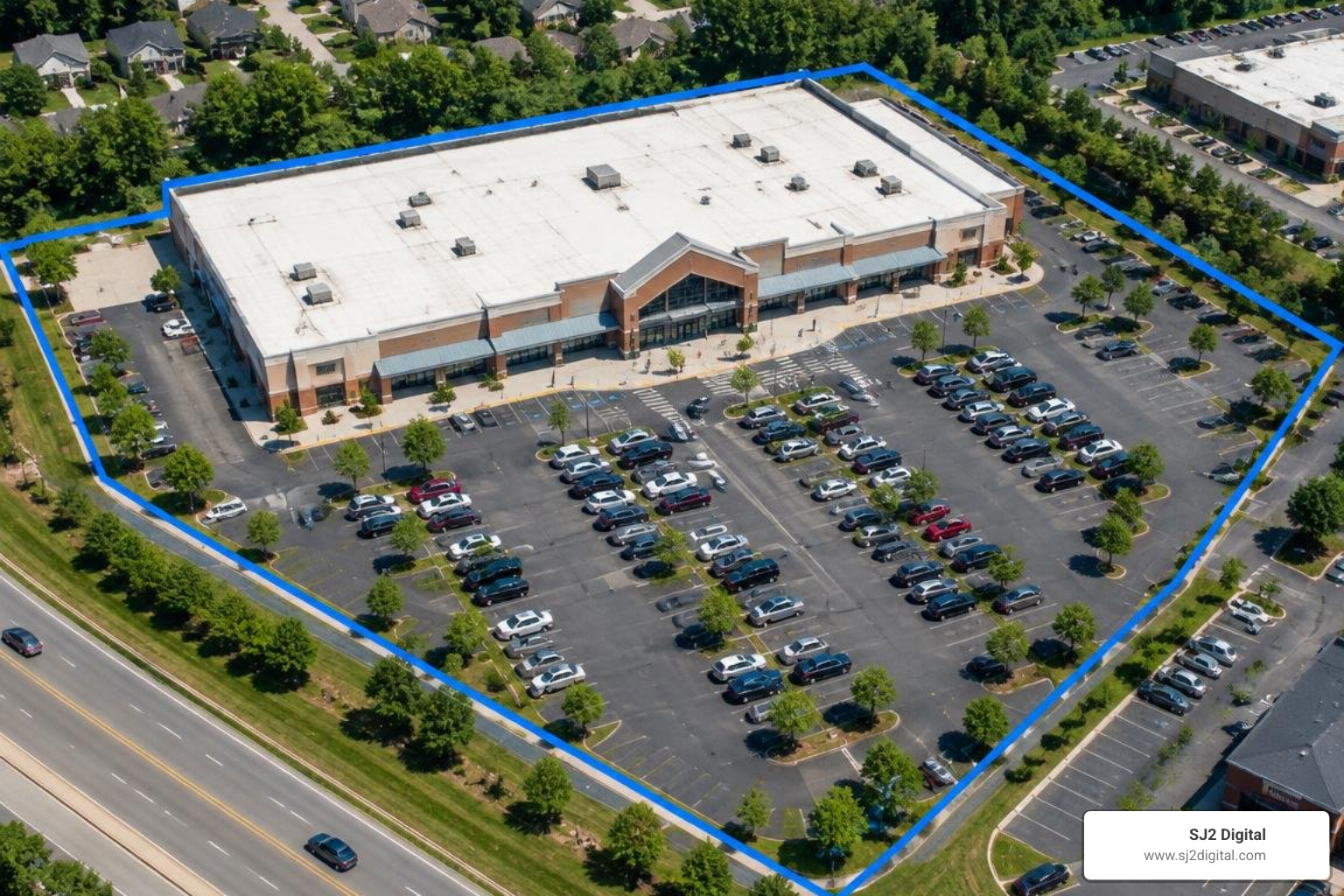
One of the most powerful applications of polygon mapping is geoconquesting. This strategy involves drawing virtual boundaries around direct competitor locations. When prospective customers enter those conversion zones, you can deliver targeted mobile campaigns showcasing your unique value propositions, specialized amenities, or special introductory offers. Geofencing can boost engagement rates by up to 30% and lift conversion rates significantly when paired with a compelling call to action.
Dynamic Creative Personalization and Weather Triggers
Location signals reach peak performance when paired with dynamic creative optimization (DCO). Dynamic ads automatically modify headlines, imagery, and calls to action depending on the user’s exact geographic area, nearby store address, or environmental factors.
Research indicates that brain response increases by over 32% when ads are contextually relevant in both time and content. For instance, dynamic weather triggers allow campaigns to automatically adapt in real time:
- A senior living community can highlight indoor social activities, dining halls, and wellness amenities during extreme heat or freezing winter storms.
- A home service or auto repair provider can dynamically trigger storm-preparation promotions when severe weather enters a specific ZIP code.
Cross-Channel Activation: Connecting Physical Footfall to Digital Media
Delivering a seamless location-based experience requires orchestrating multiple marketing channels into a unified journey.
How Multi-Channel Platforms Power Location Based Digital Advertising
When an audience member enters a target geofence, their anonymized device ID can be mapped into privacy-compliant household graphs. This allows marketers to coordinate touchpoints across several touchpoints:
- Paid Social: Run highly targeted social media campaigns that show personalized video creative to users living within specific residential neighborhoods or drive-time radiuses.
- Search Engine Marketing: Combine high-intent local keywords with strict geographic bidding. By integrating local search engine advertising, you ensure top placement on Google and Bing precisely when nearby consumers search for urgent local services.
- In-App Programmatic: Serve interactive rich media banners to mobile users actively using maps, weather apps, and local news outlets while inside your target commercial zones.
High-Impact Digital Out-of-Home (DOOH) and Connected TV (CTV)
Local digital advertising has expanded well beyond the smartphone screen. The intersection of location data with Connected TV (CTV) and Digital Out-of-Home (DOOH) programmatic screens offers unprecedented scale. In December 2025, streaming captured 47.5% of total TV viewing—the largest share ever reported in Nielsen’s The Gauge—making location-targeted CTV essential for local branding.
Programmatic DOOH allows advertisers to trigger digital billboard displays when mobile traffic in a specific area spikes. Combining DOOH with mobile proximity targeting amplifies message retention:
- Contextually relevant DOOH campaigns increase sales by over 16% compared to campaigns without an out-of-home presence.
- 59% of consumers report that DOOH displays improve their overall shopping experience, and 56% have purchased an item featured on a DOOH screen.
- Geofenced DOOH displays can achieve click-through rates (CTR) of up to 4.39% on retargeted mobile devices, compared to just 0.7% for standard static displays.

Measuring Real-World Footfall Lift and Campaign Attribution
The greatest advantage of modern location digital advertising is its ability to measure physical outcomes rather than just vanity metrics like clicks and impressions.
Setting Up Holdout Geo-Experiments and Dwell Time Tracking
To establish true causality, leading marketers use incrementality testing and matched-market geo-experiments. Approximately 52% of top brand and agency marketers now rely on incrementality testing to evaluate media effectiveness.
Here is how a verified geo-experiment works:
- Market Matching: Select two statistically identical geographic markets (e.g., Market A and Market B) with similar population sizes and baseline sales.
- Expose and Hold Out: Run location-based digital media in Market A, while keeping Market B completely dark as a holdout control.
- Dwell Time Validation: Use polygon tracking to measure physical visits to your location, applying dwell thresholds (e.g., minimum 15-minute stay) to filter out passing commuters or delivery staff.
- Attribution Analysis: Compare the visitation rate of the exposed group against the unexposed holdout group to calculate your exact cost per incremental visit (CPIV).
Seeing real-world results in action is best reflected in our multi-location client case study results, where localized ad spending directly correlated with verified on-site appointments.
Best Practices for Privacy-Compliant Location Based Digital Advertising
As consumer privacy expectations rise and regulations evolve, location marketing must be built on trust, transparency, and data governance. Around 70% of U.S. consumers say they are familiar with state privacy laws, yet 60% still find privacy management confusing.
To maintain complete compliance with global and state privacy frameworks (such as GDPR, CCPA/CPRA, and state-level comprehensive data privacy laws), follow these core rules:
- 100% Opt-In Consent: Only utilize location data collected via explicit, transparent user consent through trusted publisher SDKs.
- Privacy-First Geofiltering: Use privacy-safe platforms that can deliver real-time proximity campaigns without capturing personally identifiable information (PII).
- Establish Sensitive Location No-Go Zones: Never build geofences around sensitive POIs, such as addiction treatment clinics, places of worship, or specialized medical facilities.
- Leverage Clean Rooms and Data Aggregation: Always aggregate location signals into anonymized cohort groups before analyzing footfall lift or sharing attribution reports.
Industry-Specific Strategies: From Senior Living to Retail
Different business models require tailored location strategies depending on sales cycle length, consumer radius, and transaction value.
Driving Inquiries and Tours in Healthcare and Senior Living
In industries like senior living, the decision-making process is emotional, considered, and involves both the future resident and their adult children. Simply putting a geofence around an assisted living community is not enough.
A winning senior living location strategy requires:
- Trade-Area Alignment: Mapping residential ZIP codes where adult children (typically ages 45–64) live within a 10- to 20-minute drive of your community.
- Integrated Organic Visibility: Ensuring your local Google Business Profiles are fully optimized through targeted local search engine optimization so nearby searchers find you organically.
- Full-Funnel Nurturing: Backing up your paid media with our comprehensive marketing services, connecting paid search clicks to automated tour scheduling and behavior-triggered email automations that guide families through every step of the decision process.
Quick-Serve Restaurants and Retail Trade-Area Capture
For quick-serve restaurants (QSR) and retail storefronts, consumer decision windows are measured in minutes rather than months. Success relies on capturing immediate footfall and drive-thru traffic:
- Dayparted Bidding: Ramp up geofence ad spend during prime meal windows (e.g., 11:30 AM to 1:30 PM for lunch promotions).
- Curbside and In-Store Pick-up Targeting: Serve specific mobile ads to consumers who have visited competitive drive-thrus in the past 30 days, offering app-exclusive discounts or free upgrades.
Frequently Asked Questions About Location Based Advertising
How precise can location targeting be without violating privacy laws?
Location targeting can safely achieve meter-level accuracy when using privacy-compliant, consented SDK data and custom polygon geofencing. Privacy regulations do not prohibit location advertising; rather, they require transparency, opt-in consent, and the anonymization of individual identifiers. By operating on aggregated audience cohorts and utilizing privacy-safe data platforms, brands achieve high precision without collecting personal data.
What is the difference between real-time presence and historical location targeting?
Real-time presence targeting serves ads at the precise moment a user is physically inside a geofenced boundary (such as walking through a shopping district or entering an event venue). Historical location targeting (or location-based audience segmentation) identifies devices that visited specific places over a rolling window (e.g., the last 30 to 90 days), allowing advertisers to target proven lifestyle profiles, such as frequent business travelers or golfers, regardless of where they are right now.
How do marketers verify that digital ads actually drove in-store visits?
Verification is achieved through foot traffic attribution studies and geo-holdout testing. Attribution platforms measure when a mobile device that was served an ad subsequently enters a physical location's polygon boundary. To ensure the ad caused the visit (rather than the user visiting organically), the visitation rate of the exposed audience is compared against an unexposed control group with identical demographic and geographic traits.
Conclusion
Location-based digital advertising has matured into an essential intelligence layer for any business that depends on real-world foot traffic. By moving away from basic radius blasts and embracing privacy-first polygon geofencing, dynamic creative triggers, and omnichannel attribution, businesses can eliminate wasted ad spend and generate measurable footfall.
At SJ2 Digital, we operate on an agile "anti-agency" model. We believe in complete transparency, live client dashboards, hands-on senior expertise, and zero restrictive long-term contracts. Whether you are seeking to fill senior living residences or dominate local trade areas, our team builds custom media architectures that convert geographic proximity into bottom-line revenue.
Ready to transform your local marketing performance? Discover how our scalable programmatic advertising solutions can drive qualified in-person visits to your locations, or contact our senior digital experts today to schedule your strategy consultation.