
Choose a Senior Housing Marketing Agency That Drives Qualified Move-Ins

A strong senior housing marketing agency should do more than generate website traffic or form fills. It should help your community reach local prospects and adult children, turn interest into qualified tours, and clearly show which campaigns contribute to move-ins.
Look for an agency that can:
- Build local visibility through SEO, paid search, social media, video, and virtual tours.
- Connect campaigns to your CRM so leads receive useful follow-up across a long decision cycle.
- Report on the numbers that matter: qualified inquiries, completed tours, cost per move-in, and occupancy impact.
- Use authentic resident stories responsibly, with clear consent and Fair Housing-aware messaging.
Senior housing decisions rarely happen after one ad or one website visit. A family may research options for months, then act quickly after a health change or life event. Digital marketing gives operators a way to remain helpful throughout that process, rather than relying only on billboards, print ads, or a single outreach call.
That shift matters because older adults and their families are online. According to the Pew Research Center, about three-quarters of adults age 65 and older use the internet, and many go online daily. Adult children often compare communities, read reviews, watch videos, and schedule tours before a prospect ever speaks with a sales counselor.
The right partner combines hands-on digital expertise with transparent reporting, so marketing spend can be tied to real business outcomes - not vague awareness metrics.
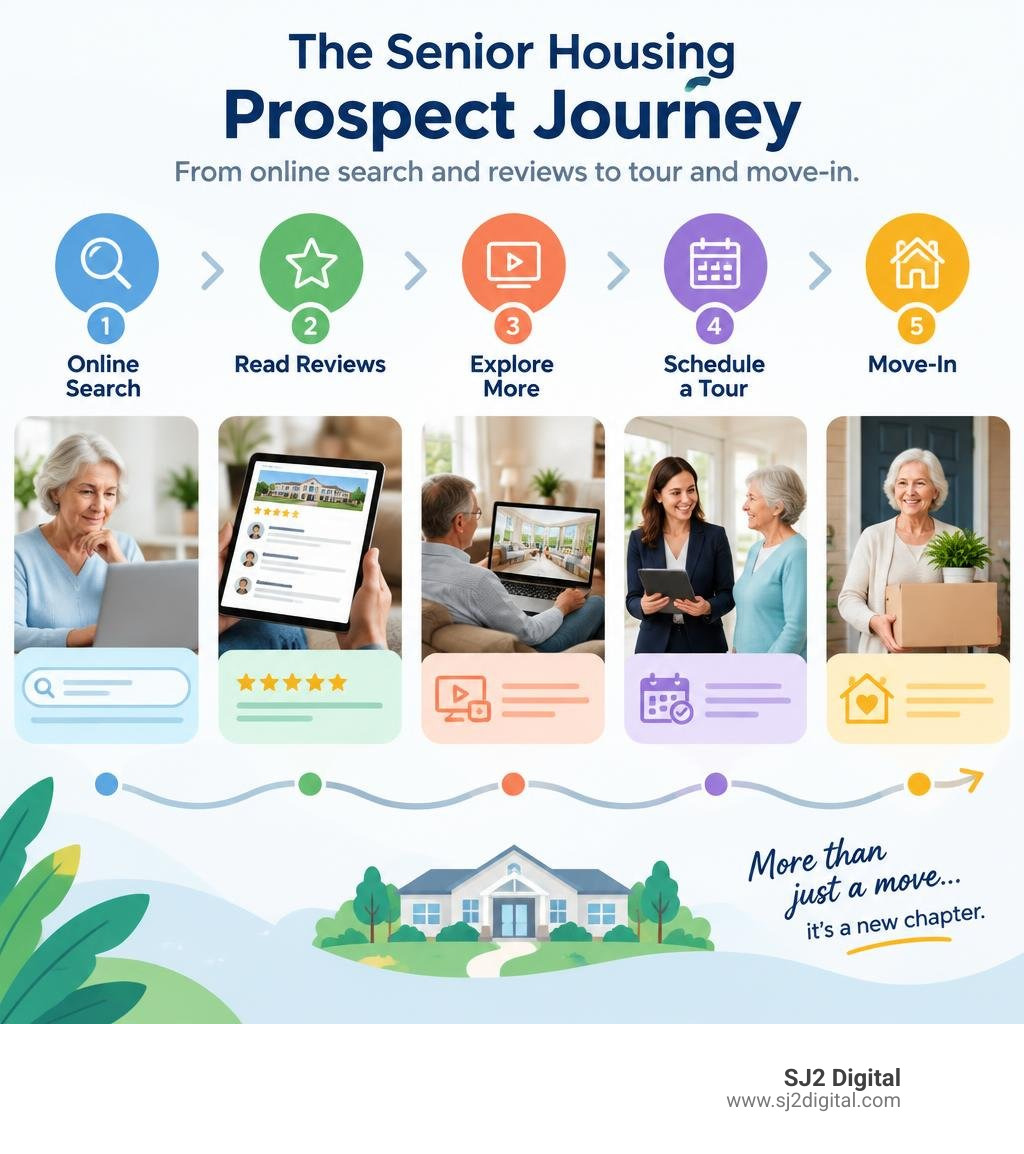
The Shift from Traditional Advertising to Digital Engagement
Gone are the days when a full-page newspaper spread and a highway billboard were enough to maintain 95% community occupancy. Traditional push advertising assumed families made housing decisions simply based on name recognition. Today, prospective residents and their families conduct exhaustive digital research before reaching out to an on-site team.

The demographic data tells a compelling story. In the early 2000s, fewer than one in five seniors used the internet. Today, three-quarters of adults aged 65 and older are active online, and three-quarters of those log on daily. Furthermore, three-quarters of adults aged 50 and older—the demographic that includes adult children driving assisted living and memory care research—regularly engage on social media.
Because senior living is hyper-local, successful operators rely on targeted digital acquisition rather than broad, expensive brand plays. Implementing granular senior living SEO strategies ensures your community appears at the top of organic results when local families search for specific care levels. Complementing organic efforts with precision programmatic advertising in senior living allows operators to serve relevant video and display assets directly to adult child decision-makers across their favorite websites, mobile apps, and streaming platforms.
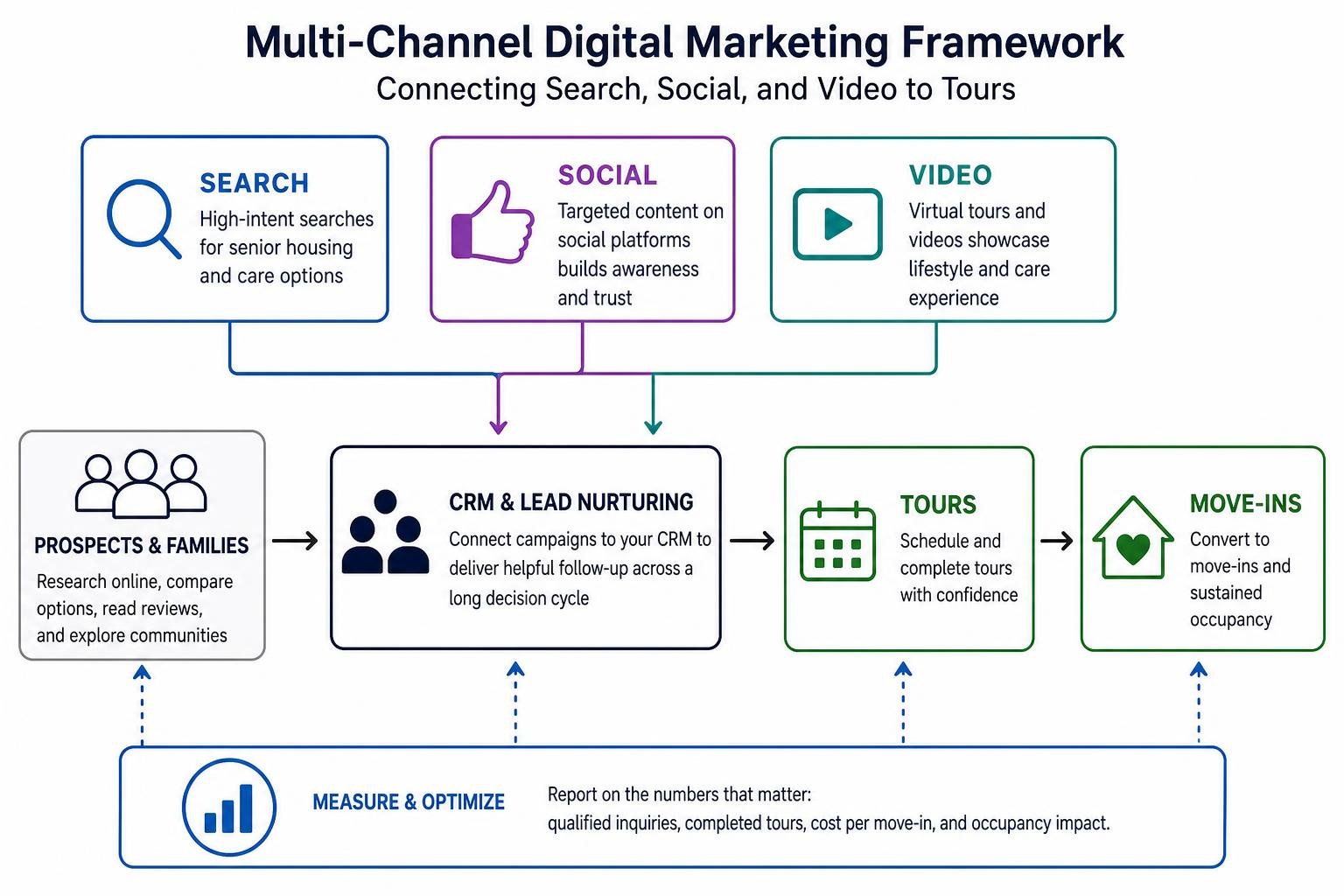
Multi-Channel Strategy: Aligning Search, Paid Media, and Social Content
A modern prospect interacts with your brand across multiple touchpoints before scheduling a tour. Achieving consistent move-in growth requires aligning every channel:
- High-Intent Search Media: Capturing immediate needs when families search terms like "assisted living near me" or "memory care facilities in [City]."
- Audience-Targeted Social Channels: Utilizing targeted social marketing across platforms like Facebook and Instagram to share resident stories, community dining experiences, and educational resources with adult daughters (ages 45–64) who serve as primary care coordinators.
- Immersive Visual Experiences: Deploying 4K video walkthroughs and interactive virtual open houses, letting out-of-town family members explore floor plans and common areas with confidence.
Why Specialization Matters in a Senior Housing Marketing Agency
Marketing senior living is fundamentally different from selling luxury apartments or retail goods. A generalist marketing agency often fails because it treats senior care as a purely transactional purchase.
In reality, the journey to a move-in involves complex care level nuances—ranging from active independent living to specialized memory care—and deep emotional decision triggers. Prospective residents often enter a community past age 80, frequently prompted by an adverse health or life event. A specialized agency understands how to tailor messaging to these sensitive moments while keeping your sales pipeline full.
Operators looking to bridge this gap benefit from comprehensive senior living marketing services designed by strategists who understand healthcare operations, local referral networks, and the emotional psychology of family-led transitions.
Balancing Authentic Storytelling, Resident Feedback, and Compliance
The days of relying on overly polished, generic stock photography of silver-haired models playing chess are over. Today’s consumers spot stock assets instantly, creating skepticism about the genuine quality of life inside a community.

Authenticity drives move-ins. Highlighting real resident stories, gardening clubs, culinary creations, and intergenerational events builds immediate trust. However, putting residents at the center of marketing requires strict operational and legal rigor:
- Explicit Photo and Likeness Consent: Operators must obtain written consent releases from residents or their legal guardians before publishing images, video testimonials, or life stories in digital campaigns or print mailers.
- Fair Housing Act (FHA) & HOPA Compliance: All digital campaigns must strictly adhere to the Fair Housing Act and Housing for Older Persons Act (HOPA) guidelines. While communities designated under HOPA may lawfully restrict occupancy based on age, digital marketing campaigns must avoid discriminatory language or ad-targeting exclusions that violate federal protections regarding race, religion, sex, disability, or familial status.
- Resident Feedback Loops: Leading operators gather feedback via monthly resident council meetings and quarterly satisfaction surveys rather than relying on annual check-ins. When residents feel heard, their organic advocacy becomes your most powerful marketing asset.
Building Trust Through Online Reviews and Reputation Management
Online reviews are the modern front porch of your community. When adult children narrow their choices down to two or three local communities, online ratings frequently dictate which community gets the first tour booking.
A robust reputation management strategy involves:
- Proactive Review Generation: Actively prompting satisfied family members and residents to share their experiences on Google Business Profiles, Facebook, and specialized senior care directories.
- Empathetic Public Responses: Publicly addressing negative reviews within 24–48 hours with empathy, professional poise, and operational transparency, while moving specific disputes offline to protect resident privacy.
- Operational Feedback Integration: Relaying review trends directly to community executive directors and dining teams so operational improvements directly fuel positive marketing narratives.
Nurturing the Extended Sales Cycle with Automation and AI
Because the senior housing consideration process can span anywhere from a few weeks to several years, communities frequently struggle with lead leakage. Sales teams often focus solely on hot, immediate move-in inquiries, leaving early-stage prospects neglected.
By deploying automated email workflows tied directly to your CRM, communities can nurture prospects systematically without overburdening on-site sales counselors.
Integrating conversational AI assistants on your website allows after-hours visitors to ask specific questions about pricing, pet policies, and care levels, automatically qualifying prospects and populating CRM records with valuable context before the sales counselor makes their initial phone call.
Lead Nurture Workflows Across Prospect Lifecycle Stages
| Prospect Stage | Intent Level | Primary Channels | Content & Automation Triggers | Primary Goal |
|---|---|---|---|---|
| Top of Funnel (Discovery) | Low / Researching | SEO Blog, Paid Social, Display Ads | Educational guides (e.g., Navigating Assisted Living Costs), financial planning checklists | Capture email address & establish trust |
| Middle of Funnel (Evaluation) | Moderate / Comparing | Dynamic Email Drips, Retargeting | Resident spotlight videos, dining menu previews, virtual event invitations | Position community culture against local alternatives |
| Bottom of Funnel (Decision) | High / Immediate Need | Paid Search (PPC), Direct Outreach | Automated SMS tour confirmations, personalized video messages from Executive Director | Secure completed on-site tour and deposit |
Key Criteria for Selecting a Senior Housing Marketing Agency
Not all digital marketing partners deliver equal value. Traditional agencies frequently push long-term, rigid 12-month retainers, pass client work down to junior account coordinators, and hide campaign performance behind vanity metrics like impressions and clicks.
When evaluating an agency, prioritize partners who operate on an anti-agency model:
- No Long-Term Contract Lock-In: You should retain the freedom to scale or adjust your engagement based on results, keeping the agency accountable month after month.
- Direct Access to Senior Strategists: Ensure the experts strategizing your campaigns are the hands-on specialists actually managing your ad accounts and SEO audits.
- Multi-Location Expertise: Look for a team capable of customizing local campaigns for individual communities while maintaining unified brand reporting across regional portfolios.
Reviewing an agency's proven growth metrics and case study insights provides clarity on how they solve occupancy challenges in competitive markets.
Measuring Success: How a Senior Housing Marketing Agency Proves ROI
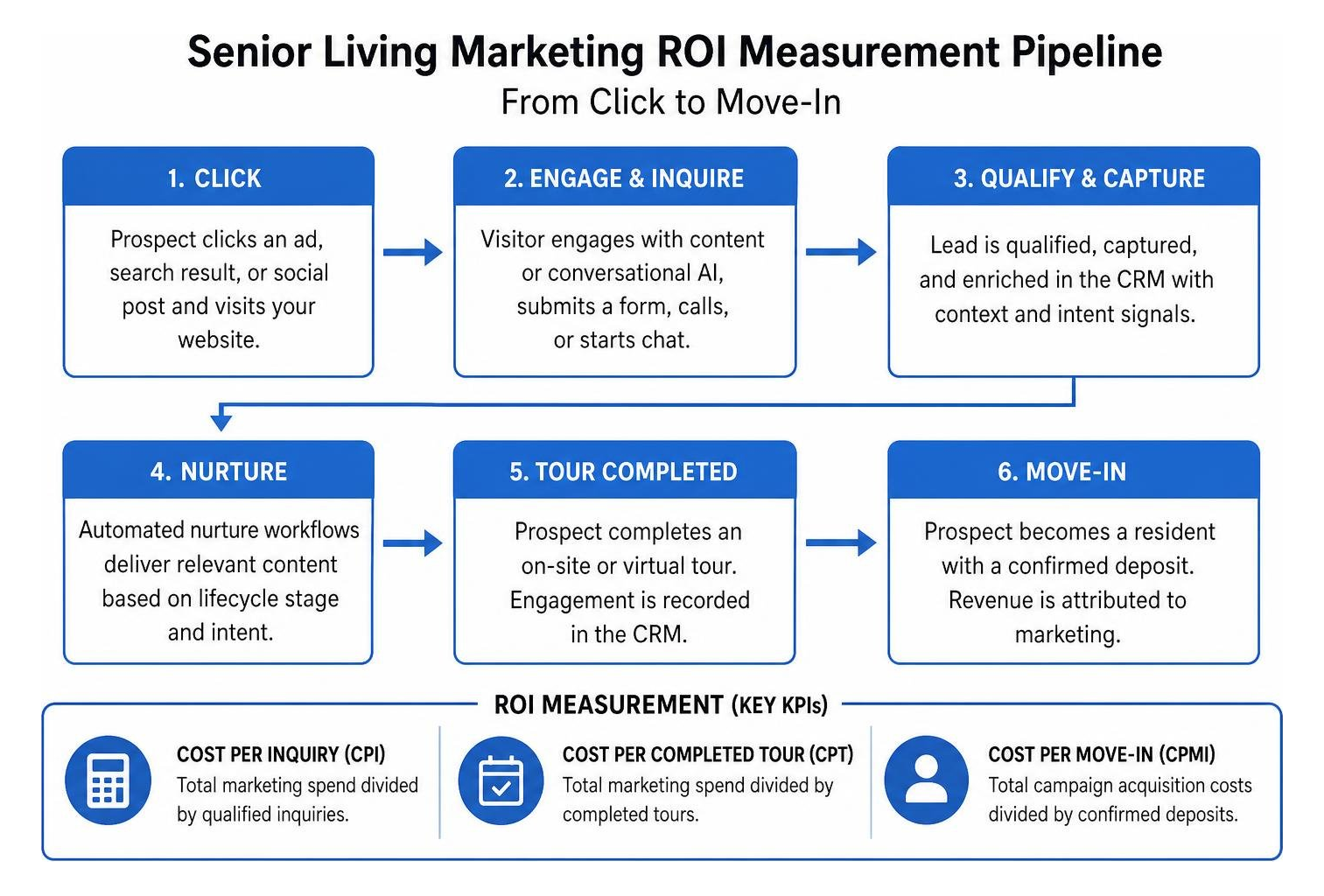
Your agency should provide 24/7 transparent live dashboards that directly tie digital marketing spend to pipeline revenue. The key performance indicators (KPIs) that truly matter include:
- Cost Per Inquiry (CPI): Total marketing spend divided by qualified phone, form, and chat inquiries.
- Cost Per Completed Tour (CPT): The true measure of campaign intent, filtering out casual website browsers from qualified prospects who physically or virtually tour the community.
- Cost Per Move-In (CPMI): Total campaign acquisition costs divided by confirmed deposits, allowing leadership to evaluate customer acquisition cost against average resident length of stay and lifetime value (LTV).
Frequently Asked Questions About Senior Housing Marketing
How do marketing agencies ensure Fair Housing Act compliance in digital campaigns?
Agencies ensure compliance by strictly following HUD guidelines and the Housing for Older Persons Act (HOPA). While HOPA provides specific exemptions allowing 55+ and 62+ communities to market age-qualified housing, all marketing assets must avoid any discriminatory messaging, imagery, or exclusionary targeting based on protected classes such as race, color, national origin, religion, sex, and disability. Campaigns should focus on care offerings, lifestyle amenities, and welcoming language.
Why is the senior living sales cycle so long, and how does marketing bridge the gap?
The sales cycle is uniquely extended because moving into senior living involves emotional, financial, and family consensus hurdles. Unless accelerated by an unexpected health crisis, families take time to evaluate finances and tour multiple communities. Digital marketing bridges this gap through intelligent automation—delivering helpful educational content, virtual event invites, and resident stories over time so your community remains top-of-mind when the family is finally ready to make a decision.
Which performance metrics matter most when evaluating agency results?
While web traffic and impressions show reach, the metrics that matter most for senior living operators are inquiry-to-tour conversion rates, cost per completed tour, and cost per move-in. Aligning your digital marketing analytics with your on-site CRM ensures every marketing dollar is evaluated by its ability to generate occupied units and revenue.
Conclusion
Maximizing community occupancy requires a partner that understands the sensitive, multi-touch nature of senior living sales. At SJ2 Digital, we reject the traditional agency playbook. Through our anti-agency philosophy, we provide flexible arrangements without locking you into long-term contracts, maintain transparent live reporting dashboards, and ensure our senior-level digital experts work hands-on with your team.
Ready to transform your digital strategy into reliable move-ins? Learn how we help communities drive qualified tour volume with a senior living pay-per-click agency strategy tailored to your exact occupancy goals, or explore our about us story and contact our team today.