
Customer Acquisition Blueprint: Aligning Channels to Reduce Cost per Lead
Deconstructing the Modern Customer Acquisition Funnel

Effective digital marketing for customer acquisition means aligning high-intent search, paid social, programmatic display, and automated nurturing into one connected journey, then removing friction at every stage so more qualified prospects convert at a lower cost per lead. Start by matching each channel to the prospect's intent level, capture zero-party data with low-friction tools, and route high-value leads to immediate follow-up.
Acquiring customers in today's digital landscape requires understanding how users navigate modern touchpoints. Eight in 10 online purchase journeys now involve multiple touchpoints across various channels before an individual ever converts. If your customer experience features unnecessary friction, the consequences are severe: 96% of customers experiencing high friction are likely not to sign up for a brand's offerings.
Optimizing your funnel is about building a cohesive journey where each stage transitions smoothly into the next, as outlined in detailed customer acquisition framework analysis.
Top-of-Funnel Demand Generation and Brand Discovery
At the top of the funnel (TOFU), your prospective customers are rarely looking to make an immediate commitment. Instead, they are experiencing initial symptoms of a problem or seeking general education.
To capture this early attention without wasting budget:
- Deploy short-form educational video assets and informative articles answering core industry questions.
- Establish distinct brand positioning that clearly highlights your unique value proposition.
- Target problem-aware audiences through interest-based social campaigns and broad organic content clusters.
Mid-Funnel Consideration and High-Intent Lead Capture
Once prospects understand their core challenge, they enter the middle of the funnel (MOFU). Here, they evaluate specific solutions, compare providers, and determine credibility.
Speed and relevance are paramount at this stage. Research indicates that 82% of customers spend less than 10 minutes looking for an item or solution they need. If your capture process is slow or complex, prospects bounce.
- Implement low-friction capture mechanisms like interactive quizzes, calculators, and assessments that provide immediate value.
- Capture zero-party data (preferences, immediate needs, timelines) to tailor subsequent messaging.
- Align on-site experiences with multi-channel campaigns, drawing from modern omnichannel acquisition conversion research.
Bottom-of-Funnel Conversion and Frictionless Onboarding
The bottom of the funnel (BOFU) is where high-intent prospects take definitive action—scheduling a tour, booking a consultation, or completing an application.
- Streamline forms by eliminating unnecessary fields; every additional question introduces friction.
- Employ automated lead scoring to instantly route high-value prospects to your senior intake or sales team.
- Provide instant confirmation and self-scheduling links via SMS and email to eliminate phone tag and reduce drop-off.
Core Channels in Digital Marketing for Customer Acquisition
No single channel can sustain a scalable acquisition system on its own. Balancing organic discovery, direct response search, social engagement, and display conditioning creates an interconnected web that lowers overall cost per acquisition.
High-Intent Search: Blending SEO and Paid Search
Search engines remain the primary engine for capturing active intent. When a family member or prospect searches for immediate solutions, organic visibility and paid ads must work in tandem.
Organic search builds sustainable long-term equity. Implementing specialized senior living SEO helps your site capture educational and high-volume local search queries through strategic content clusters. Meanwhile, deploying high-intent pay-per-click advertising guarantees top-of-page visibility on immediate transactional keywords, capturing high-urgency leads instantly.
Paid Social and Creator-Led Acquisition
Social channels excel at capturing passive demand and building brand affinity before an urgent need arises. In fact, 83% of global businesses report social media as their primary marketing channel, and 23% of consumers have completed a purchase based on creator or influencer endorsements.
Through targeted social media campaigns, you can present authentic community culture, video walkthroughs, and resident testimonials directly to decision-makers, utilizing platform algorithms to reach precise demographic profiles.
Programmatic Display and Audience Conditioning
Cold prospects rarely convert on their first visit. Programmatic display serves as an audience conditioning layer, reinforcing brand credibility while leads research their options.
Using targeted programmatic display advertising, you can sequence display ads based on how prospects interact with your digital properties. This approach keeps your brand top of mind, delivers relevant social proof, and sets up high-converting direct-response interactions down the line.
Tactical Blueprint: Building a Repeatable Acquisition Engine
Scaling acquisition sustainably requires a disciplined operating framework. Rather than running disconnected experiments, structure your channel stack based on cost, intent, and scalability.
| Channel Type | Primary Intent Level | Typical Relative CAC | Scalability Potential | Key Strategic Role |
|---|---|---|---|---|
| Paid Search (PPC) | High / Immediate | Moderate to High | Medium (Capped by volume) | Capturing active solution-seekers |
| Organic Search (SEO) | High to Informational | Low (Long-term) | High | Building baseline domain authority & compounding traffic |
| Paid Social | Low to Medium (Latent) | Moderate | Very High | Generating targeted awareness & mid-funnel interest |
| Programmatic Display | Awareness / Retargeting | Low to Moderate | High | Multi-touch brand conditioning & retargeting |
| Email Automation | High (Nurture stage) | Very Low | High | Converting captured leads into scheduled tours |
For deeper insights into managing paid channel infrastructure, consult this paid acquisition engine scaling methodology.
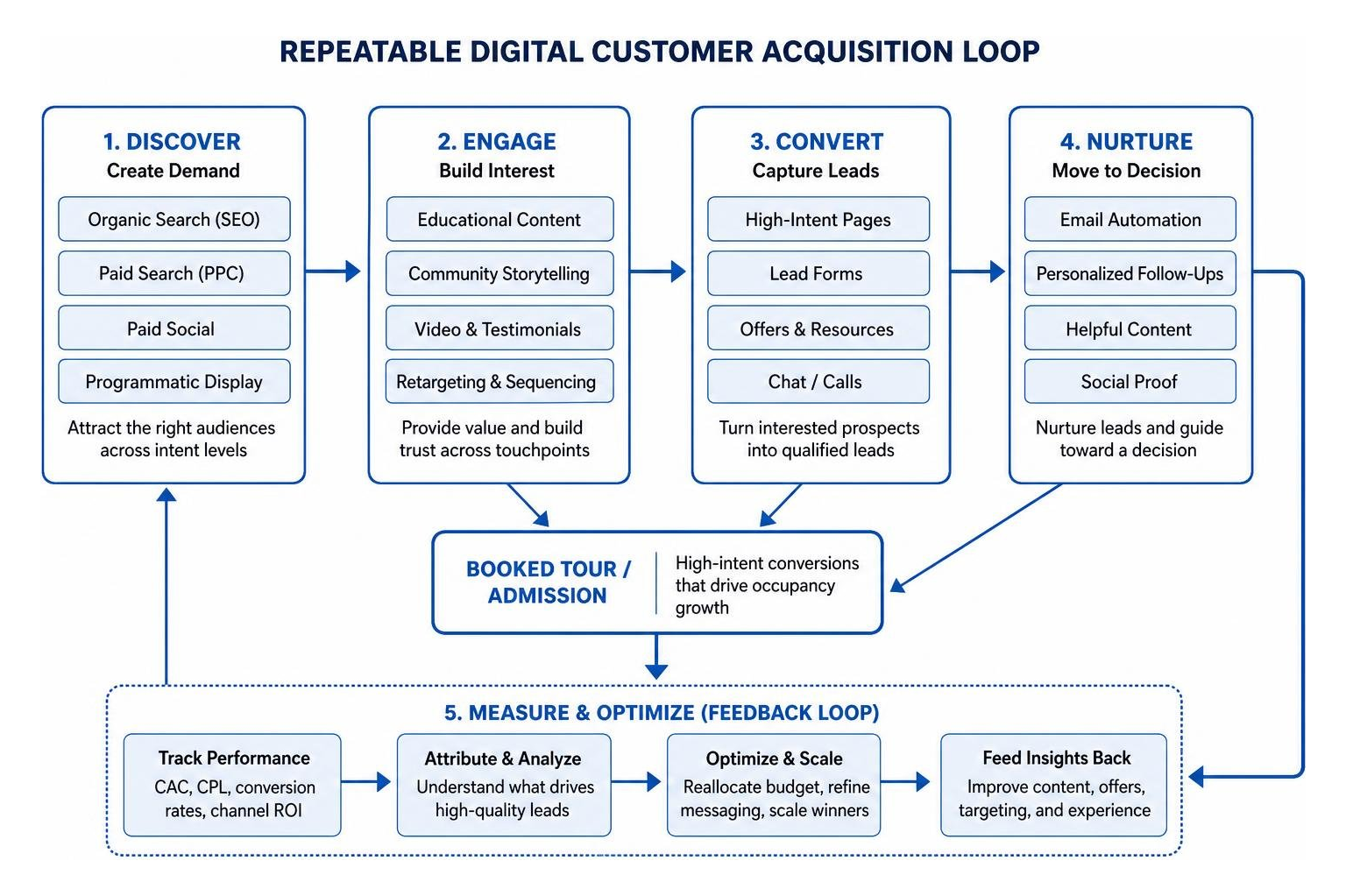
Integrating Paid and Organic Channels
Paid and organic strategies reinforce one another. Organic content identifies high-converting topics, while paid ads amplify your best-performing assets to wider audiences.
When prospects see your brand in both organic results and paid placements, trust increases significantly. This cross-channel lift lowers paid search click costs through higher Quality Scores and drives higher click-through rates across organic listings.
Leveraging First-Party Data and Automated Nurturing Sequences
With third-party tracking cookies phasing out, first-party data is the foundation of modern acquisition. Modern consumers recognize this shift: 86% of consumers are willing to share more personal information when brands are transparent about how they use it. Furthermore, 64% of shoppers want marketing to be more personalized, and a tailored experience influences 93% to remain loyal.
Deploying responsive automated email workflows allows you to deliver timely, behavioral-triggered follow-ups. For example, personalized email campaigns have driven documented conversion lifts of 7%, while top-tier welcome series consistently achieve order rates close to 10%.
Implementing Advanced Bidding Modes and Exclusion Protocols
To ensure your ad spend targets genuine growth rather than paying for existing contacts, use modern bidding controls and automated audience exclusions.
Platforms now offer dedicated acquisition features. According to Google's guide to new customer acquisition modes, advertisers utilizing New Customer Only bidding modes improved their new customer acquisition ratio by an average of 11.5% while reducing cost per new customer by 3%.
- New Customer Only Mode: Directs 100% of campaign spend toward prospects who have never converted before.
- New Customer Value Mode: Places higher bid multipliers on first-time prospects while maintaining baseline remarketing efficiency.
- Negative Audience Layering: Automatically excludes past website visitors, current CRM leads, and active residents from top-of-funnel discovery campaigns to prevent wasted budget.
Financial Benchmarks and Unit Economics for Sustainable Growth
A customer acquisition strategy is only as viable as its underlying financial metrics. High lead volumes mean little if the cost to generate them outpaces the revenue those customers bring in.
Measuring ROI and Unit Economics
To calculate true Customer Acquisition Cost (CAC), factor in all associated marketing expenses:
$$\text{CAC} = \frac{\text{Total Marketing & Sales Spend (Ad Spend + Fees + Software + Overhead)}}{\text{Total New Customers Acquired}}$$
Key benchmarks to measure alongside CAC include:
- LTV-to-CAC Ratio: A sustainable business model targets a healthy 3:1 ratio. Ratios near 1:1 signal cash flow risks, while ratios exceeding 5:1 suggest you are underinvesting in growth.
- Payback Period: High-growth organizations aim to recoup acquisition costs within 3 to 6 months, while enterprise models typically target 6 to 12 months.
- Downstream Conversion Rate: Monitor the entire progression from initial click to lead, qualified tour, and final move-in.
Review real-world examples of disciplined unit economics in our documented client case study.
Identifying Diminishing Returns and Optimizing Payback Periods
Every acquisition channel eventually hits a saturation point where increasing spend yields fewer incremental leads.
When doubling ad spend yields only a 10% increase in qualified inquiries, the channel has reached saturation. Rather than pushing more budget into an exhausted audience, redirect capital into secondary channels or optimize conversion velocity through post-capture nurturing.
Common Pitfalls in Digital Customer Acquisition and How to Avoid Them
Even robust marketing strategies can falter due to structural errors in execution and follow-up.
The Risk of Single-Channel Overdependence and Ad Fatigue
Relying entirely on a single paid channel exposes your business to unexpected cost spikes. Paid ad CPMs rose 8.64% year over year in 2025, demonstrating how rapidly platform shifts can erode margins.
- Maintain a 70/20/10 creative testing framework: 70% proven assets, 20% iteration tests, 10% high-concept experiments.
- Rotate ad creatives whenever frequency reaches 2.5 to 3.0 impressions per user.
- Balance paid media with organic search, referral systems, and owned email lists.
Post-Click Conversion Leakage and Broken Nurture Tracks
Driving traffic to slow-loading pages with generic messaging is one of the fastest ways to waste marketing spend.
- Ensure mobile load speeds clock in under 2.5 seconds.
- Maintain strict message match between ad creative and landing page headlines.
- Connect landing page forms directly to your CRM with instant alerts to ensure sales teams follow up while prospect interest is highest.
Frequently Asked Questions about Digital Customer Acquisition
What is a healthy CAC to LTV ratio for digital marketing campaigns?
A healthy benchmark across most industries is an LTV:CAC ratio of 3:1. This ensures that the lifetime gross profit generated by a customer is at least three times the total cost required to acquire them, leaving sufficient margin for operational overhead and reinvestment.
How quickly can a business expect to see a return on investment from new acquisition channels?
Paid search and social channels can generate initial leads within days of launch, but stabilizing cost per lead and refining conversion workflows typically takes 30 to 90 days. Organic channels like SEO require 3 to 6 months of consistent execution to build topical authority and deliver compounding, low-cost returns.
What is the most cost-effective way to acquire qualified leads in competitive industries?
The most cost-effective approach blends organic search visibility with automated retargeting and structured referral loops. Capturing organic demand reduces baseline media spend, while automated email workflows turn initial inquiries into high-converting appointments at minimal ongoing cost.
Conclusion: Transforming Acquisition Into Predictable Revenue
Building a profitable customer acquisition engine is not about chasing the newest platform hack. It comes down to aligning high-intent search, social storytelling, automated nurturing, and disciplined unit economics into a unified system.
At SJ2 Digital, we operate on an "anti-agency" model. We skip long-term lock-in contracts, maintain fully transparent live reporting dashboards, and provide hands-on access to senior-level marketing experts who work directly within your budget. Whether you want to reduce your cost per lead or scale overall occupancy, explore our comprehensive senior living marketing services to build a predictable, scalable acquisition pipeline.