
Modernizing Digital Marketing for Healthcare in a Patient-Centered Landscape
Healthcare marketing reaches today's digital patient by combining privacy-compliant tracking, service-line search visibility, and multi-channel engagement that spans organic search, paid media, email automation, and local reputation management. This coordinated ecosystem captures high-intent demand at every stage of the patient journey while building lasting credibility.
The way consumers interact with medicine has fundamentally shifted. Healthcare decisions are deeply personal, emotionally charged, and driven by an urgent need for reassurance. Modern patients expect the convenience of retail e-commerce combined with the rigorous privacy of clinical environments.
Meeting these expectations requires a coordinated ecosystem across every touchpoint. In an era where digital ad spending across healthcare and pharmaceuticals is projected to reach $26.2 billion in 2026—eclipsing traditional media channels at $6.9 billion—organizations must move beyond fragmented tactics. Implementing an intentional framework for digital marketing for healthcare ensures that providers capture high-intent demand while building enduring credibility.
Navigating Patient Search Behavior and the Online Journey
Online discovery has replaced the traditional word-of-mouth referral as the primary entry point for care. Roughly 59% of U.S. adults look for health information online, and eight in ten internet users have searched for a health-related topic. Patients consult "Google Doctor" long before walking through a clinic's doors.
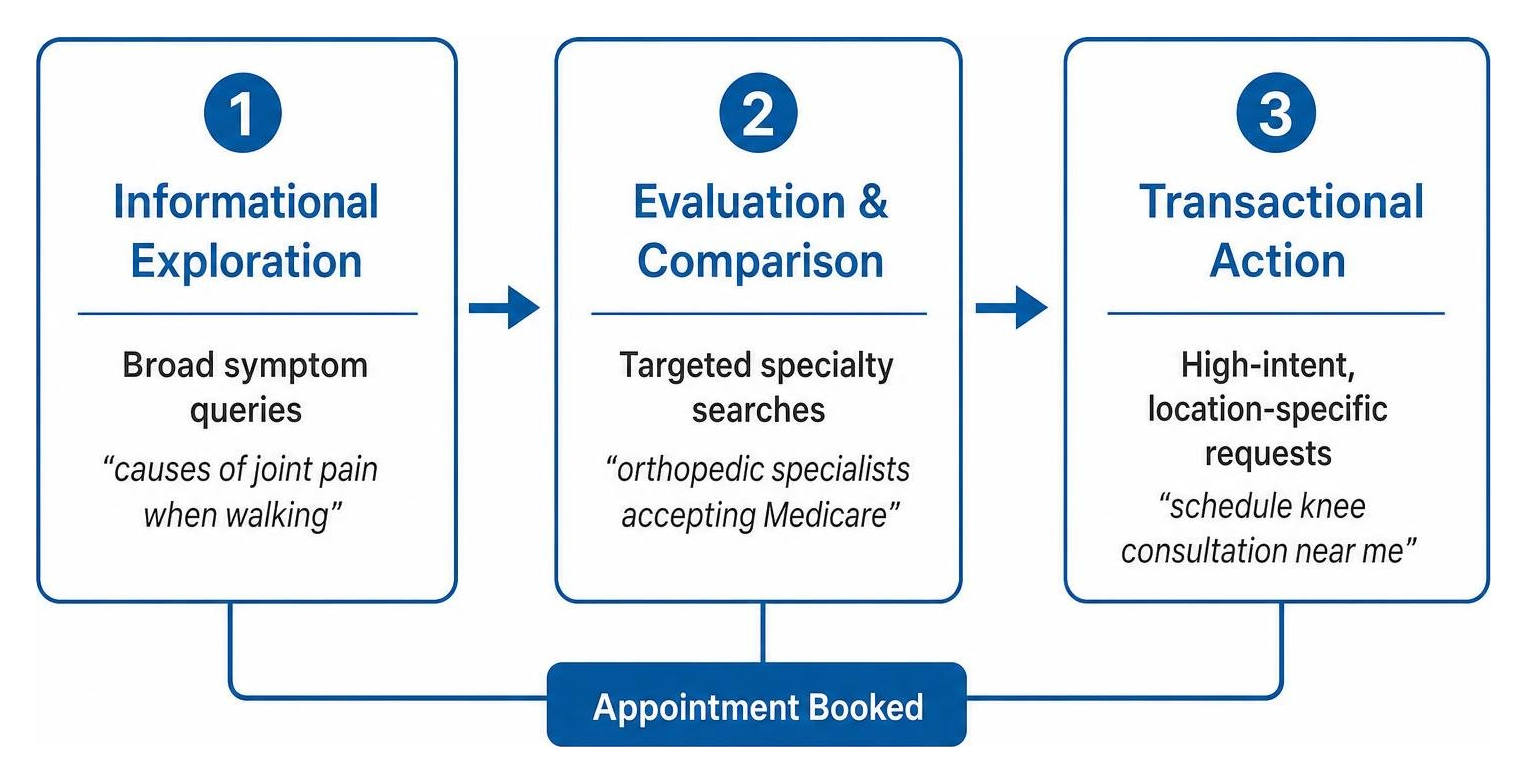
Search engines drive three times more visitors to hospital websites than any other channel. When users experience acute symptoms or navigate chronic conditions, their search intent progresses through clear stages:
- Informational Exploration: Broad symptom queries (e.g., "causes of joint pain when walking").
- Evaluation & Comparison: Targeted specialty searches (e.g., "orthopedic specialists accepting Medicare").
- Transactional Action: High-intent, location-specific requests (e.g., "schedule knee consultation near me").
Capturing patients during these critical micro-moments requires fast load times, intuitive mobile navigation, and transparent service information. Because 44% of mobile researchers immediately book an appointment, any friction in mobile navigation directly hurts acquisition.
Privacy Guardrails: HIPAA, FTC Guidance, and Tracking Compliance
Growth must never compromise patient privacy. Regulatory scrutiny from the Department of Health and Human Services (HHS) Office for Civil Rights (OCR) and the Federal Trade Commission (FTC) has transformed healthcare data governance. Standard marketing practices—such as embedding unvetted third-party tracking pixels on scheduling portals or condition-specific pages—can inadvertently transmit protected health information (PHI) and IP addresses to ad networks, creating severe liability.
To build a secure, high-performing foundation, we follow strict compliance principles:
- Server-Side Tracking: Transition away from client-side ad pixels toward privacy-preserving, server-side data infrastructure.
- Zero-Party and First-Party Data: Rely on voluntary, consent-backed information gathered directly through intake forms rather than rented third-party audiences.
- Business Associate Agreements (BAAs): Ensure every technology vendor processing patient identifiers signs a legally binding BAA.
- Clean Marketing Architecture: Keep unauthenticated informational pages strictly separated from authenticated patient portals, telehealth access points, and digital scheduling workflows.
Far from limiting performance, privacy-first data infrastructure filters out bot traffic and form spam, improving lead-quality signals by up to 30%.
High-Impact Patient Acquisition Strategies: Search, Media, and Content
Acquiring patients online requires a balanced multi-channel engine. A single campaign cannot carry an entire organization; sustainable growth demands harmony between organic search visibility, high-intent paid advertising, and trust-centered educational content.
Service-Line SEO, Local Listings, and Voice Search
High-converting search engine optimization in healthcare relies on structured service-line architecture. Rather than relying on generic service summaries, providers need comprehensive hubs for specific conditions, treatments, and procedures.
Every high-performing service-line page should feature:
- Clinically accurate condition overviews reviewed by credentialed medical staff (reinforcing Google's Experience, Expertise, Authoritativeness, and Trustworthiness—E-E-A-T guidelines).
- Transparent operational details, including accepted insurance networks, physician bios, facility locations, and parking directions.
- Conversational FAQ sections optimized for voice search phrases (e.g., "Where can I find an urgent care clinic open near me?").
Local SEO forms the backbone of community-based healthcare. Maintaining accurate Google Business Profiles (GBPs) across all clinic locations and individual practitioners captures high-intent local map pack queries. To discover how organic visibility scales specialized care facilities, explore our approach to specialized healthcare SEO.
Precision Paid Search and Programmatic Advertising
Organic search takes time to mature, but paid media captures immediate demand from patients actively seeking care. High-intent Google Search campaigns targeting procedure-specific terms (such as "cataract surgery consultation" or "memory care community placement") deliver consistent appointment volume when managed within platform healthcare advertising policies.
Pairing paid search with programmatic display allows providers to build local brand presence through sophisticated geo-fencing around target territories, medical districts, and complementary professional offices. By deploying targeted pay-per-click campaigns alongside programmatic advertising solutions, we optimize bids toward verified conversions while respecting platform policies. Discover additional multi-channel frameworks via Invoca's road map for healthcare digital marketing.
Content-Led Trust Building and Clinician Video Marketing
Healthcare decisions carry emotional weight, making video one of the most effective storytelling tools available. Placing authentic video on landing pages can increase conversion rates by up to 80%.
Short clinician introductions humanize care teams, demystify complex procedures, and alleviate patient anxiety before consultations. Genuine patient success stories—published with written HIPAA consent—resonate far more deeply than dry text descriptions. Authentic patient testimonial videos consistently yield higher engagement and consultation inquiries than basic condition explainers because they validate clinical outcomes through relatable human experiences.
Personalization and Lifecycle Engagement Across Patient Journeys
Patient acquisition is only the first step. Long-term organizational sustainability relies on patient retention, care plan compliance, and proactive wellness management.

Implementing Compliant Email Automations and Segmentation
Email remains an exceptionally personal and cost-effective channel for healthcare engagement. With 47.6% of healthcare emails opened on mobile devices compared to just 25.9% on desktop computers, responsive, clean email templates are essential.
Using permission-based lists gathered at patient check-in or through digital intake forms, organizations can configure privacy-safe automations:
- Appointment Prep & Reminders: Automated pre-visit instructions, directions, and reminders that dramatically reduce costly no-show rates.
- Preventive Care Nurture: Seasonal vaccine availability alerts, wellness check reminders, and age-appropriate screening notifications.
- Post-Visit Follow-Up: Care satisfaction inquiries and educational recovery guides delivered after discharge.
Deploying automated email nurture workflows keeps your organization top-of-mind without exposing sensitive diagnostic data.
Social Media Engagement and Online Reputation Management
Social proof drives healthcare decision-making: 57% of consumers report that a provider's social media presence strongly influences their choice of treatment facility. Social channels offer a venue for community education, public health updates, and clinician highlights.
Active reputation management is equally vital. Proactively soliciting patient reviews via secure SMS or email workflows builds a strong rating profile across Google Business Profiles and healthcare directories. A consistent review footprint protects organic visibility and reassures prospective patients. For proven strategies in community storytelling, explore our social media marketing strategies.
Performance Metrics, Budget Allocation, and 2026 Industry Trends
Managing a successful digital healthcare strategy requires disciplined resource allocation and a commitment to measuring tangible clinical outcomes rather than vanity metrics.
| Marketing Channel Bucket | Core Components | Primary Role in Patient Acquisition | Typical Budget Allocation |
|---|---|---|---|
| Owned Media | Website, Service-Line Content, E-E-A-T Articles, Email Workflows | Foundational trust, organic search ranking, and patient education | 30% – 35% |
| Paid Media | High-Intent Paid Search, Programmatic Display, Social Ads | Capturing active demand and expanding local territory reach | 45% – 50% |
| Earned Media | Local Review Profiles, Community PR, Physician Referral Networks | Third-party validation, reputation management, and brand authority | 15% – 20% |
To see how structured channel optimization transforms operational growth, review our proven healthcare marketing case study.
Emerging AI and Omnichannel Trends in Digital Marketing for Healthcare
The healthcare marketing environment is undergoing rapid technological innovation. With Deloitte reporting that 37% of U.S. consumers already use generative AI tools for health research, and traditional search engine query volume projected to drop 25% by 2026, healthcare providers must adapt to new discovery models.
Key developments reshaping the industry include:
- Answer Engine Optimization (AEO): Structuring medical content with schema markup and physician citations so generative AI answer engines accurately cite your clinical experts.
- Real-Time Bidding Automation: Machine-learning bidding systems that adjust paid media spend across service lines based on capacity and inquiry volume.
- Conversation Intelligence: AI-assisted call analytics that identify patient intent trends and operational bottlenecks at the front desk while protecting caller privacy.
- Unified Omnichannel Experiences: Connecting web, email, SMS, and portal communications to provide seamless patient navigation across every touchpoint.
Measuring True ROI in Digital Marketing for Healthcare
Clicks and impressions do not keep clinic doors open. Healthcare marketers must align reporting with real financial and operational metrics.
Instead of tracking vanity metrics, leading healthcare systems focus on:
- Cost Per Qualified Lead (CPQL): The total media cost required to generate an inquiry that meets clinical and geographic criteria.
- Cost Per Booked Appointment (CPBA): The exact ad spend required to place a confirmed patient on the schedule.
- Call Answer Rates & Booking Velocity: Front-desk operational efficiency metrics that ensure marketing leads turn into actual patient visits.
- Patient Lifetime Value (LTV): The aggregate value of long-term care adherence, family member referrals, and ongoing wellness service utilization.
Frequently Asked Questions About Healthcare Marketing
Is digital marketing for healthcare legal under HIPAA regulations?
Yes, healthcare digital marketing is entirely legal under HIPAA regulations when executed using compliant methods. Organizations must ensure that protected health information (PHI)—including IP addresses tied to medical conditions, appointment forms, and diagnostic pages—is never shared with non-compliant third-party advertising platforms. Maintaining valid Business Associate Agreements (BAAs) with technology vendors and implementing server-side tracking protocols preserves full compliance.
How long does it take for healthcare SEO to generate booked appointments?
Building organic search authority for healthcare service lines typically takes three to six months. Technical site audits, localized Google Business Profile optimizations, and E-E-A-T content creation establish the foundation, while competitive service-line keywords gain authority over time. Many healthcare organizations run targeted paid search campaigns alongside early SEO efforts to capture high-intent appointment bookings immediately.
How should healthcare organizations split their marketing budget across channels?
Most healthcare organizations achieve optimal results by allocating approximately 45–50% of their digital budget to high-intent paid search and targeted media, 30–35% to owned website assets and SEO content architecture, and 15–20% to reputation management, review generation, and referral marketing. Holding these budget allocations steady over several quarters ensures reliable performance tracking.
Transforming Patient Acquisition with SJ2 Digital
Developing an effective, privacy-conscious digital marketing engine requires deep technical expertise, transparent data oversight, and specialized industry knowledge.
At SJ2 Digital, we operate on an "anti-agency" model. We reject long-term vendor lock-ins, complex markups, and vanity metrics. Instead, our senior-level growth specialists work directly with your leadership team, delivering transparent live reporting dashboards that link marketing spend directly to real appointments and admissions.
Whether you operate a specialized medical clinic or a multi-facility care network, our team delivers custom paid search, programmatic display, social outreach, and compliant automation strategies built for your budget. Explore our full-service healthcare marketing solutions to discover how we help you reach today's digital patient, or contact our experts directly to begin modernizing your patient acquisition pipeline. You can also explore our latest insights to stay ahead of modern patient engagement trends.