
A Practical Guide to Modern Senior Living Digital Marketing
Why Digital Marketing for Senior Living Starts With Trust

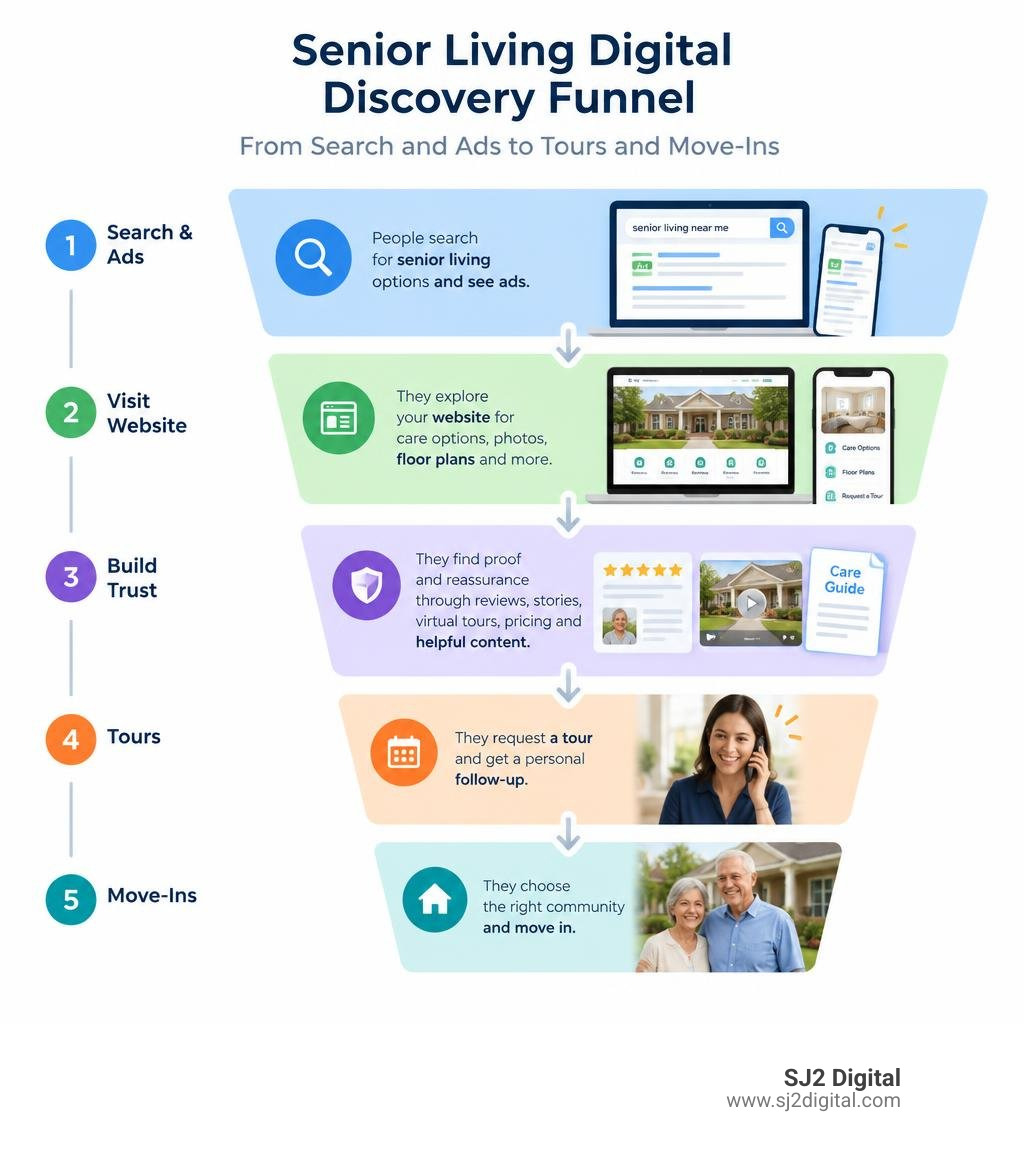
Effective digital marketing for senior living brings qualified prospects to a clear, helpful website, then gives them the proof and follow-up they need to act. Start with these priorities:
- Make your website easy to use on mobile, with clear care options, photos, floor plans, and tour requests.
- Use local SEO and Google Ads to reach families searching for a specific level of care in your market.
- Build trust with reviews, staff and resident stories, virtual tours, pricing guidance, and useful educational content.
- Nurture every inquiry with prompt, personal calls and email follow-ups based on what the prospect viewed or requested.
For many communities, the website is now the first visit. Seniors and adult children research care options online, compare reviews, explore photos, and ask detailed questions before they ever schedule a tour. Google matters especially here: 87% of consumers use it to evaluate local businesses, and 76% regularly read online reviews.
That does not mean direct mail, radio, or local events are obsolete. The strongest approach connects them to digital action. A mailer can include a QR code for a virtual tour. A radio spot can promote a local care guide. Every channel should lead to a useful next step that can be measured.
The goal is not more leads at any cost. It is to help families find the right care, earn their confidence, and show a transparent return on marketing spend.
Understanding the Modern Senior Living Audience and Decision Journey
The senior housing market is undergoing a seismic generational shift. As Baby Boomers enter their retirement and assisted-care years, the dynamics of discovery and conversion look vastly different than they did a decade ago. Over the next two decades, demographic studies project that solo senior households will double from 6% in 2018 to 12% in 2038. This surge in independent aging means more individuals are planning their own transitions, while adult children continue to serve as the primary research engine during acute care moments.
Families searching for senior housing are rarely casually browsing. They are navigating an emotionally charged, high-stakes decision triggered by a sudden health event, progressive memory loss, or mounting caregiver fatigue. When someone opens a search browser at 11:00 PM, they want clarity, reassurance, and validation that a community can address their unique situation.
Demographics, Solo Agers, and the Adult Child Persona
Understanding who actually makes the call requires evaluating the resident population alongside the digital searcher. Across the 800,000+ individuals living in assisted living communities throughout the United States, roughly 70% are women. More than half are aged 85 and older, while 31% fall within the 75-to-84 age bracket. Given that roughly 40% of residents live with Alzheimer's or other forms of dementia, the decision-maker is very frequently an adult daughter or son acting under significant time pressure.
These dual audiences demand distinct messaging strategies. Solo agers seek autonomy, vibrant social programming, and maintenance-free independence. Adult children, conversely, look for clinical competency, safety protocols, responsive staff, and transparent care levels. Generic advertising that treats these two profiles as identical wastes marketing dollars and fails to build necessary trust.
Implementing Digital Marketing Senior Living Strategies Across Channels
Modern families do not move in a straight line from seeing an ad to scheduling a move-in. Effective lead generation requires an integrated mix across both digital and physical touchpoints. When communities invest in senior living marketing services, our focus is on building cohesive journeys where offline collateral directly feeds digital conversion points.

For example, high-performing operators pair localized print direct mailers with dedicated QR codes that take prospects straight to an interactive floor plan or video tour. Streaming audio and local radio campaigns build local awareness while directing listeners to search for specific community names. By tracking every touchpoint inside centralized conversion dashboards, operators eliminate guesswork and allocate budgets toward the channels delivering confirmed move-ins.
Core Pillars of Digital Marketing Senior Living Campaigns
High-intent customer acquisition for senior care rests on three core operational pillars: a website designed as modern curb appeal, localized organic visibility, and hyper-targeted paid advertising.

Optimizing the Website as the New Digital Curb Appeal
A community's website is no longer just an online brochure; it is the virtual front door. Industry data reveals that around 80% of lead generation for major providers now originates directly through their web properties. If your site is difficult to navigate on a smartphone, hides floor plans behind contact walls, or obscures pricing models, families simply click away to a competitor.
Modern website curb appeal requires:
- True Mobile Responsiveness: Adult children research during lunch breaks and doctor visits; fast, seamless mobile navigation is essential.
- Frictionless Floor Plans and Video Walkthroughs: Highlighting actual layouts reduces hesitation before tour requests.
- Pricing and Financial Guides: Educational resources addressing financial planning, Medicaid waivers, or level-of-care costs keep prospects engaged longer.
- Authentic Visuals Over Generic Stock: Replacing generic stock photos with genuine photos of residents and care teams builds immediate authenticity.
Local Search Visibility and Senior Living SEO Tactics
Because senior living choices are deeply geographic, achieving top rankings on Google's Map Pack and local search results is paramount. When families search for terms like "memory care near me" or "assisted living in [City]," your community must appear with verified credentials and strong social proof.
Through targeted senior living SEO, communities optimize their Google Business Profiles, maintain consistent name-address-phone (NAP) citations across healthcare directories, and target high-intent, localized keywords. Actively gathering and responding to positive resident and family reviews directly reinforces local search ranking algorithms while satisfying the 76% of consumers who consistently read reviews before contacting a business.
Paid Search, Programmatic Display, and High-Converting Ad Copy
Paid search connects your facility with families experiencing immediate care needs. Major senior housing brands have seen Google Ads drive up to a 600% increase in inbound phone inquiries when campaigns move away from generic messaging and focus on care-level specificity.

Recent ad spend analyses highlight the massive performance gap between specific ad copy and generic placeholders. Ad copy that addresses the family's exact question dramatically lowers customer acquisition costs while boosting qualified engagement.
According to data from seven years of community campaigns and over $2M in ad spend, headlines focused on specific care levels outperform generic or automated headlines by three to four times in click-through rate (CTR).
| Ad Headline Variation | Click-Through Rate (CTR) | Conversion Rate | Performance Takeaway |
|---|---|---|---|
| "Right Level of Care & Support" | 32.3% | 72.0% | Mirrors the family's core internal question; sub-$1 CPC. |
| "Enhanced Personal Care / Assisted Living" | 33.2% | High | Clear, care-level specificity removes ambiguity immediately. |
| "Personalized Care & Support" | 29.5% | 72.8% | Reassures families seeking individualized attention. |
| "Schedule A Community Tour" | 24.9% | 77.9% | Direct call-to-action for high-intent late-stage searchers. |
| "Senior Care Community" (Generic/AI) | 8.2% | Moderate | Too broad; fails to resonate with specific search intent. |
| "Relax and Recharge" (Vague Lifestyle) | 4.4% | Low | Completely disconnected from urgent health and care needs. |
Pairing senior living pay per click with programmatic advertising allows operators to retarget non-converting visitors with lifestyle imagery and cultural proof across display networks, keeping the community top-of-mind throughout a multi-month decision cycle.
Multi-Touch Lead Nurturing: Social Media, Video, and Automation
Generating an initial web inquiry is only the first step. The typical senior care decision spans weeks or months, demanding continuous nurturing that educates families without overwhelming them.
Storytelling via Social Media and Trust-Building Content
Social channels offer a window into daily life inside a community. Rather than broadcasting static sales pitches, effective providers leverage senior living social marketing to highlight caregiver milestones, resident birthdays, dining experiences, and specialized wellness activities.
Publishing quarterly trust pieces—such as caregiver spotlights, dementia communication guides, and educational webinars—positions your community as an honest broker of information rather than just another sales organization.
Email Drip Automations and Lead Acceleration
When a prospect downloads a brochure or floor plan, their stage in the buying cycle dictates the follow-up strategy. Using automated email automations, sales teams can deliver targeted, value-driven messages that address common hesitations:
- Immediate Delivery (Day 0): Send the requested digital brochure, floor plans, and a direct link to book a virtual or in-person tour.
- Educational Support (Day 3): Provide a checklist on how to evaluate assisted living vs. memory care communities.
- Financial Transparency (Day 7): Share a practical guide explaining long-term care insurance, veterans' benefits, and bridge financing.
- Social Proof (Day 14): Deliver a video interview featuring a current resident and their family discussing their move-in transition.
To see how automated workflows transform occupancy rates, review our senior living growth case study.
Overcoming Hurdles in Digital Marketing Senior Living Execution
Implementing digital marketing senior living strategies successfully requires closing the gap between marketing lead generation and on-site sales execution. Sales directors are frequently occupied with resident care and community tours, meaning incoming web inquiries can sit unanswered for hours.
To solve this, operators are embracing modern tools such as AI meeting notetakers for virtual consultations and unified CRM integrations that immediately notify sales teams via SMS when high-intent leads submit a form. For more operational insights on balancing efficiency with hands-on care, explore our senior living blog.
Frequently Asked Questions About Digital Marketing for Senior Living
How do senior living operators balance traditional and digital marketing?
Top-performing operators use traditional channels like print mailers, local sponsorships, and radio to drive traffic toward measurable digital assets. By embedding dedicated landing page URLs, tracking phone numbers, and QR codes into print materials, communities can measure exact return on ad spend across every market demographic.
What headlines and ad copy drive the highest conversion rates for care communities?
Data shows that care-specific headlines such as "Right Level of Care & Support" (32.3% CTR) and "Enhanced Personal Care / Assisted Living" (33.2% CTR) dramatically outperform vague headlines like "Relax and Recharge" (4.4% CTR). Searchers respond best to copy that directly answers their care questions and provides clear pricing and layout proof.
How can communities integrate AI and virtual tools without losing human empathy?
AI tools should handle administrative friction—such as automating tour reminders, transcribing discovery calls, and routing leads—leaving admissions teams with more time for genuine, empathetic conversations. Virtual 360-degree tours and video calls should serve as helpful initial touchpoints that build confidence before an in-person visit.
Conclusion
Succeeding in senior living customer acquisition requires moving away from outdated, one-size-fits-all advertising models. Families demand care specificity, visual transparency, authentic storytelling, and frictionless digital experiences. By integrating local SEO, data-backed paid search campaigns, responsive website design, and automated nurturing, operators can build consistent occupancy pipelines.
At SJ2 Digital, we operate on an anti-agency model with no long-term contracts, fully transparent live reporting dashboards, and senior-level marketing experts dedicated to your growth. Discover how our team can scale your community's occupancy by exploring our proven senior living social marketing and digital strategies.