
What Is Geofencing Digital Advertising and How Does It Work?
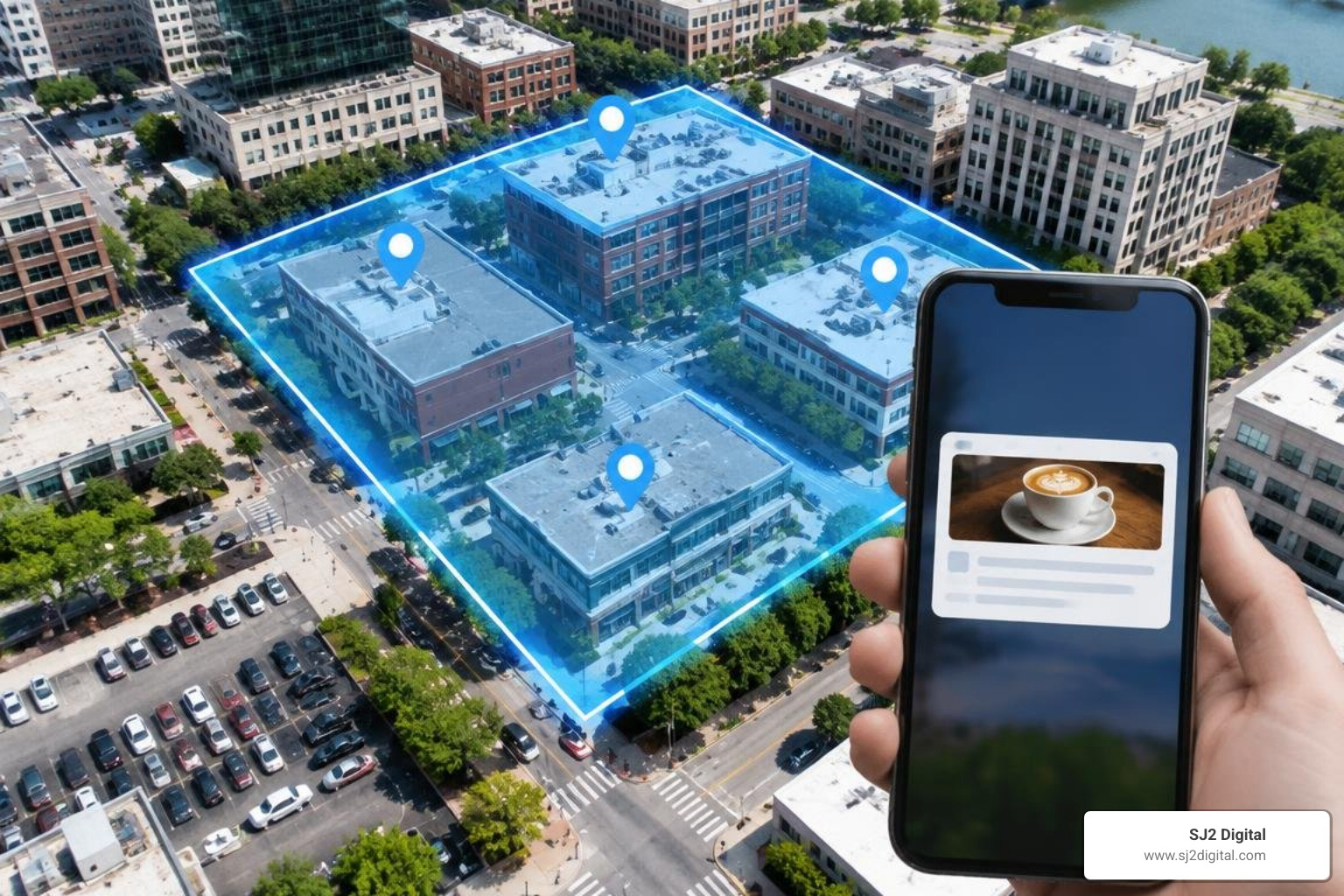
Geofencing establishes a virtual perimeter around a real-world location using geographic coordinates. When a consumer carrying a GPS-enabled smartphone crosses that virtual line, the event can trigger targeted programmatic display ads, video spots, or in-app alerts on their device.
Think of it as drawing an invisible digital fence around a building, a neighborhood, or an entire event complex.
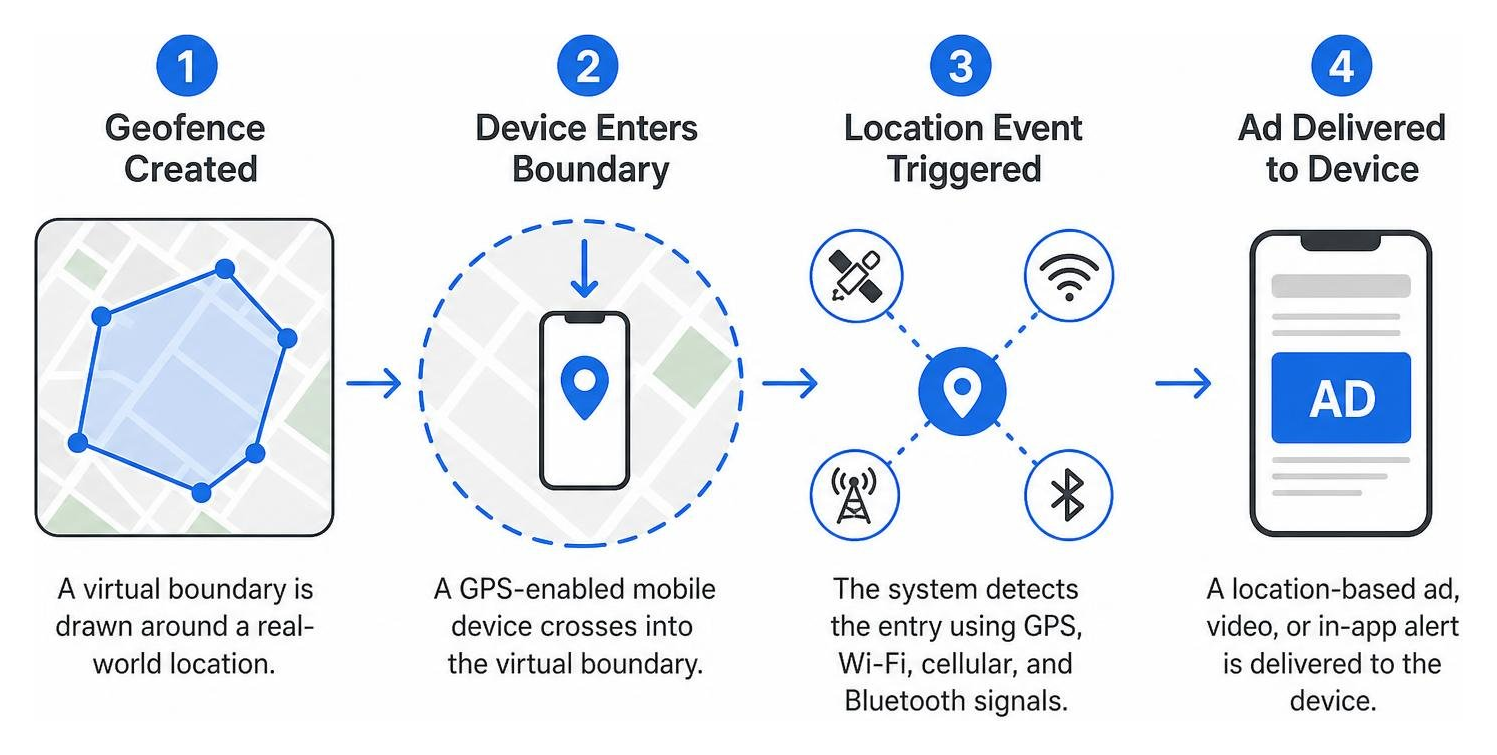
The technology relies on multiple location data signals, including satellite GPS, Wi-Fi network handshakes, cellular tower triangulation, and short-range Bluetooth beacons. Unlike basic zip-code targeting that blankets an entire postal region, geofencing lets advertisers choose between simple circular radii and custom polygon shapes tailored to specific property boundaries.
| Feature / Tactic | Radius Geofencing | Polygon Geofencing | Standard Geotargeting |
|---|---|---|---|
| Target Boundary | Circular perimeter (e.g., 500m to 2 miles) | Custom multi-point shape drawn to parcel lines | Broad regional area (DMA, city, or postal code) |
| Precision Level | Moderate (may capture adjacent roadways) | Ultra-high (fits exact building or parking footprint) | Low to Moderate (broad regional reach) |
| Hardware Required | None (uses device location services) | None (uses device location services) | None (uses IP and platform signals) |
| Primary Use Case | Local storefront awareness, travel corridors | Trade shows, competitor conquesting, campuses | Broad regional branding, market-wide reach |
| Setup Complexity | Simple (enter central point and distance) | Advanced (requires boundary mapping) | Low (select pre-set geographic lists) |
Core Technologies Powering Geofencing Digital Advertising
The engine behind modern location-based campaigns is real-time location data processed through programmatic ad exchanges. Studies show that when users are not actively browsing the web, they spend roughly 86% of their mobile smartphone time inside apps. Furthermore, around 90% of smartphone owners keep location services active for navigation, weather updates, and delivery apps.
When an app requests an ad fill via a real-time bidding exchange, it passes latitude and longitude coordinates. Programmatic Demand-Side Platforms (DSPs) evaluate these coordinates against active campaign fences in milliseconds. If the device falls within the boundary, the ad serves across mobile apps or mobile web inventory.
Advertisers using search networks should consult the platform documentation for targeting ads to geographic locations to understand how platforms evaluate user presence versus general search intent.
Geofencing vs. Geotargeting vs. Beacon Technology
Marketers often use location terminology interchangeably, but distinct functional differences exist:
- Geotargeting delivers content across broad geographical boundaries such as cities, designated market areas (DMAs), or zip codes. It often incorporates demographic and interest filters but lacks physical pinpoint precision.
- Geofencing uses virtual boundaries around specific buildings, lots, or street corridors, capturing devices the moment they cross the perimeter or storing their device identifiers for retargeting over a 1 to 30-day window.
- Beacon Technology uses physical hardware units installed on walls or shelves that communicate with smartphones via Bluetooth Low Energy (BLE). While beacons offer hyper-accurate indoor positioning down to individual aisles, they require physical hardware installation and compatible apps installed on the user's device.
- Addressable Geofencing maps digital boundaries directly against property tax plat lines, matching physical mailing addresses to digital households without requiring physical hardware.
High-Impact Strategies for Hyper-Local Dominance
Running location-based ads without a clear tactical framework often leads to wasted ad spend. When applied strategically, geofencing bridges real-world consumer behavior with digital touchpoints.
A comprehensive local approach works best when integrated with tailored programmatic advertising for senior living and healthcare operators who need to reach adult children, healthcare professionals, and local community influencers across multiple screens.
Competitive Conquesting and Trade-Area Interception
Competitive conquesting involves drawing precise polygon boundaries around rival service providers, retail showrooms, or related facilities. When prospective buyers visit a competitor's location, their device enters an audience pool that receives customized ads highlighting your unique value proposition, special incentives, or superior services.
Research shows this approach directly shifts consumer intent. In quick-service dining, major brands have generated an 8.8% lift in foot traffic by capturing competitor visitors, while consumer packaged goods brands have achieved an 18% lift in purchase intent by triggering proximity campaigns during major events.
Interception strategies do not have to be aggressive. Instead of attacking a competitor, provide a helpful alternative offer while the user is actively evaluating options in your category.
Addressable Geofencing for Precision Household Targeting
Traditional IP targeting often suffers from inaccuracy due to dynamic IP assignments from internet service providers. Addressable geofencing solves this problem by using property plat line data to trace the exact physical boundaries of individual home lots and business addresses.

This method yields up to a 90% match rate when onboarding customer lists or direct-mail databases. Marketers can target lists ranging from 1,000 to over 1,000,000 distinct addresses. Once a household is mapped, campaigns serve ads across mobile devices, desktop browsers, and Connected TV (CTV) units tied to the household network, reinforcing offline direct mail initiatives with synchronized digital impressions.
Step-by-Step Implementation of Location-Based Campaigns
Executing a successful campaign requires structured planning, precise configuration, and strict frequency controls.

To explore step-by-step technical workflows, review our detailed guide on implementing geo-fenced advertising campaigns to ensure your account settings prevent budget leakage.
Configuring Custom Boundaries and Location Parameters
Follow these steps to establish your campaign parameters:
- Select the Right Boundary Model: Use radius targeting (500 meters to 2 kilometers) for general corridor visibility, or draw custom polygon shapes around building parcel lines to exclude nearby highways and unrelated businesses.
- Adjust Presence Targeting Settings: Always select "Presence: People in or regularly in your targeted locations" rather than "Presence or Interest." This setting prevents ads from serving to users who are physically hundreds of miles away simply searching for local news.
- Layer Device Filters: Prioritize mobile smartphone devices for real-time venue geofences. Deselect desktop and tablet placements if your goal is immediate foot-traffic interception.
- Apply Dayparting Schedules: Run ads when your sales team, leasing office, or retail storefront is open and ready to field incoming inquiries.
- Establish Frequency Caps: Limit ad delivery to 2 to 3 impressions per user per day. This prevents ad fatigue while maintaining sufficient brand recall.
Creative Asset Strategy and Hyper-Local Messaging
Generic banner creative underperforms in localized campaigns. Hyper-local advertising requires relevant ad copy that acknowledges the user's immediate context.
- Reference recognizable local landmarks, neighborhoods, or cross streets (e.g., "Convenient Care Right Off Main Street").
- Include a clear, time-sensitive call-to-action (CTA) such as "Schedule a Tour Today," "Claim Your Free Consultation," or "Explore Care Options."
- Design mobile-first formats (300x250, 320x50, 300x600, and 9:16 vertical video) using readable typography, clear contrast, and minimal body copy.
- Pair your display initiatives with complementary channels, using senior living social marketing to maintain retargeting sequences across major social platforms once a user leaves the geofenced area.
Measuring ROI, Foot-Traffic Attribution, and Compliance
Location-based campaigns must demonstrate clear business value beyond impressions and click-through rates. Marketers can now track digital ad exposure directly to real-world store visits.
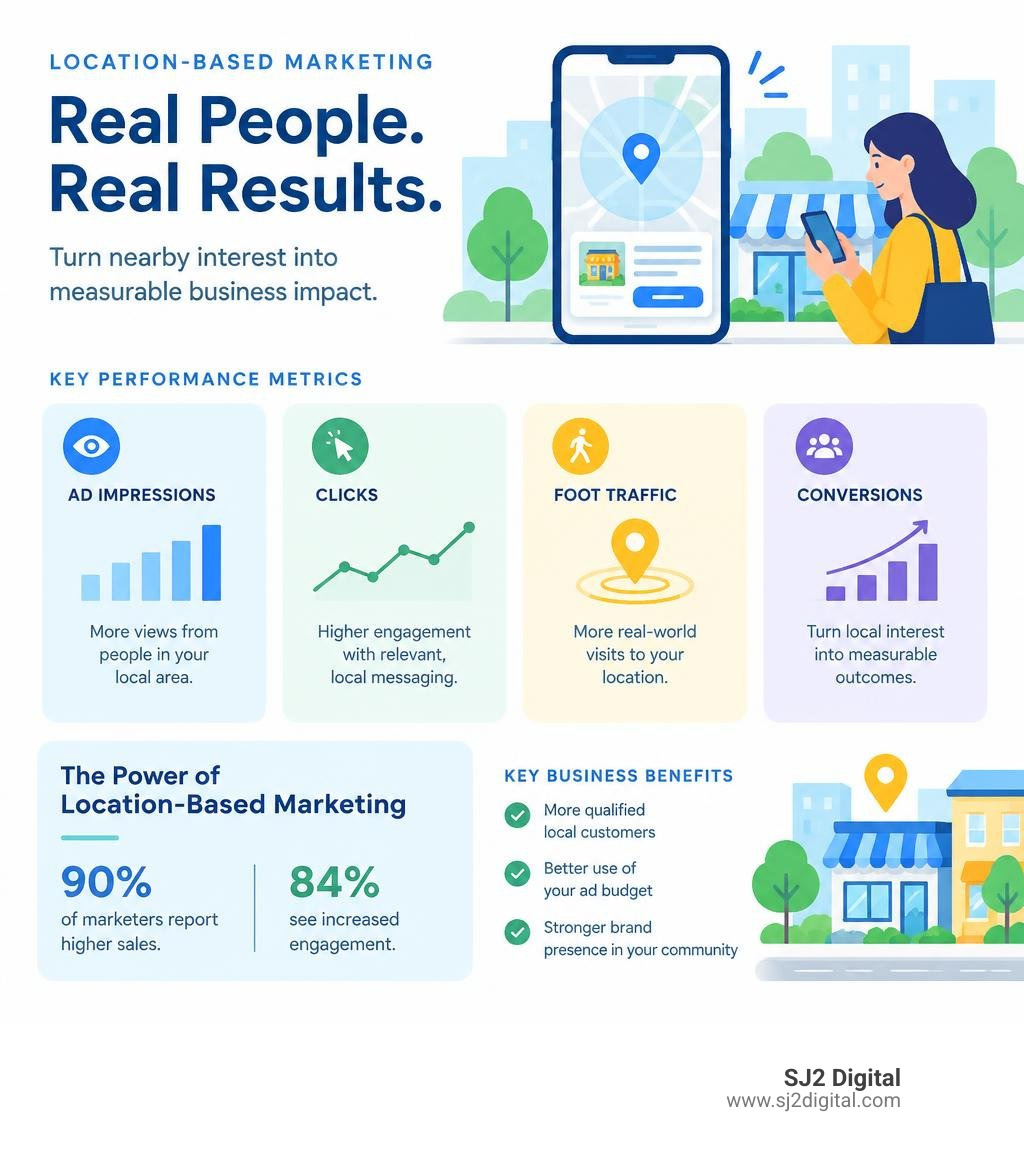
Industry studies show that 90% of marketers report higher sales and 84% see increased engagement when utilizing location-based marketing tactics.
Key Business Benefits of Geofencing Digital Advertising
- Elimination of Geographic Waste: Every dollar is concentrated within defined trade areas where your target audience lives, works, or shops.
- Cross-Channel Amplification: Geofencing data feeds into broader search strategies. Combining location display ads with high-intent senior living pay per click captures users across both passive discovery and active evaluation phases.
- Enhanced Data Insights: Location analytics provide aggregated data regarding peak visitation days, average dwell times, and common cross-shopping patterns across your market.
Tracking In-Store Visits with Conversion Zones
A conversion zone is a virtual boundary drawn around your own business location, sales office, or community center.
When a user who was served an ad within a target geofence later walks into your conversion zone, the platform records a physical visit attribution.
To maintain measurement accuracy:
- Set dwell-time minimums (e.g., 5 to 10 minutes) so drive-by traffic and delivery drivers are excluded from conversion counts.
- Compare foot traffic against an unexposed control group to calculate true incremental lift.
- Calculate Cost Per Visit (CPV) by dividing total campaign spend by verified conversion zone visits to evaluate offline return on investment (ROAS).
Privacy Frameworks and Compliance
Location advertising must prioritize consumer privacy and regulatory compliance. Campaigns operate using aggregated, anonymized Mobile Advertising IDs (MAIDs) rather than personally identifiable information (PII).
Platforms comply with CCPA, GDPR, and state-level consumer privacy laws by requiring user consent for location services at the operating system and app levels. Advertisers should avoid drawing geofences around sensitive health facilities, religious centers, or elementary schools to maintain ethical and regulatory standards.
Frequently Asked Questions About Geofencing Digital Advertising
What is the ideal radius size for an effective geofence?
For dense urban areas, a radius of 500 meters to 1 kilometer (or a tight polygon boundary around a single facility) provides high relevance while capturing sufficient device density. In suburban or rural areas with lower foot traffic, expand the target radius to 2 to 5 miles (or roughly a 5 to 10-minute drive time) to ensure the programmatic exchange has enough impression volume to deliver your daily budget efficiently.
How does geofencing handle user data privacy and tracking permissions?
Geofencing relies on anonymized signals transmitted via mobile apps where users have opted in to share location data. Modern ad exchanges do not track personal identities; instead, they associate location visits with non-personally identifiable Mobile Advertising IDs. Platforms aggregate this data to report on overall foot-traffic trends and conversion rates without exposing individual user identities.
How does addressable geofencing differ from IP address targeting?
Standard IP address targeting maps desktop and mobile users to broad network routing hubs, which frequently change and often cover multiple blocks or neighboring towns. Addressable geofencing uses county tax assessor plat line data to trace the exact physical property lines of a specific home or commercial structure, delivering up to a 90% match rate for direct-mail lists and household-specific outreach.
Conclusion: Scaling Your Brand with Hyper-Local Precision
Geofencing digital advertising provides local operators and multi-location brands with a level of geographic precision that traditional broadcast and broad digital media cannot match. By intercepting high-intent foot traffic, mapping direct-mail lists to physical properties, and measuring real-world walk-ins through conversion zones, businesses can turn location data into a scalable acquisition channel.
At SJ2 Digital, we operate on an anti-agency model designed around full transparency. We eliminate long-term lock-in contracts, provide real-time dashboard visibility, and put senior-level digital marketing experts directly on your campaigns. Whether you need to dominate local trade areas, improve inquiry velocity, or integrate multi-channel media, explore our expert programmatic advertising solutions to build your hyper-local strategy today.