
Stop Paying for Clicks From People Who Cannot Become Residents
A location based advertising agency helps you spend less on broad, low-intent traffic by showing ads to people in the areas most likely to become qualified leads. For senior living operators, that can mean targeting adult children near a community, people researching care options in a defined service area, or audiences attending relevant local events.
The right partner should help you:
- Define practical geographic zones around each community and its key referral areas.
- Layer location signals with audience, search, and behavioral data.
- Run campaigns across mobile, social, programmatic display, and digital out-of-home.
- Measure outcomes beyond clicks, including inquiries, tour requests, and visits.
- Report costs and performance clearly, without hiding results behind vague metrics.
Hyperlocal marketing uses device location signals such as GPS, Wi-Fi, and IP data to make advertising more relevant to where a person is or has been. Instead of paying to reach an entire metro area, you can focus budget on the neighborhoods, competitor locations, medical corridors, and community events that matter to your occupancy goals.
This does not mean every campaign needs a tiny geofence or costly in-store beacon setup. Strong location campaigns balance precision with enough reach to generate meaningful results - then connect location targeting to transparent attribution and lead quality.
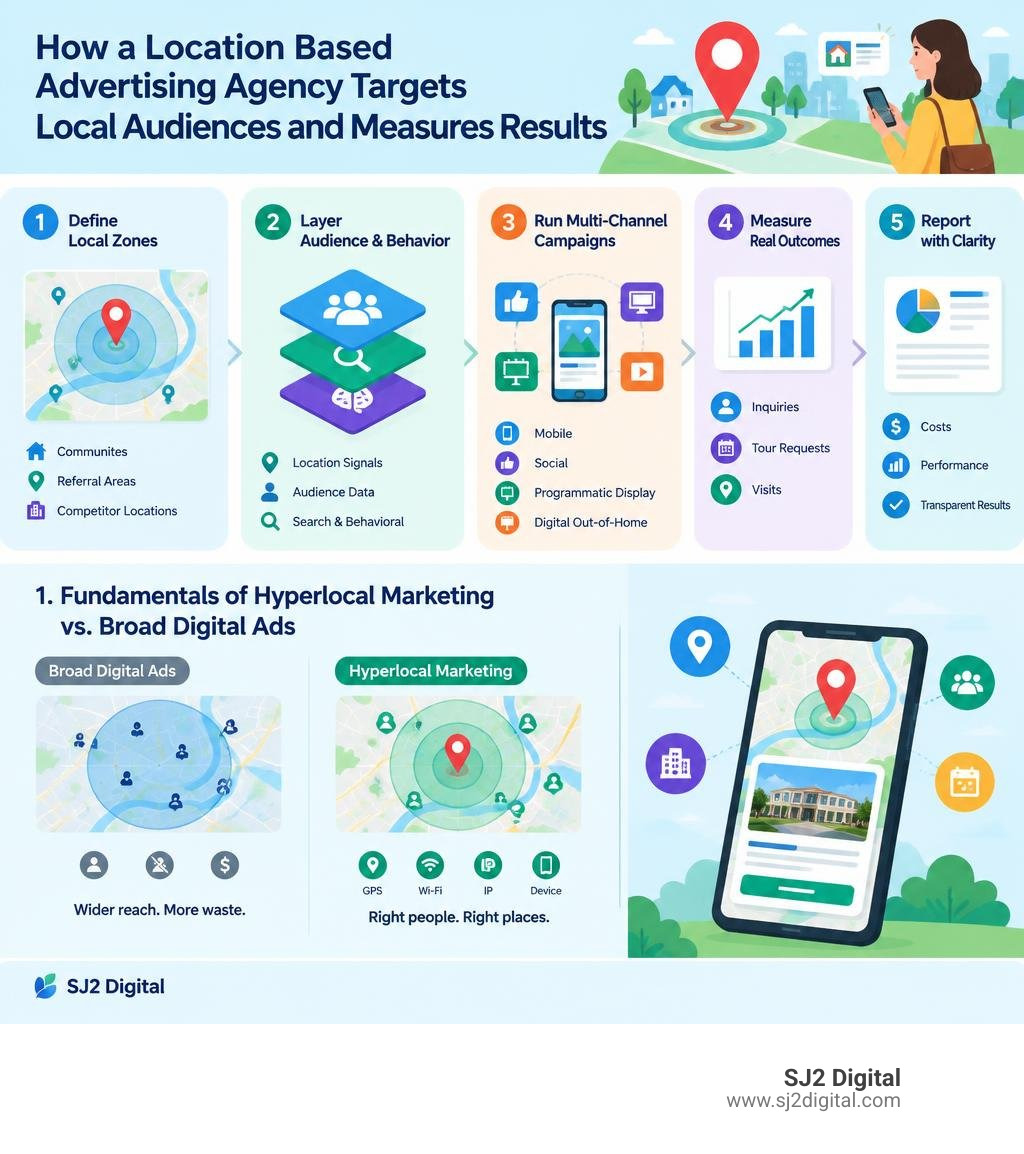
1. Fundamentals of Hyperlocal Marketing vs. Broad Digital Ads
Standard digital advertising casts a wide net across expansive designated market areas (DMAs) or metro boundaries. While broad reach creates basic brand awareness, it often wastes ad spend by delivering impressions to users who are physically unable or unwilling to visit your facility.
Hyperlocal marketing solves this issue by leveraging latitude-longitude coordinates, GPS signals, connected Wi-Fi networks, and localized IP addresses to deliver targeted messages in real time.
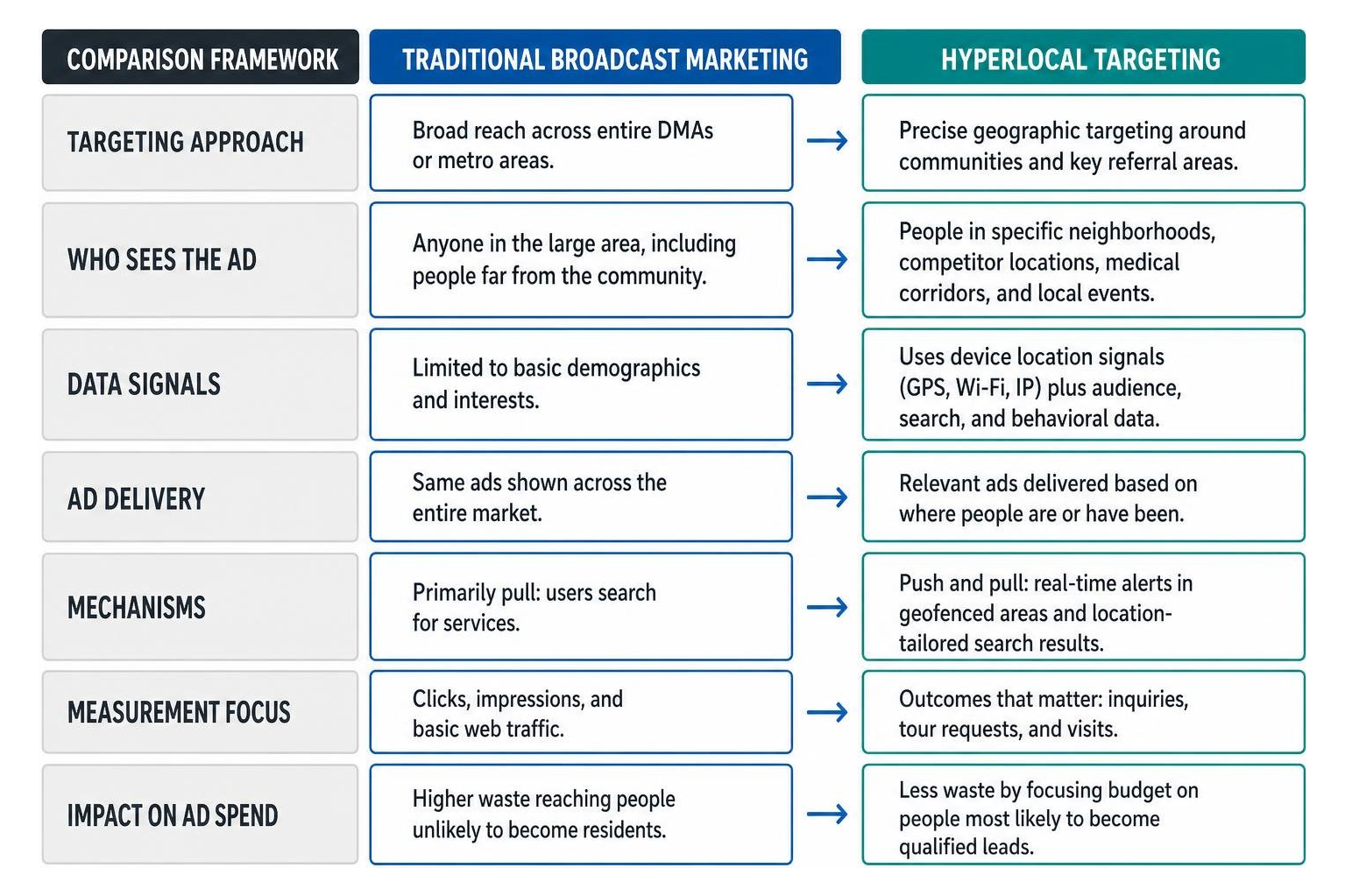
Location-based advertising operates primarily through two mechanisms:
- Push Advertising: Proactively serves contextual alerts, notifications, and mobile banner ads when a user enters a specific geographic perimeter. The push segment commands roughly 60% of the location-based advertising market share because it drives real-time engagement.
- Pull Advertising: Delivers dynamic, location-tailored search results or map listings when a user actively looks for nearby services.
| Targeting Dimension | Traditional Mass Digital Advertising | Hyperlocal Location-Based Targeting |
|---|---|---|
| Geographic Scope | Broad city, state, or entire DMA | Precise street-level radius, zip code, or custom virtual polygon |
| Data Inputs | General IP addresses, self-reported user profiles | Real-time GPS, validated Wi-Fi, cellular triangulation, and IP |
| Ad Delivery Timing | Scheduled display or generalized search bids | Contextual triggers based on proximity, dwell time, and live foot traffic |
| Budget Efficiency | High ad waste from clicks outside primary service areas | Concentrated spend on qualified local prospects |
| Primary Attribution | Virtual impressions, basic click-through rates (CTR) | Verified physical store visits, tour bookings, and localized phone inquiries |
Precision Geotargeting, Geofencing, and Proximity Beaconing
Modern location technology allows marketing teams to tailor perimeters based on distinct business objectives:
- Geotargeting: Directs ad content to consumers based on predefined geographic criteria such as postal codes, designated neighborhoods, or demographic clusters. It works well for broader regional awareness.
- Geofencing: Uses GPS and cellular data to draw virtual polygon boundaries around specific real-world buildings, commercial districts, or street blocks. Advanced tools like Geofencing & Real-Time Location Targeting | FSQ Proximity validate device coordinates against these custom boundaries to serve immediate mobile creative.
- Proximity Beaconing & Indoor Positioning: Deploys physical Bluetooth Low Energy (BLE) transmitters or hardware-free sensor frameworks within indoor environments. Modern solutions from Location Based Marketing - Geolocation Marketing Solutions for Various Industries | Mapsted achieve 1-to-5-meter positioning accuracy without requiring external beacons, allowing multi-floor facilities to guide visitors contextually.
Competitor Geo-Conquesting and Event-Based Targeting
Location-based strategies allow you to reach prospects outside your own front door.
- Competitor Geo-Conquesting: Involves drawing custom virtual boundaries around rival facilities, regional competitors, or alternative care centers. When a prospective family visits a competing location, mobile targeting platforms deliver relevant ads highlighting your unique amenities, pricing, or availability.
- Event-Based Targeting: Captures high-intent foot traffic at temporary gatherings such as health expos, local festivals, and medical conferences. Automated platforms like Geofencing Advertising | Location-Based Mobile Ads | Groxio allow agencies to activate precise event geofences during peak hours.
- Addressable Retargeting: Maps physical property boundaries and residential addresses to digital device graphs. This lets you retarget family decision-makers across mobile apps and connected TV after they return home from a physical visit.
2. Key Industries Leveraging Location-Based Strategies for Maximum ROI
The global location-based advertising market was valued at USD 81.7 billion in 2022 and is projected to expand at a 14% compound annual growth rate through 2032, reaching USD 303.8 billion. North America represents over 30% of this market, driven by high smartphone adoption and local search intent.
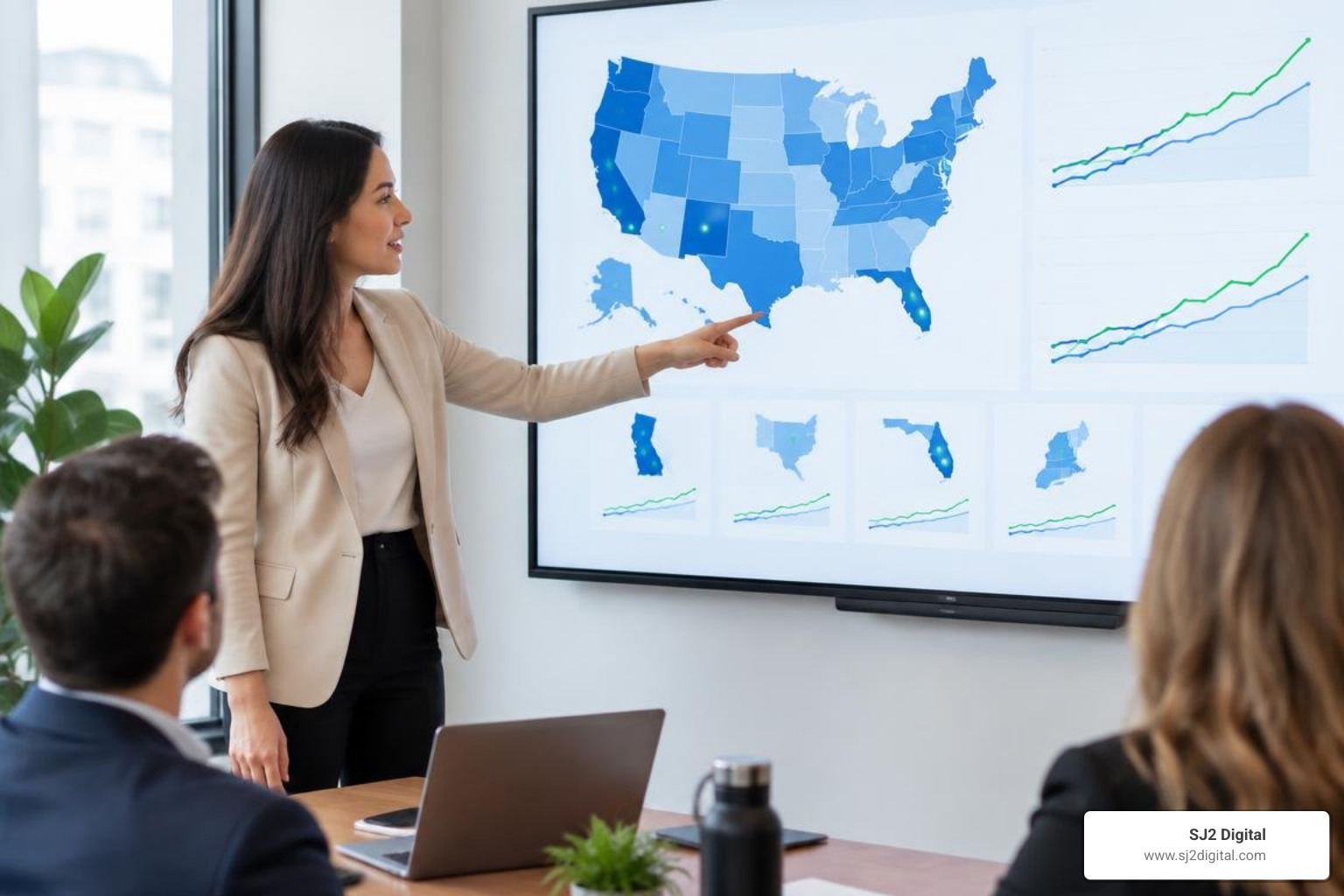
Industries achieving high performance from location-targeted campaigns include:
- Quick-Service Restaurants (QSR): Jack in the Box achieved an 8.8% lift in foot traffic by integrating real-time proximity audiences into dynamic digital campaigns.
- Sports & Entertainment: Anheuser-Busch InBev drove an 18% lift in purchase intent by utilizing real-time geofencing around NFL stadiums to connect directly with attending fans.
- Healthcare & Specialized Clinics: Urgent cares, outpatient centers, and physical therapists use precise radius targeting (500 meters to 3 miles) to reach nearby residents during active treatment windows.
- Automotive Dealerships: Dealerships capture active buyers on competing lots, serving comparison trade-in offers that direct showroom traffic back to their inventory.
Driving High-Intent Inquiries in Specialized and Local Verticals
Specialized verticals rely heavily on defined catchment zones. For community-centered organizations, prospective clients rarely travel beyond a 15-to-20-minute drive from their familiar neighborhoods.
Maximizing qualified local inquiries requires aligning location targeting with your broader digital presence:
- Targeted Local SEO: Ensuring regional pages capture high-intent queries is foundational; our Senior Living SEO strategies optimize local search visibility so communities dominate nearby map pack results.
- Comprehensive Service Integration: Combining real-time geofencing with our Senior Living Marketing Services ensures every touchpoint—from local brand discovery to in-person tour bookings—is optimized for conversion.
3. Why Partnering with a Location Based Advertising Agency Maximizes Ad Spend
Operating location campaigns in-house presents technical challenges, including bid waste, fragmented ad buying platforms, and strict regulatory standards. A specialized agency provides the technical infrastructure, demand-side platform (DSP) access, and data validation necessary to execute profitable campaigns.
Core Services Provided by a Location Based Advertising Agency
An experienced agency helps eliminate trial-and-error by deploying proven multi-channel workflows:
- Programmatic DSP Media Buying: Agencies purchase ad inventory programmatically across mobile exchanges, using real-time bidding algorithms to target users within specific geofences.
- Paid Search Alignment: High-intent search campaigns must align with geographic boundaries; our approach to Senior Living Pay Per Click focuses budget on qualified zip codes to prevent wasted spend.
- Dynamic Creative Optimization (DCO): Dynamic creative templates automatically update visual ads and copy based on the viewer's current neighborhood, distance to the community, or local weather conditions.
- Lead Nurturing & Email Integration: When local prospects submit an inquiry, responsive workflows like our Email Automations immediately nurture families with personalized tour reminders and local community guides.
Cross-Channel Omnichannel Integration and Attribution
Modern consumers interact with multiple digital channels before making high-consideration decisions. Location-based advertising agencies unify these channels into an integrated ecosystem:
- Social Media Precision: With Facebook hosting over 3 billion monthly active users, Instagram reaching 2 billion, and nearly 80% of social media users engaging on mobile apps with location services enabled, we pair location data with interest signals using our Senior Living Social Marketing campaigns.
- Digital Out-of-Home (DOOH): Programmatic outdoor billboards along commuter corridors dynamically sync with mobile geofencing to reinforce messaging across physical and digital environments.
- Data Privacy & Regulatory Compliance: Professional agencies implement privacy-forward frameworks compliant with GDPR, CCPA, and regional advertising standards. By using anonymized device signals, aggregated cohort data, and verified opt-in permissions, agencies safeguard brand reputation while maintaining precision.
4. How to Evaluate Costs, Platforms, and Performance
Evaluating location-based advertising performance requires looking beyond top-of-funnel clicks to measure cost per physical visit, dwell time, and downstream lead quality. Research shows that 35% to 50% of users exposed to geofenced ads visit the target physical location within 7 days, and retargeting these visitors increases repeat visits by 40%.
| Pricing Model | Typical Cost Structure | Best Use Case | Performance Metric to Watch |
|---|---|---|---|
| Cost-Per-Thousand (CPM) | $3.50 – $9.50 CPM | Broad local awareness, DOOH, and display | Effective reach, frequency capping, viewability rate |
| Cost-Per-Click (CPC) | $1.50 – $4.50 CPC | Local paid search and high-intent social ads | CTR, landing page conversion rate, bounce rate |
| Cost-Per-Visit (CPV) | $8.00 – $25.00 CPV | Retail foot traffic and showroom promotions | 7-day conversion window, physical dwell time |
| Monthly Retainer | Variable tiered pricing | Ongoing agency strategy, DSP management, and optimization | Total cost per acquisition (CPA), pipeline ROI |
Reviewing verified performance data in our Case Study shows how pairing programmatic location buying with transparent conversion tracking consistently lowers cost-per-lead for multi-location operators.
How to Vet and Choose the Right Location Based Advertising Agency
When evaluating potential agency partners, avoid firms that obscure campaign data behind rigid markups and long-term contracts.
Look for these essential operational criteria:
- No Long-Term Contracts: Flexible, performance-driven agreements reflect an agency's confidence in delivering ongoing results.
- Transparent Live Dashboards: You should always have direct access to raw impression data, click metrics, foot traffic attribution, and actual platform spend.
- Hands-On Senior Strategists: Ensure your campaigns are built and managed by experienced senior media buyers rather than delegated to entry-level coordinators.
- Direct Audience Ownership: All custom geofence lists, historical visitor data, and CRM audiences developed during your campaigns should remain your intellectual property.
Frequently Asked Questions About Location-Based Advertising
What is the ideal radius for a geofencing ad campaign?
The most effective radius for local service campaigns ranges between 500 meters and 3 miles. In dense urban areas, a tight polygon or 500-meter boundary prevents budget waste, while suburban or rural markets benefit from expanding to 3 to 5 miles to maintain adequate impression volume. Setting exclusion zones around areas where your brand awareness is already saturated helps conserve budget for high-intent zip codes.
How do agencies track physical foot traffic without compromising user privacy?
Agencies track foot traffic using privacy-forward attribution solutions that analyze anonymized device IDs and aggregated mobile location cohorts. Devices entering a defined geofence during an active campaign are matched against historical baseline foot traffic to measure lift. No personally identifiable information (PII) is captured, stored, or shared, ensuring full compliance with state and federal data privacy standards.
What average ROI and lift can businesses expect from location campaigns?
When messaging is tailored to geographic context, location-based advertising can achieve response rates near 20%, significantly outperforming generic mobile ads. Marketers regularly report a 35% to 50% lift in physical visits within a 7-day conversion window, a 47% reduction in CPA, and a 40% increase in repeat visits through sequential audience retargeting.
Conclusion: Turn Proximity into Measurable Revenue
Broad digital campaigns that spray ad dollars across entire metropolitan areas drain marketing budgets on clicks that cannot convert. By partnering with an experienced agency, you can concentrate your budget directly on qualified local audiences, medical corridors, and nearby competitor hubs.
At SJ2 Digital, we operate on an anti-agency model. We eliminate long-term lock-in contracts, provide completely transparent live reporting dashboards, and deploy hands-on senior advertising strategists who treat your budget with care.
Ready to eliminate ad waste and capture high-intent inquiries in your local market? Explore how we Programmatic Advertising Senior Living operators reach qualified prospects, learn more About Us, or Contact our team today to build your custom hyperlocal growth plan.