
Why Generalist Marketing Agencies Often Fail at B2B PPC Lead Gen
Why Generalists Struggle: 5 Flaws in Traditional B2B Paid Search

Generalist marketing agencies often fail at B2B PPC lead generation because they optimize for vanity clicks instead of qualified pipeline, mismanage keyword intent, and lack CRM conversion feedback. Running paid search for business-to-business brands requires a completely different mindset than selling consumer gadgets or generating high-volume ecommerce clicks. Nearly 70% of B2B marketers are increasing their lead generation budgets, yet a huge portion of that capital is lost to basic execution errors. Traditional generalist agencies often treat B2B campaigns like retail ads, focusing on vanity metrics rather than real revenue.
Here are the five primary flaws that cause generalist agencies to struggle with complex B2B campaigns:
- Chasing Clicks Over Pipeline Impact: Generalists celebrate high click-through rates (CTR) and low cost-per-click (CPC), ignoring whether those clicks ever turn into sales-qualified opportunities.
- Over-Reliance on Broad Match Keywords: Unmanaged broad matching pulls in informational searchers, students doing research, and job seekers rather than decision-makers with purchasing authority.
- Neglecting Negative Keyword Lists: A high-performing lead generation campaign requires tens of thousands of negative keywords to filter out irrelevant queries, consumer intent, and low-budget searchers.
- Failing to Align with Long Buyer Journeys: B2B purchases take weeks or months. Generalists often run single-touch campaigns that abandon prospects after the first interaction instead of nurturing them through multi-stage retargeting.
- Ignoring Conversion Quality and CRM Feedback: Without integrating conversion data with client CRM systems, generalist teams optimize for cheap form fills—often spam or unqualified inquiries—rather than closed-won deals.
When evaluating potential growth partners, understanding how specialized execution differs from standard agency habits is critical:
| Strategy Dimension | Generalist Agency Approach | Specialized Lead Gen Approach |
|---|---|---|
| Primary Metric | Impressions, clicks, and generic form submissions | Qualified sales pipeline, booked appointments, and pipeline revenue |
| Keyword Strategy | Broad terms focused on aggregate search volume | High-intent search terms combined with exhaustive negative keyword lists |
| Landing Pages | Generic website pages or unoptimized templates | Custom conversion-focused pages with strict qualifying form fields |
| Data Integration | Google Analytics surface-level goal tracking | Bi-directional CRM integration tracking full-funnel sales velocity |
| Account Ownership | Locked proprietary setups and closed reporting | Direct client account ownership and transparent live dashboards |
Working with a dedicated performance marketing agency ensures your media budget is actively guarded against low-quality traffic, directing every dollar toward measurable pipeline growth. For broader context on how paid search fits into demand generation, see Pay-per-click.
What Sets a Dedicated PPC Lead Generation Agency Apart From Traditional Firms?
A dedicated lead generation partner operates with an outcome-first mindset. Rather than simply managing bids inside Google Ads or Meta Ads Manager, specialists analyze the entire path a buyer takes—from the initial search query down to the signed contract.
Outcome Accountability: Qualified Leads vs. Empty Clicks
Traditional agencies frequently hide behind activity metrics. They deliver monthly reports showing hundreds of clicks, yet your sales team sits with empty calendars.
A dedicated lead partner focuses on lead qualification criteria established before launching a single campaign. By leveraging intent data, firmographic filtering, and strict conversion definitions, campaigns are continuously tuned to target prospects with the budget, authority, and need to purchase your services.
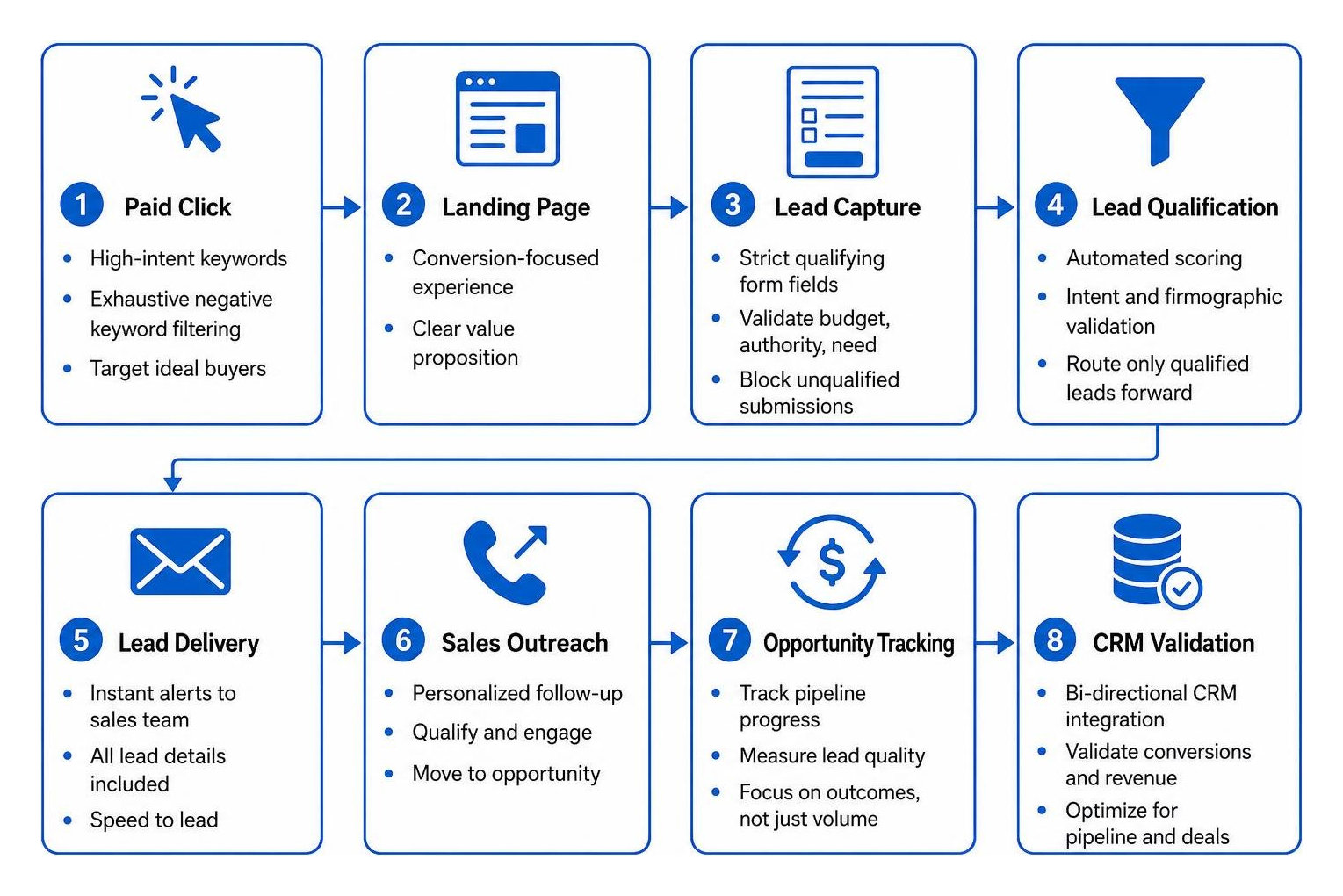
Core Services Offered by a Dedicated PPC Lead Generation Agency
Top-tier lead generation partners do far more than toggle keyword bids. To achieve meaningful reductions in cost per acquisition, they provide comprehensive conversion infrastructure:
- Landing Page Conversion Rate Optimization (CRO): Designing fast-loading, distraction-free landing pages built specifically to convert cold traffic into qualified inquiries.
- Continuous A/B and Multivariate Testing: Testing headlines, value propositions, social proof elements, and form friction to systematically lift conversion rates.
- Exhaustive Negative Keyword Curation: Maintaining extensive, industry-specific negative keyword libraries to prevent wasted ad spend on irrelevant traffic.
- Full-Funnel CRM Integration: Connecting Google Ads and paid social platforms directly to platforms like HubSpot or Salesforce to pass offline conversion values back to the ad algorithms.
- Transparent, Bi-Weekly Reporting: Providing clear, senior-led reviews rather than automated monthly PDF summaries that obscure real performance.
Securing these capabilities from a full-service digital marketing agency bridges the gap between ad impressions and closed-won revenue.
B2B Lead Generation Models, Channels, and Timelines
Generating high-value leads requires balancing realistic ramp-up periods, effective fee structures, and multi-channel channel distribution.
Retainer and Campaign-Budget Models
Selecting the right commercial model ensures your agency's incentives match your growth objectives. The table below outlines how common fee arrangements operate:
| Engagement Model | How It Works | Best Suited For | Risk Profile |
|---|---|---|---|
| Flat Monthly Retainer | Fixed monthly management fee alongside direct client ad spend | Established businesses needing continuous, strategic optimization | Predictable operational costs; requires agency transparency |
| Percentage of Ad Spend | Agency fee scales as total media budget increases | High-budget advertisers scaling rapidly across multiple networks | Fee scales with volume; ensure performance scales alongside spend |
| Performance / Pay-Per-Appointment | Client pays per qualified lead or confirmed sales meeting | Companies testing new channels with rigid acquisition goals | Lower initial financial risk; requires strict lead qualification definitions |
Choosing the Right Platforms: Google Ads, LinkedIn, and Meta
Not every platform fits every sales model. B2B and high-consideration consumer services require distinct platform mixes:
- Google Search Ads: Captures active commercial intent. When buyers search for urgent solutions, search ads position your business at the precise moment of need.
- LinkedIn Ads: Provides unmatched demographic and firmographic targeting, allowing you to reach decision-makers by job title, company size, and specific industry vertical.
- Meta (Facebook & Instagram) Ads: Exceptional for mid-funnel retargeting and reaching consumers during personal decision cycles, especially when paired with comprehensive senior living marketing services.
- Emerging Native Placements: Incorporating new AI-native placements and conversational search channels to engage tech-forward audiences early in their discovery process.
How to Evaluate and Choose Your Growth Partner
Selecting an agency is a major operational decision. The market is filled with firms offering generic promises, making a structured vetting process essential.

How to Choose the Right PPC Lead Generation Agency for Your Pipeline
To safeguard your advertising investment, prioritize partners that demonstrate:
- Deep Industry Specialization: Look for proven track records in your specific vertical rather than generic claims of universal marketing mastery. An experienced Senior Living PPC Agency, for instance, understands the unique emotional journey and long deliberation periods typical of family care decisions.
- Live, Unfiltered Dashboard Access: Never accept delayed, static monthly reports. Insist on real-time dashboards that show spend, cost per lead, and pipeline generation around the clock.
- Flexible, Anti-Agency Contract Terms: Avoid agencies that demand rigid 6- to 12-month lock-in contracts before proving their value. Month-to-month terms keep performance accountable.
- Direct Senior-Level Oversight: Ensure that seasoned strategists manage and optimize your account daily, rather than having your campaigns handed off to junior coordinators after the sales pitch.
Crucial Questions to Ask Before Signing a Contract
Before signing an agreement, ask prospective agency leadership these direct questions:
- Who will personally manage and optimize our ad accounts on a weekly basis?
- Will our company own all ad accounts, tracking pixels, and campaign data outright?
- What exact criteria do you use to classify an inquiry as a qualified lead?
- How do you integrate conversion data back into our sales CRM?
- How frequently will we review live performance data together?
- What specific negative keyword libraries and brand safety measures do you deploy on day one?
Evaluating these factors helps ensure you partner with an expert team capable of managing nuanced sector strategies, such as comprehensive digital marketing senior living programs.
Frequently Asked Questions About B2B Lead Generation
How long does it take to see results from a paid lead generation campaign?
Initial lead volume typically begins within the first 1 to 2 weeks following campaign launch. However, paid search and paid social algorithms require a 30-day initial learning phase to collect sufficient conversion data. Campaign stabilization and cost-per-lead optimization generally hit peak efficiency between days 45 and 90 as negative keyword lists expand and landing page A/B test results are implemented.
What is the average cost per qualified lead in B2B PPC?
Cost per qualified lead varies significantly by industry price point, competition, and deal size:
- High-ticket enterprise software and specialized business services often see qualified meeting costs range from $200 to $500+ per opportunity.
- Localized high-intent consumer and trade services can achieve qualified lead costs between $35 and $100 through targeted search and retargeting campaigns.
- Calculating your target cost per lead requires working backwards from your customer lifetime value (LTV) and sales close rates.
What are the most common mistakes businesses make when hiring an ad agency?
The single biggest mistake is failing to agree on a clear, written definition of what constitutes a "qualified lead." Without this alignment, agencies optimize for low-cost, low-intent form fills that waste your sales team's time. Other widespread mistakes include signing lengthy 12-month contracts without pilot performance milestones, surrendering account ownership, and failing to connect CRM pipeline tracking to ad platforms.
Conclusion
Maximizing return on ad spend requires moving beyond basic traffic generation toward structured pipeline accountability. When campaigns are anchored in precise search intent, rapid landing page testing, and strict qualification standards, paid advertising turns into a predictable revenue engine.
At SJ2 Digital, we operate on an anti-agency model designed to protect your investment. We eliminate bloated long-term contracts, provide transparent live dashboards, and ensure our senior specialists directly manage your campaigns to keep performance sharp. Whether you are scaling specialized services or exploring high-impact senior living pay per click strategies, our hands-on team is ready to help you capture higher-quality leads at a lower acquisition cost.