
The Pragmatic Guide to Partnering with a Paid Media Agency
How to Choose a Performance Marketing Agency That Drives Qualified Leads

The best performance marketing agency for a senior-living operator does more than generate clicks or form fills. It should connect ad spend to qualified inquiries, tours, move-ins, and revenue - with reporting your team can verify.
Before choosing an agency, look for these three basics:
- Revenue-focused KPIs: Cost per qualified lead, tour rate, occupancy impact, and cost per move-in - not just impressions or clicks.
- Transparent reporting: Live or regular dashboards that show where leads came from and what happened after they entered your CRM.
- Flexible, hands-on support: Senior channel expertise, clear fees, and an agreement that does not lock you into a long contract before results are proven.
Performance marketing is a results-driven approach to paid media. It can include paid search, social ads, programmatic display, native placements, retargeting, and affiliate partnerships. Unlike brand marketing, which focuses largely on long-term awareness and preference, performance marketing is built around measurable actions.
That distinction matters. In 2026, rising media costs and less reliable platform attribution make vanity metrics easy to buy and hard to trust. The right partner treats paid media as part of a revenue system: testing offers and creative, improving landing pages, feeding clean data into the CRM, and reallocating budget based on lead quality.
For senior living, that means aligning campaigns with the outcomes your sales team actually needs - qualified prospects, scheduled tours, and future residents. For a broader view of how this discipline fits into digital advertising, see performance-based advertising.
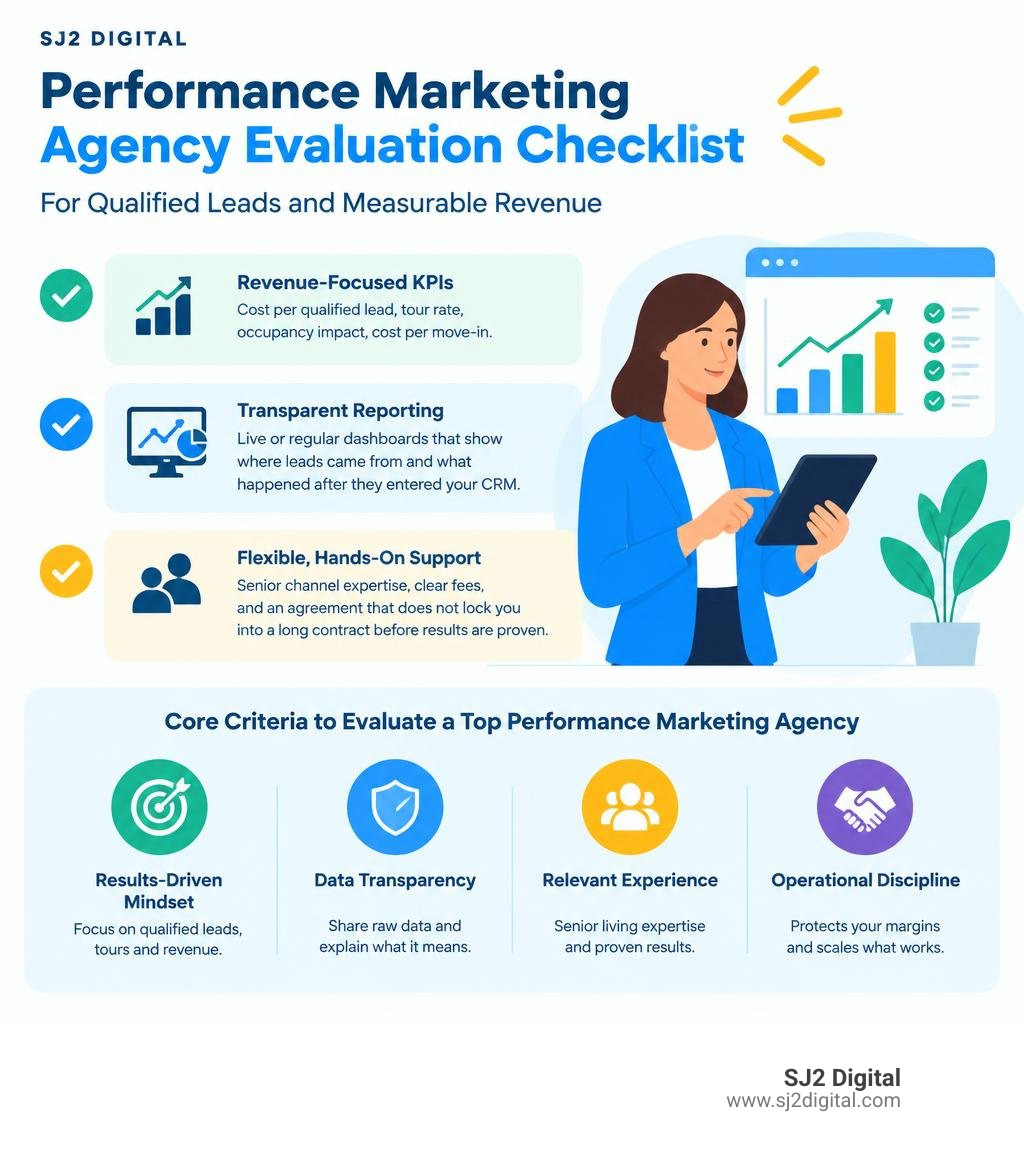
Core Criteria to Evaluate a Top Performance Marketing Agency
Finding an agency that claims it can drive growth is easy. Finding a partner that understands the financial mechanics of customer acquisition, respects your operating margins, and actively shares raw data is far more challenging. In the past, agencies were rewarded for how quickly they could spend budgets. Today, operational maturity and granular efficiency are what separate high-performing partners from bloated service providers.
When vetting potential agency partners, prioritize four governance standards:
- Radical Transparency: You must own your ad accounts, pixel data, tracking assets, and creative collateral outright. If an agency tries to run campaigns inside proprietary accounts you cannot access, walk away.
- Direct Access to Senior Talent: The team pitching you during sales discovery should be the specialists executing your daily media buys—not handed off to junior coordinators learning on your dime.
- Revenue Operations Alignment: Your media partner must speak the language of your CRM, lead pipeline, and sales cycle duration.
- Contractual Agility: Avoid rigid 12-month lock-ins. Top performers back their capabilities with month-to-month or flexible milestone-based agreements.
Essential Capabilities of a Modern Performance Marketing Agency
A competent performance partner does not treat media channels as isolated silos. Driving sustained growth requires combining high-intent demand capture with structured mid-funnel retargeting and rapid creative experimentation.
For high-consideration sectors, managing conversion mechanics across multiple platforms is crucial. High-intent search programs like senior living pay-per-click campaigns must work alongside hyper-targeted programmatic advertising strategies to build localized awareness without wasting ad spend.
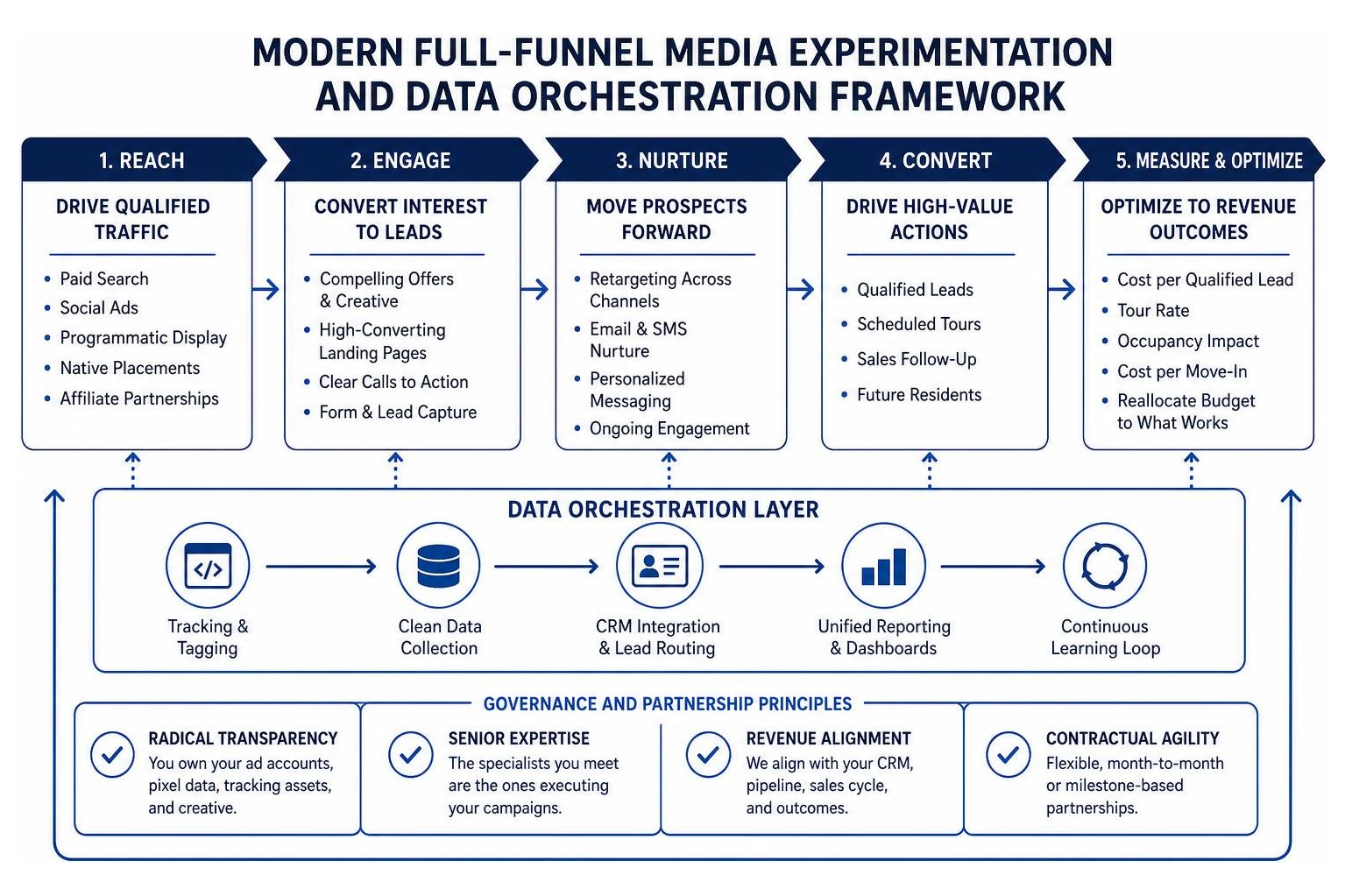
Modern agencies build dynamic experimentation frameworks. Instead of guessing which messaging angle works, they systematically test headlines, value propositions, and visual assets across structured audience segments. Every campaign should tie back to financial metrics like contribution margin, customer lifetime value (LTV), and target customer acquisition cost (CAC).
Pricing Models, Contracts, and Retainer Structures
How an agency charges for its services reveals where its incentives truly lie. While traditional agencies often push fixed retainers with heavy onboarding fees, modern performance teams operate with models that reward mutual efficiency.
| Pricing Model | How It Operates | Best Suited For | Key Risk / Drawback |
|---|---|---|---|
| Percentage of Ad Spend | Agency takes a sliding fee (typically 10%–20%) based on total gross ad budget. | Scaling brands with proven unit economics and large budgets. | Incentivizes the agency to encourage higher spend rather than true CPA efficiency. |
| Flat Monthly Retainer | Predictable monthly fee covering media management, creative testing, and optimization. | Mid-market businesses requiring stable operational overhead. | Scope creep or stagnant optimization if service deliverables are poorly defined. |
| Performance Milestones / Hybrid | Base operational retainer combined with bonus incentives tied to pipeline volume or revenue. | High-growth organizations with deep CRM attribution tracking. | Requires total agreement on pipeline data hygiene and closed-loop reporting. |
| Flexible "Anti-Agency" Model | Month-to-month arrangements with transparent dashboards, senior hands-on execution, and no long-term lock-ins. | Agile operators, senior care providers, and ROI-focused SMBs. | Demands mutual accountability and clear, regular communication on pipeline velocity. |
We believe the anti-agency model—characterized by flexible agreements, zero long-term handcuffs, and transparent live dashboards—gives businesses the control and financial predictability they need.
Multi-Channel Execution: How Growth Agencies Drive Pipeline
Top performance marketing teams coordinate media channels into an integrated acquisition engine. Rather than hoping a single platform solves all pipeline challenges, a multi-channel framework captures active buyers while nurturing prospective customers who are earlier in their decision journey.

Paid Search and Programmatic Ad Buying
Paid search captures high-intent prospects at the exact moment they are looking for solutions. Building an effective search engine marketing engine requires tight keyword clustering, continuous negative keyword scrubbing, and compelling landing pages that mirror user intent.
To maximize local capture and prevent ad waste, paid search must be paired with programmatic display and native advertising. Programmatic networks leverage real-time bidding (RTB) and first-party data to reach prospective decision-makers across niche websites, local news portals, and streaming platforms. This keeps your brand visible throughout the extended evaluation process.
Paid Social, Creative Testing, and Retention Automations
Paid social is no longer about boosting posts for engagement; it is a primary driver of qualified pipeline. Engaging platforms like Meta, LinkedIn, and YouTube requires tailored content formats that address specific pain points.
In high-trust verticals, our senior living social marketing programs emphasize authentic community tours, resident stories, and transparent pricing information.
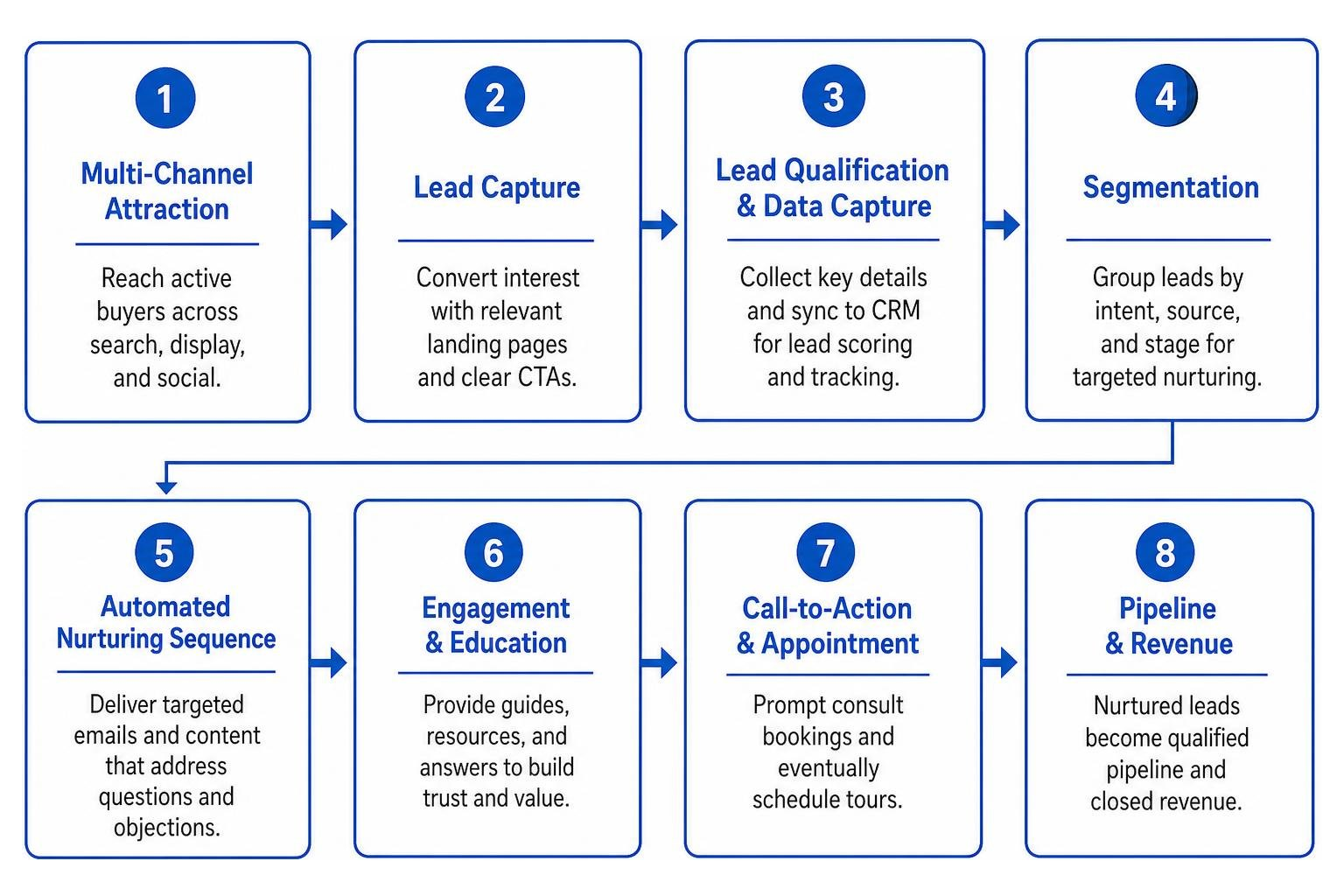
Driving pipeline does not end when an ad click yields an initial form fill or phone inquiry. High-performing agencies deploy lifecycle email automations to nurture inbound leads through targeted, multi-stage sequences. These automated workflows answer common objections, provide downloadable guides, and prompt direct consultation bookings, ensuring that prospective inquiries progress into scheduled tours and closed revenue.
Measuring True Revenue Impact: Attribution, AI, and CRM Integration
The biggest gap in performance advertising is the disconnect between front-end ad clicks and back-end closed revenue. A campaign can easily generate hundreds of low-cost conversions inside an ad platform while producing zero qualified pipeline for the sales team.
True performance marketing bridges this gap by aligning media attribution directly with your CRM and sales pipeline data.
Connecting Ad Spend to Closed-Won Revenue and CRM Systems
To calculate true customer acquisition cost and return on ad spend (ROAS), your agency must integrate ad platforms directly with CRM solutions like Salesforce, HubSpot, or industry-specific lead management software.
- Closed-Loop Attribution: Tracking leads from their initial ad interaction all the way to a closed-won sale or finalized resident move-in.
- Pipeline Velocity Tracking: Identifying which ad channels and audience segments move through the sales pipeline fastest.
- LTV-to-CAC Modeling: Ensuring acquisition costs remain balanced against the long-term revenue generated by each customer.
Reviewing proven agency case studies helps demonstrate how closed-loop attribution reveals high-value lead sources that basic platform dashboards often miss.
Leveraging AI and Predictive Media Optimization
Modern media buying relies heavily on artificial intelligence and machine learning. Algorithmic bidding platforms on Google and Meta analyze thousands of contextual signals in real time to optimize ad delivery.

Agencies use machine learning models to analyze historical performance data, predict budget reallocations across channels, and identify creative fatigue before campaign efficiency declines. Instead of manually adjusting individual keyword bids, our specialists guide the algorithms with first-party audience signals, offline conversion data, and negative match parameters to keep spend focused on high-intent prospects.
Risk Management and Media Strategy Optimization
Without continuous governance, paid media campaigns can suffer from budget waste, creative fatigue, and attribution drift. Managing risk requires continuous oversight of spend efficiency, channel mix, and landing page conversion rates.
Common Pitfalls When Hiring a Performance Marketing Agency
Many organizations experience frustrating agency relationships. Recognizing common warning signs early helps protect your marketing budget:
- Optimizing for Vanity Metrics: Celebrating high impressions, video views, or click-through rates while lead quality drops.
- Siloed Reporting: Presenting channel metrics without showing how paid media impacts total sales pipeline and occupancy rates.
- Opaque Account Access: Restricting administrative access to ad accounts, analytics setups, or creative files.
- Set-and-Forget Campaign Management: Launching ad campaigns and letting them run on autopilot without regular creative testing, query auditing, or audience refinement.
Integrating Organic Discovery with Paid Media Performance
Paid media should not operate in isolation from organic search. Unifying your paid campaigns with organic search and SEO alignment creates a cohesive search strategy that lowers overall customer acquisition costs.
Organic search insights help identify high-converting, long-tail queries that can be tested in paid search campaigns. Conversely, paid search data shows which keywords yield the highest conversion rates, guiding your organic content strategy. When paid and organic search work together, your business captures top positions across search results while maintaining a consistent landing page experience.
Frequently Asked Questions about Performance Marketing Agencies
How does performance marketing differ from brand and affiliate marketing?
Performance marketing is built entirely around measurable actions, such as form submissions, inbound calls, tour bookings, or sales. Payment and strategic optimizations are directly tied to these quantifiable results.
Brand marketing focuses on top-of-funnel reach, brand recognition, and audience perception, which are valuable but harder to track directly to revenue. Affiliate marketing is a specific subset of performance marketing where third-party publishers or influencers receive a commission only after a confirmed conversion occurs.
How do performance marketing agencies measure ROI and pipeline in 2026?
Top agencies measure success using closed-loop CRM reporting rather than relying solely on front-end ad metrics. Key metrics include:
- Cost Per Qualified Lead (CPQL): Spend divided by leads that meet specific buying criteria.
- Pipeline Value Generated: The total monetary value of qualified opportunities sourced through paid channels.
- Customer Acquisition Cost (CAC): The total media spend and management cost required to secure a closed customer.
- Contribution Margin & LTV:CAC Ratio: Ensuring customer lifetime value comfortably exceeds acquisition costs.
What budget and KPIs should a business establish before hiring an agency?
Before engaging an agency, determine your baseline customer lifetime value, your target cost per acquisition, and your sales team's lead-to-close conversion rates.
Your initial media budget should be large enough to generate statistically significant conversion data across your chosen channels—typically several thousand dollars per month depending on your market size and competitive landscape. Establish clear benchmarks for cost per lead, sales-qualified opportunities, and target close rates so both teams share clear expectations from day one.
Conclusion: Choosing the Right Growth Partner
Partnering with an agency should give you complete visibility into your acquisition funnel, not leave you guessing about spend efficiency. When evaluating partners, prioritize teams that offer transparent reporting, hands-on senior specialists, and contract models that align directly with your growth goals.
At SJ2 Digital, we operate on an anti-agency model. We eliminate rigid long-term contracts, provide transparent live dashboards, and deploy senior-level experts who actively manage your campaigns within your operating budget.
Whether you need paid search, programmatic ad buying, paid social, or email lead nurturing, our team aligns every media dollar with measurable pipeline outcomes.
Discover how our comprehensive performance marketing services can help you scale acquisition, increase occupancy, and drive predictable revenue.