
LinkedIn B2B Advertising Framework: Targeting Buying Committees with Precision
Build a Profitable LinkedIn B2B Advertising Engine

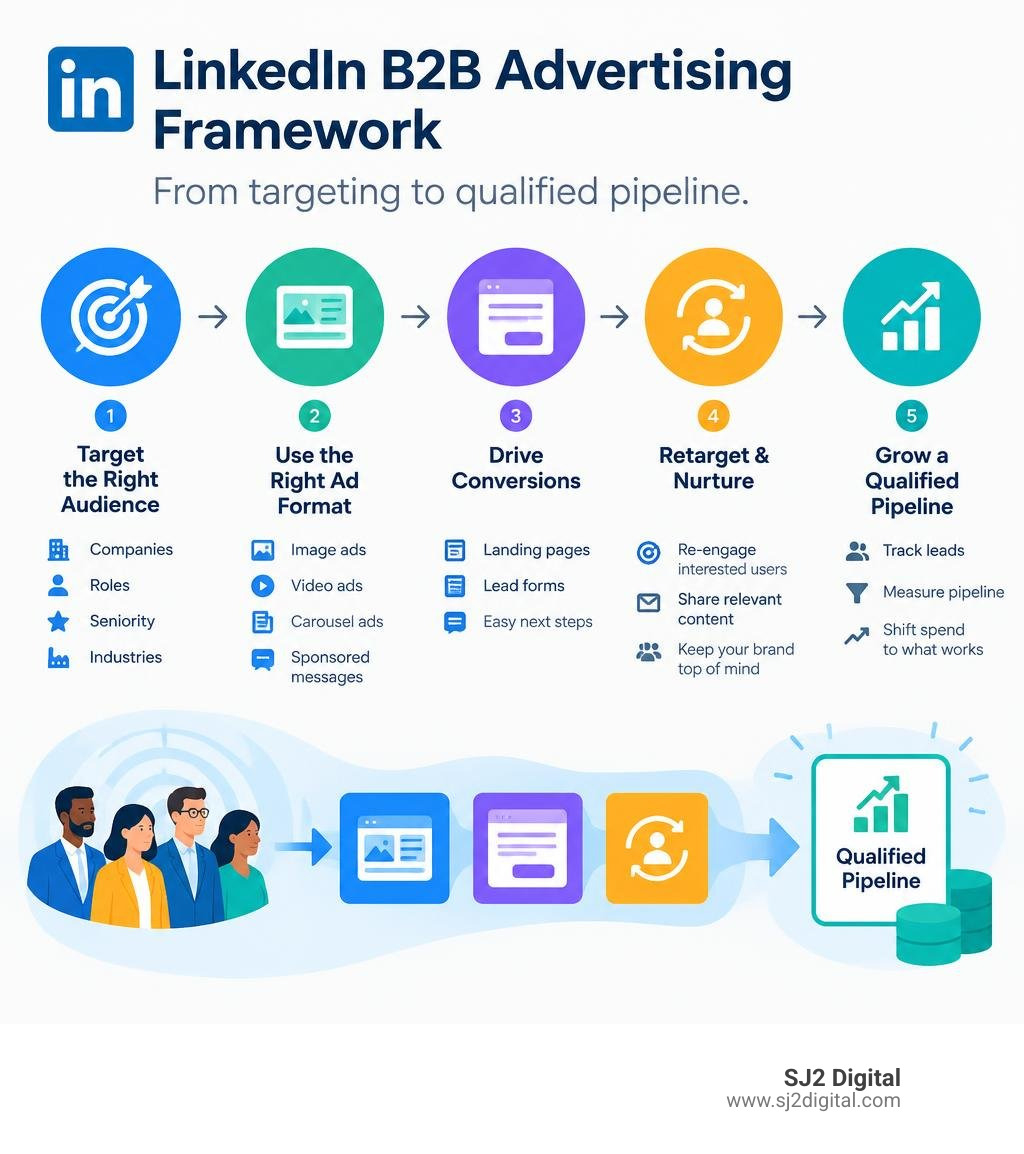
To run profitable linkedin b2b advertising, start by targeting the buying committee, not the widest possible audience. Define the companies, roles, seniority levels, and industries that influence a sale. Then pair a relevant ad format with a clear conversion path, track qualified leads through to pipeline, and shift spend toward the audiences and creative that produce real opportunities.
For senior-living operators, this means reaching the people who shape referral relationships, partnerships, operations, and purchasing decisions - rather than paying for clicks from people who cannot move a deal forward.
LinkedIn is built for this work. Its members supply professional data such as job title, company, function, seniority, industry, and skills. With more than 1 billion members worldwide, the platform gives B2B advertisers a practical way to reach both decision-makers and the colleagues who help evaluate a vendor.
This guide shows how to build a full-funnel LinkedIn program: precise audience targeting, useful ads, low-friction lead capture, retargeting, and transparent pipeline measurement. The goal is not the cheapest click. It is a repeatable cost per qualified lead and a clearer return on ad spend.
Why Modern B2B Marketers Prioritize LinkedIn Over Search and Meta
B2B buying is rarely an impulse purchase. The typical B2B sales cycle averages 211 days and involves multiple stakeholders across finance, operations, and executive leadership. While platforms like Meta offer vast consumer scale and Google captures active bottom-funnel intent, neither provides the verified professional identity layer inherent to LinkedIn.
LinkedIn hosts over 1 billion members across 200 countries, including more than 180 million senior-level influencers and 10 million C-suite executives. When prospective buyers log into LinkedIn, they are in a professional mindset, actively consuming industry news, evaluating operational solutions, and engaging with peers.
Because users voluntarily keep their employment history, job titles, and company affiliations up to date, LinkedIn ad conversion rates are 3x higher than other major social networks. While surface-level cost per click (CPC) on LinkedIn is higher than consumer platforms, the cost per influenced company and sales-qualified lead (SQL) is often significantly lower.
Furthermore, LinkedIn has emerged as the second most-cited domain by large language models (LLMs) like ChatGPT and Google AI Overviews, trailing only Reddit. High-authority native content published on the platform directly feeds the generative search engines your buyers use to research solutions.
To maximize efficiency across the customer journey, high-performing growth teams coordinate their paid social efforts alongside targeted senior living pay-per-click strategies to capture demand across every search and discovery touchpoint.
Targeting Buying Committees with LinkedIn B2B Advertising
Reaching an enterprise decision-maker requires understanding the entire committee surrounding them. A single director rarely signs a contract in isolation; technical evaluators, financial controllers, and end users all influence the vendor choice.
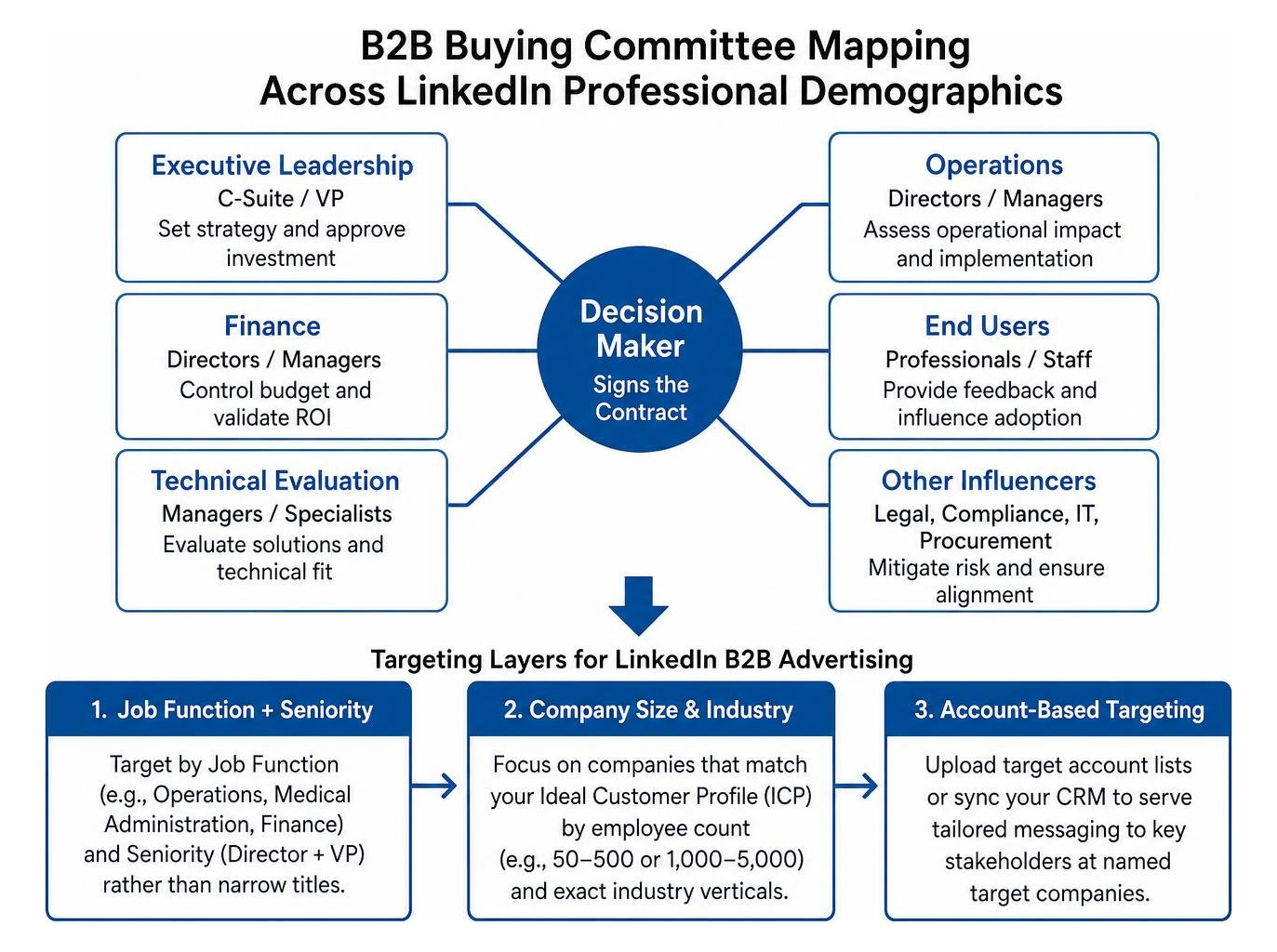
To build a high-precision audience without over-restricting delivery, configure your campaign parameters around strategic layers:
- Job Function + Seniority Over Narrow Titles: Job titles vary widely across organizations. Targeting "Director + VP" seniority within specific "Job Functions" (e.g., Operations, Medical Administration, Finance) captures the full buying committee more reliably than individual title strings.
- Company Size & Industry Layering: Focus your budget on organizations that match your Ideal Customer Profile (ICP), filtering by employee count (e.g., 50–500 or 1,000–5,000 employees) and exact industry verticals.
- Account-Based Marketing (ABM) via Matched Audiences: Upload target account lists or sync your CRM directly to serve tailored messaging to key stakeholders at named target companies.
- Aggressive Exclusions: Protect ad spend by actively excluding current employees, existing customers, job seekers, entry-level roles, and irrelevant industry classifications.
For operators scaling specialized programs, utilizing tailored senior living marketing services helps streamline audience segmentation and eliminate wasted impressions on non-buyers.
The Strategic Value of Thought Leadership and Organic Synergy
Paid distribution delivers immediate visibility, but organic credibility cements trust. Research shows that 55% of decision-makers review thought leadership content during their vendor vetting process. When paid ads are backed by active organic engagement, overall customer acquisition costs drop.
LinkedIn Pages that post updates at least weekly experience double the engagement of inactive pages. To balance your organic pipeline, implement the 3-2-1 content formula:
- 3 Industry Insights: Practical commentary on industry shifts, operational data, or regulatory updates.
- 2 Company Proof Points: Case studies, client wins, employee spotlights, and behind-the-scenes execution.
- 1 Direct Solution Offer: A gated whitepaper, webinar registration, or discovery call invitation.
By activating Thought Leader Ads, brands can sponsor native posts directly from their founders, executives, or subject-matter experts. These personal endorsements routinely outperform corporate brand posts in click-through rates (CTR) and conversion volume.
Core Formats for LinkedIn B2B Advertising and Objective Mapping
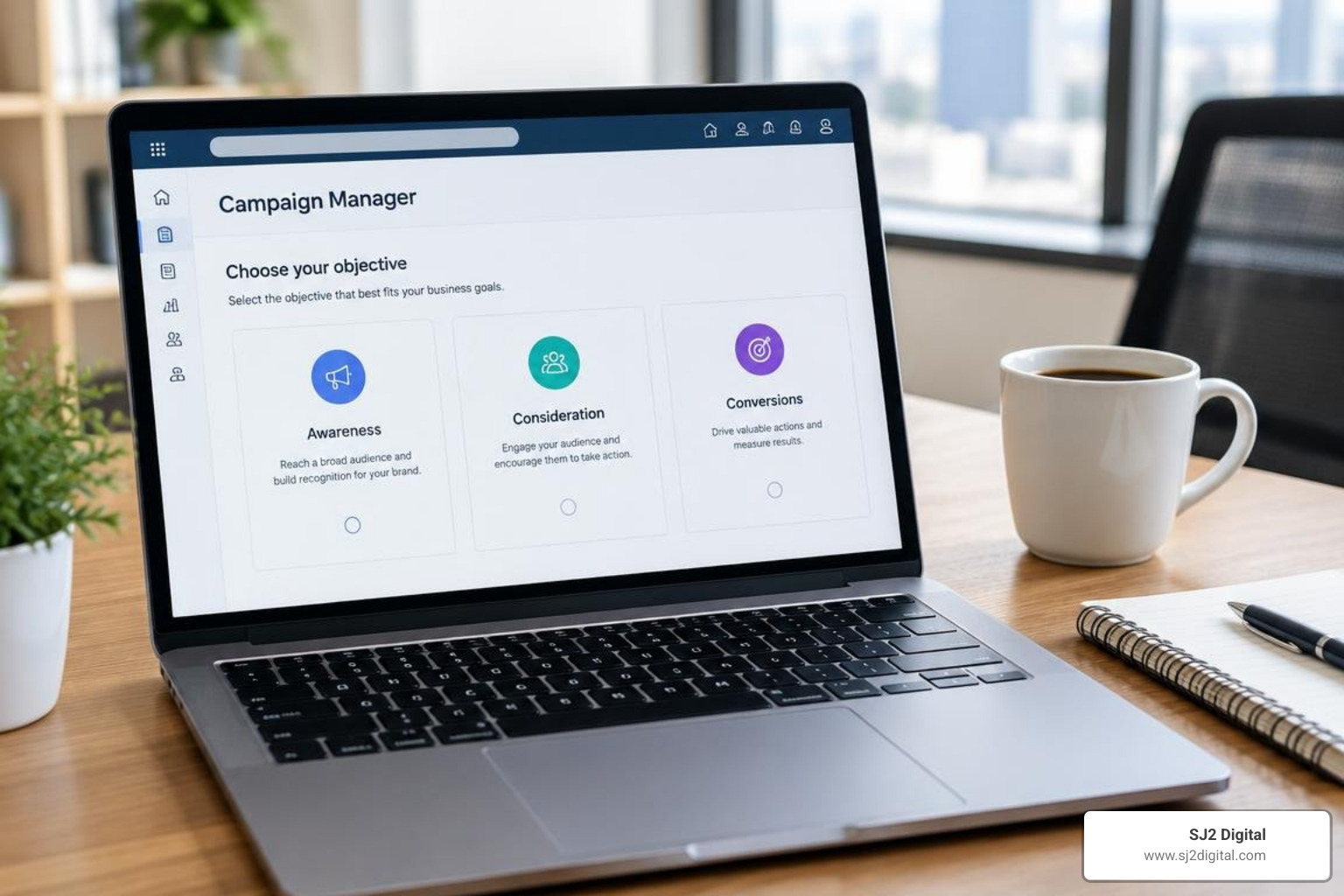
Selecting the right campaign objective within LinkedIn Campaign Manager establishes the bidding logic, algorithmic optimization, and available creative formats. According to technical documentation on Campaign Objectives - LinkedIn | Microsoft Learn, mapping objectives to business goals ensures the delivery algorithm bids accurately on real conversions rather than empty interactions.
Feed Placements: Single Image, Video, and Document Ads
The LinkedIn main feed is the primary battleground for buyer attention. Maximizing performance in this placement requires matching your asset type to audience intent:
- Single Image Ads: Ideal for high-impact visual value propositions, quick stats, or direct-response CTAs. Use high-contrast imagery with minimal overlay text to stand out against desktop and mobile feeds.
- Video Ads: A vital asset for accelerating buying cycles. Industry data shows 81% of B2B CMOs report video accelerates the sales process. Keep videos between 15 and 60 seconds, deliver the core insight in the first 3 seconds, and always hardcode captions, as up to 80% of feed videos are viewed on mute.
- Document Ads: Highly effective for generating qualified pipeline. Document ads allow members to read, scroll through, and download multi-page PDFs, case studies, or slide decks natively in their feed. Gating the download behind a Lead Gen Form creates a friction-free conversion path that delivers 30–40% lower cost-per-lead (CPL) compared to standard external whitepaper landing pages.

Direct and Desktop Placements: Messaging, Dynamic, and Text Ads
Beyond the main feed, specialized ad units provide cost-effective touchpoints across desktop and inbox environments:
- Sponsored Messaging & Conversation Ads: Delivered directly to active member inboxes when prospects are logged in. Conversation ads present interactive, choose-your-own-path CTAs (e.g., "Explore Pricing" vs. "Download Case Study"). Messages sent from a credible human profile achieve a 16% higher open rate than those sent from a generic company handle.
- Dynamic Ads & Spotlight Ads: Automatically personalize the ad creative using the viewer’s profile picture, name, and current company name. These desktop units are highly effective for driving follower growth or promoting exclusive events.
- LinkedIn Text Ads: Positioned on the desktop right-hand rail. Text ads are quick to launch and operate on a strict pay-per-click model. For comprehensive specifications and desktop optimization tips, consult the official guide to LinkedIn Text Ads | Advertise on LinkedIn.
| Ad Format | Funnel Stage | Primary Placement | Key Advantage | Typical Pricing Model |
|---|---|---|---|---|
| Sponsored Content (Image/Video) | Top to Middle | Native Feed (Mobile/Desktop) | High engagement, brand positioning, broad reach | CPC / CPM |
| Document Ads | Middle to Bottom | Native Feed (Mobile/Desktop) | In-feed consumption, instant gating, high intent | CPC / CPM |
| Conversation Ads | Middle to Bottom | LinkedIn Inbox | Interactive branching paths, 1-to-1 personalization | Cost Per Send (CPS) |
| Text Ads | Bottom / Retargeting | Desktop Right Rail | Low barrier to entry, cost-efficient brand recall | CPC / CPM |
| Spotlight / Dynamic Ads | Middle to Bottom | Desktop Right Rail | High visual personalization with profile data | CPC / CPM |
High-Conversion Lead Capture: Lead Gen Forms vs. Landing Pages
The choice between on-platform conversion and external landing pages fundamentally dictates your cost-per-lead and data fidelity.
According to product documentation on Lead Generation Ads on LinkedIn, native Lead Gen Forms eliminate data entry friction by auto-populating fields (first name, work email, job title, company name, location) using verified profile data.
While Lead Gen Forms generate significantly higher volume at lower CPLs, external landing pages allow for deeper interactive product experiences, custom tracking scripts, and multi-step qualification forms.
Capturing leads is only half the battle; speed to follow-up determines revenue impact. Scale pipeline velocity by instantly pushing lead records from LinkedIn into your CRM and nurturing leads with email automations to ensure immediate follow-up.
Creative Execution and Copywriting Frameworks for Decision-Makers
B2B professionals scroll quickly during busy workdays. To hold attention, creative copy must be immediate, relevant, and free of vague buzzwords.
Use the proven Hook-Agitate-Solve-CTA structure:
- Hook (Lines 1–2): Lead with a compelling industry statistic, a contrarian question, or a pressing operational pain point before the "...see more" cutoff. Keep headlines concise and under 150 characters.
- Agitate (Lines 3–5): Briefly unpack why traditional approaches fail and the organizational cost of inaction.
- Solve (Lines 6–8): Present your framework, asset, or solution as the actionable answer to the problem.
- CTA (Final Line): Provide an explicit, singular instruction (e.g., "Download the executive brief below").
Next-Gen B2B Reach: Connected TV, BrandLink, and Creator Sponsorships
B2B advertising is expanding into high-impact media environments. As highlighted in How LinkedIn is helping B2B marketers reach audiences at scale with creators and video, platforms are integrating programmatic video buying, premium creator sponsorships, and Connected TV (CTV).
- LinkedIn CTV Buying: Marketers can now serve non-skippable, high-definition video ads directly to decision-makers streaming content on connected televisions, combining professional targeting with living-room visibility.
- BrandLink & Editorial Shows: Advertisers can place pre-roll video ads alongside top-tier global publishing partners and sponsor curated LinkedIn editorial programs.
- B2B Creator Partnerships: Partnering with trusted industry voices delivers measurable impact; 82% of B2B marketers working with creators confirm that influencer campaigns generate clear ROI, while 56% of enterprise buyers rely on creator evaluations during their final purchase validation.
For organizations integrating omni-channel awareness, exploring programmatic advertising senior living campaigns ensures full-funnel coverage across display, video, and connected devices.
Budgeting, Bidding, and Tracking Pipeline Impact
LinkedIn functions on an objective-based second-price auction system. Entering the auction requires understanding the core pricing models:
- Cost Per Click (CPC): Recommended for direct-response and lead generation campaigns. You only pay when a user clicks your link or opens a Lead Gen Form.
- Cost Per 1,000 Impressions (CPM): Recommended for upper-funnel brand awareness or retargeting small, highly refined account lists where maximum impression share is the primary KPI.
- Cost Per Send (CPS): Utilized exclusively for Sponsored Messaging and Conversation Ads.
While the platform allows a minimum daily budget of $10 per campaign, running statistically significant B2B tests requires a dedicated budget of $3,000 to $5,000 per month. This funding level allows the algorithm to exit the learning phase, test 3 to 5 creative variations per audience, and generate sufficient lead volume to evaluate downstream qualification rates.
Reviewing verifiable results from our client case study demonstrates how structured budget pacing and audience testing drive sustainable customer acquisition.
Maximizing ROAS with LinkedIn B2B Advertising
True B2B return on ad spend (ROAS) cannot be measured by vanity metrics like likes, impressions, or surface-level CTR. Maximizing ROI requires full-funnel tracking:
- Install the LinkedIn Insight Tag: Deploy the tracking script across your web properties to unlock website demographic reporting, track key conversion events, and build dynamic retargeting pools based on URL visits.
- Track Offline Conversions & CRM Sync: Integrate closed-won revenue data back into Campaign Manager to train the algorithm on closed deals rather than top-of-funnel form fills.
- Evaluate Downstream Pipeline Metrics: Focus optimization reviews on Cost Per Sales-Qualified Lead (SQL), Opportunity Win Rate, and Pipeline Velocity across your target accounts.
Frequently Asked Questions About LinkedIn Advertising
What is the minimum budget required to see results on LinkedIn?
While LinkedIn permits a daily minimum spend of $10, a viable B2B testing budget starts between $3,000 and $5,000 per month. Given that professional B2B clicks typically range between $5 and $12 depending on seniority and industry competition, this budget ensures your campaigns generate enough clicks and conversions each week to reach statistical significance and inform strategic optimizations.
How do LinkedIn Lead Gen Forms differ from driving traffic to external landing pages?
LinkedIn Lead Gen Forms convert natively within the mobile and desktop feeds using pre-filled profile information, yielding conversion rates between 10% and 15%. External landing pages average conversion rates of 2% to 5% due to manual data entry friction, but allow for deeper custom design, interactive calculators, and extensive web tracking.
How does LinkedIn advertising integrate with organic thought leadership?
Organic posting builds brand trust, algorithms index native content, and team advocacy creates authenticity. By activating Thought Leader Ads to amplify executive posts and maintaining a structured 3-2-1 content cadence, advertisers lower their blended acquisition costs and drive significantly higher engagement across paid campaigns.
Conclusion
A profitable LinkedIn B2B advertising engine requires alignment across every layer: identifying the entire buying committee, delivering native ad creative, providing frictionless conversion paths, and measuring downstream pipeline impact.
At SJ2 Digital, we help operators scale revenue through an anti-agency model. We operate without rigid long-term contracts, provide completely transparent live reporting dashboards, and deploy senior-level performance marketing experts who work hands-on within your budget.
Ready to transform your professional network into a predictable customer acquisition engine? Partner with our growth team and scale your enterprise pipeline with senior living social marketing today.