
What High-Growth Brands Look for in a Marketing Automation Agency
7 Key Qualities to Look for in a Marketing Automation Agency

High-growth brands look for a marketing automation agency that pairs hybrid AI and senior human expertise with multi-channel integration mastery and proactive diagnostic maintenance. The right partner provides full-funnel architecture, behavioral lead scoring, lifecycle messaging, and scalable email automations that connect discovery to final conversion.
When vetting partners, high-growth teams look past sales decks to evaluate practical execution capabilities. The marketing automation industry has surged to over $8 billion annually and is on track to approach $14 billion by 2030, which means tools and tactics evolve rapidly. Choosing the wrong partner often leads to shelfware, messy CRM databases, and stalled pipelines. A dedicated agency must eliminate these roadblocks by engineering predictable pathways from raw inquiry to closed deal.
A qualified agency provides a reliable technical foundation. It establishes full-funnel architecture, behavioral lead scoring, lifecycle messaging, and scalable email automations that connect discovery to final conversion. By auditing customer touchpoints and mapping behavioral triggers across the entire lifecycle, the agency builds an infrastructure where no prospect falls through the cracks.
Hybrid AI and Senior Human Expertise
Modern marketing operations demand both velocity and deep strategic oversight. The most effective agency model pairs AI speed with experienced human specialists.
AI agents excel at high-speed, repetitive tasks:
- Drafting baseline copy variations, personalization tokens, and subject lines
- Processing raw data, standardizing formatting, and cleaning contact imports
- Monitoring brand mentions, campaign deliverability anomalies, and digital sentiment
- Transcribing calls to tag intent signals and extract high-value buyer objections
Human specialists provide critical strategic judgment:
- Designing multi-touch attribution logic and revenue-weighting models
- Reviewing messaging for nuance, regulatory compliance, and empathetic brand tone
- Structuring complex, branched workflow logic that accounts for non-linear buyer journeys
- Troubleshooting technical integration conflicts and API authentication errors
This balance prevents tone-deaf messaging while maintaining high creative velocity across campaigns.
Multi-Channel Integration Mastery
Most marketing technology stacks resemble digital duct tape: disconnected tools held together by fragile automations that break without warning.
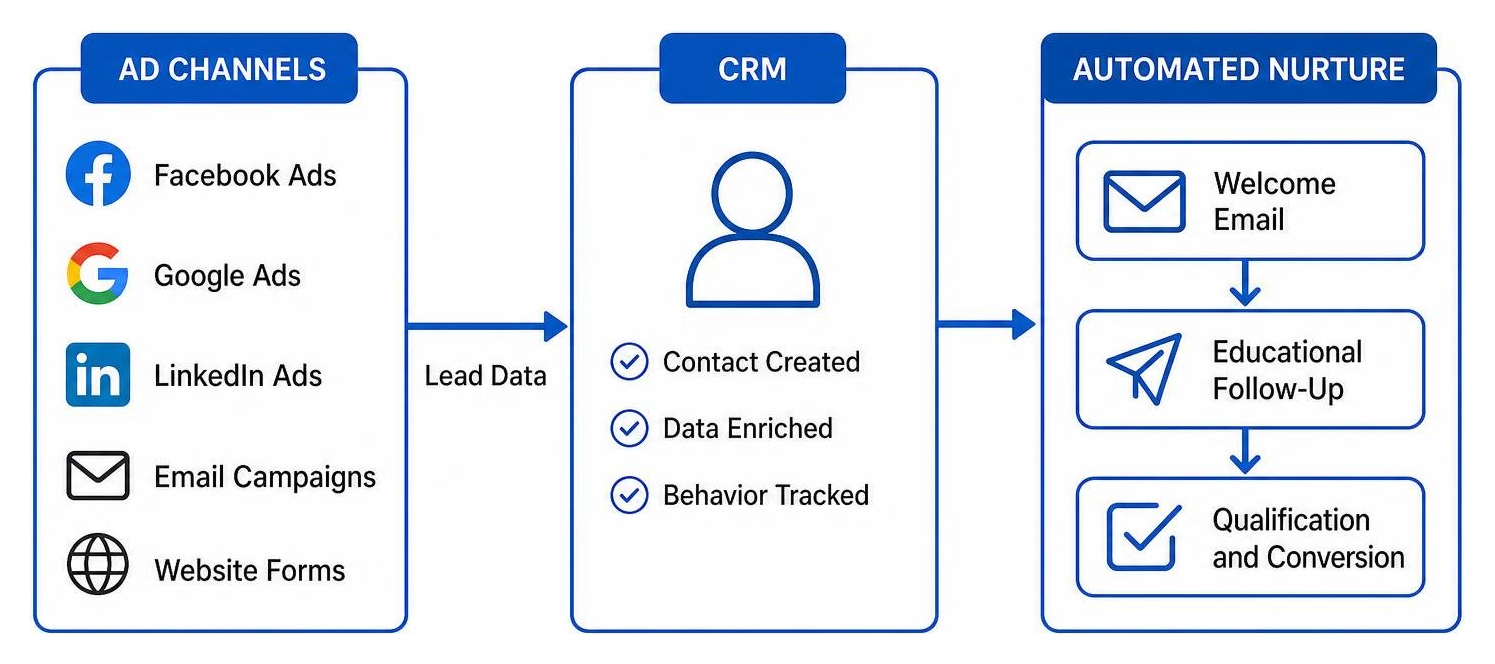
A high-caliber agency brings deep implementation experience across leading platforms, including HubSpot, Salesforce, ActiveCampaign, and Klaviyo. Beyond standalone setups, the agency must master middleware orchestration through tools like Zapier or Make, configure webhook synchronizations, and maintain strict data hygiene across systems. When customer data flows cleanly between your advertising platforms, website, and CRM, sales teams receive qualified leads immediately instead of finding them stuck in an export queue days later.
Proactive Funnel Maintenance and Diagnostic Audits
Marketing infrastructure is not a set-and-forget asset. Webhook endpoints shift, tracking scripts get overwritten during website updates, and lead scoring models drift over time as buyer behavior evolves.
Leading agencies conduct proactive diagnostic audits to identify:
- Lead leakage caused by broken form-to-CRM mappings and invalid field formats
- Abandoned cart or uncompleted inquiry triggers that fail to fire due to tracking drop-offs
- Database decay, spam traps, and deliverability issues harming overall sender reputation
- Stale email nurture sequences that fail to engage modern buyers or reflect updated service offerings
Instead of waiting for pipeline metrics to collapse, an experienced technical team continuously monitors error logs, performs automated triage, and optimizes deliverability to protect your revenue engine. For guidance on marketing automation best practices, the Marketing automation overview on Wikipedia explains the core concepts and common use cases.
Platform Implementation vs. Strategic Agency Partnership
Many organizations assume buying a top-tier software license solves their operational bottlenecks. In reality, software without experienced operators often turns into expensive overhead.
| Dimension | DIY Software Management | In-House Marketing Hire | Specialized Agency Partnership |
|---|---|---|---|
| Tech Stack Utilization | Low (often limited to basic batch emails) | Medium (constrained by single skill sets) | High (advanced multi-branch automation) |
| Launch Velocity | Slow (steep learning curve) | Moderate (onboarding takes 60–90 days) | Fast (average launch within 21 days) |
| Strategic Breadth | Limited to internal knowledge | Focused on one domain (content or ops) | Full-funnel (media, CRM, data, design) |
| Operational Overhead | High trial-and-error costs | Full-time salary, benefits, and tooling | Predictable retainer with flexible terms |
| Ongoing Maintenance | Reactive (fixed after leads are lost) | Often deprioritized for urgent tasks | Proactive monitoring and optimization |
For specialized sectors such as senior housing, generic marketing tactics rarely convert. Leveraging dedicated senior living marketing services ensures compliance, audience empathy, and tailored tour-booking workflows are built into every automation stage.
Why High-Growth Teams Choose a Marketing Automation Agency Over DIY Tools
Platform fatigue is common among growing businesses. Marketing leaders often find their internal teams spending 80% of their work hours troubleshooting software settings rather than developing strategy.
Hiring an outside partner delivers immediate structural benefits:
- Maximized Software ROI: Agencies unlock advanced capabilities you are already paying for, such as dynamic content blocks, behavioral branching, and predictive scoring models.
- Speed to Value: Rather than spending six months training an internal team, an established partner deploys battle-tested playbooks within weeks.
- Enterprise-Grade Architecture: Workflows are constructed to handle scale, preventing data bottlenecks and API rate limits as lead volume increases.
- Objective Technical Auditing: An external specialist spots systemic friction points and routing inefficiencies that in-house teams often overlook due to operational blindness.
Omnichannel Alignment Across Paid and Organic Channels
Marketing automation cannot operate in a silo away from customer acquisition channels. Isolated workflows lead to disjointed prospect experiences and wasted marketing spend.
When your automation engine works alongside top-of-funnel acquisition, growth compounds across every touchpoint:
- Integrating paid search campaigns with automated SMS and email follow-ups slashes lead response times from hours to seconds.
- High-intent organic traffic generated through senior living SEO enters tailored educational nurture sequences designed around specific search intent.
- Targeted audiences built through programmatic advertising are automatically excluded from top-of-funnel ad spend once they convert into active CRM contacts.
- Brand engagement generated via social marketing strategies routes directly into interactive community tour-scheduling funnels.
Connecting acquisition channels directly into automated lifecycle funnels ensures full attribution tracking while preventing ad budget waste on already-converted prospects.
Pricing Structures, Contract Models, and Measurable ROI

High-growth brands scrutinize billing structures carefully. Traditional agency frameworks that lock clients into rigid 12-month retainers or add percentage-based markups on ad spend often incentivize agency profit over client performance.
Look for modern, transparent service structures designed to align agency effort directly with business outcomes.
Budgeting and Pricing Models for a Marketing Automation Agency
Agencies generally structure engagements across three main pricing frameworks:
- Flat Monthly Retainers: A clear, predictable monthly investment covering ongoing workflow builds, technical maintenance, optimization, and reporting without hidden platform markups.
- Project-Based Sprints: Fixed-scope contracts tailored for specific initiatives, such as a major CRM migration, initial platform setup, custom integration build, or comprehensive data cleanup.
- Flexible Quarter-to-Quarter Agreements: Modern agreements that operate without punitive long-term commitments, keeping the agency accountable for ongoing performance every 90 days.
We operate on an anti-agency model: no long-term lock-ins, zero ad-spend markups, direct access to senior technical specialists, and transparent live dashboards that show daily progress.
Quantifiable 90-Day Performance Indicators
A structured automation rollout should produce clear performance improvements within the first quarter of engagement:
- Launch Speed (Days 1–21): Completing diagnostic audits, resolving critical tracking bugs, configuring bi-directional CRM syncing, and launching core quick-win sequences.
- Pipeline Velocity (Days 22–60): Measurable drops in lead response time, improvements in deliverability rates, and higher lead-to-opportunity conversion percentages.
- Compounding Returns (Days 61–90): Documented increases in booked sales appointments, measurable reductions in customer acquisition costs, and clean multi-touch revenue attribution.
Reviewing a documented client case study helps verify an agency's ability to turn technical architecture into documented pipeline growth.
Frequently Asked Questions About Marketing Automation
What is the typical timeframe to see measurable results from marketing automation?
Initial operational wins—such as fixing broken lead routing and deploying automated response triggers—typically go live within 21 days. Measurable pipeline improvements, increased qualification rates, and compounded ROI normally materialize within 60 to 90 days as automated sequences mature and gather behavioral data.
Which industries benefit most from dedicated marketing automation services?
Industries with multi-step sales processes, high customer lifetime value, and extended consideration cycles gain the highest returns. Key sectors include senior living, healthcare, specialized B2B services, SaaS platforms, and high-growth ecommerce brands managing complex customer retention funnels.
How do modern agencies prevent data silos and broken API connections?
Agencies prevent integration failures by establishing centralized data architecture using webhook synchronization, robust middleware (like Zapier or Make), custom API scripts, and continuous error logging. Regular platform hygiene audits ensure fields map accurately across every software update.
Conclusion
Automating your marketing workflows should simplify growth, not add operational friction. The right partner combines technical platform expertise with human strategic execution, turning underutilized software into an engine for predictable pipeline generation.
At SJ2 Digital, we help businesses eliminate operational bottlenecks through transparent dashboards, senior-level execution, and agile marketing support without locking you into long-term contracts.
Ready to streamline your lead generation and scale your pipeline? Explore our custom email automations or reach out to our team today through our contact page to schedule an infrastructure audit.