

Automate Timely Lead Follow-Ups Before Interest Fades
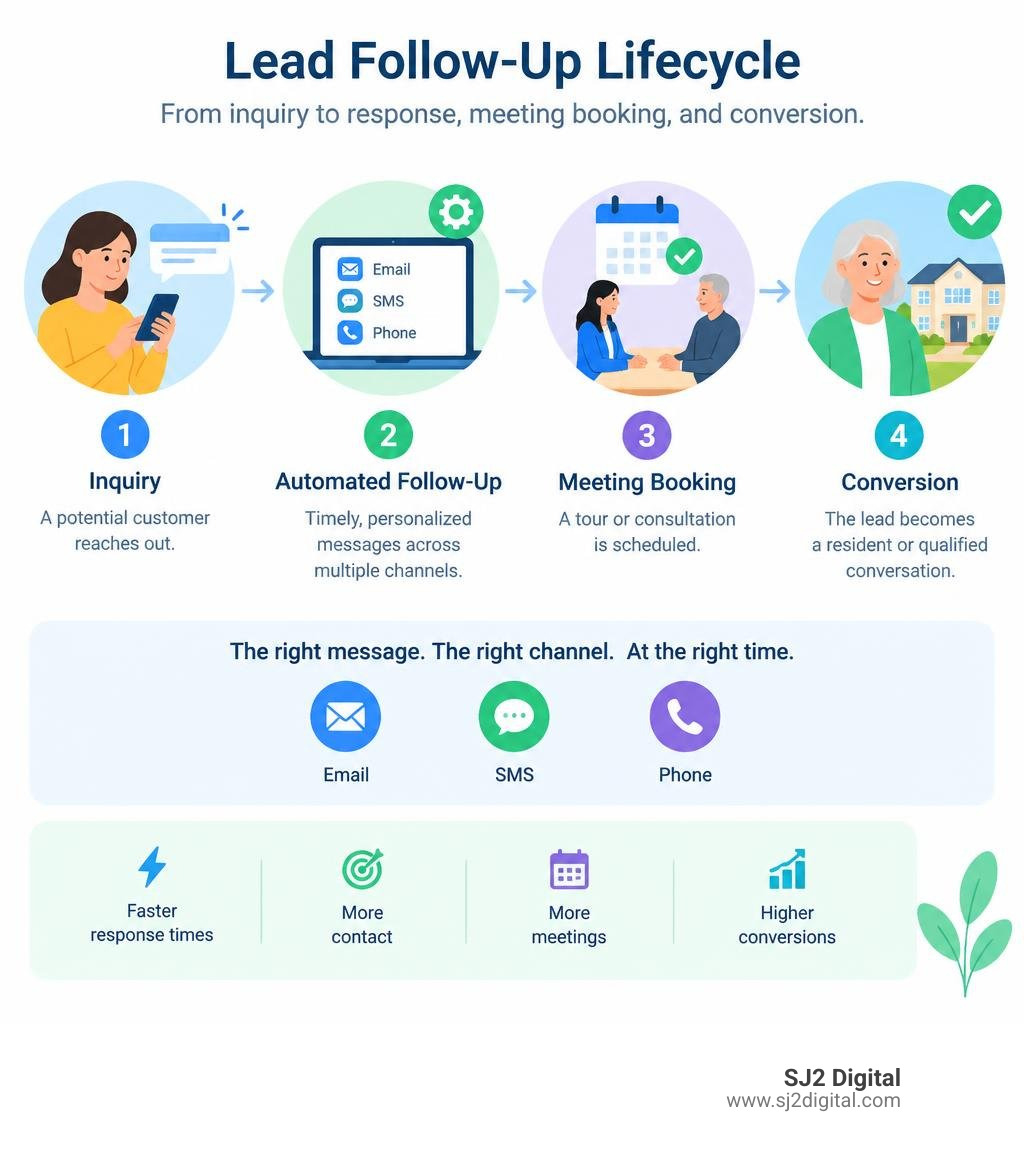
Automated lead follow up helps you respond quickly, stay consistent, and guide prospects toward a meeting without relying on staff to remember every next step. Start with one high-value workflow: trigger an immediate reply when a new inquiry arrives, schedule helpful follow-ups across email, SMS, or phone, and automatically pause the sequence when the lead responds or books.
For senior-living operators, this matters because a missed inquiry or delayed callback can mean a family chooses another community before your team has a real conversation.
A practical cadence should:
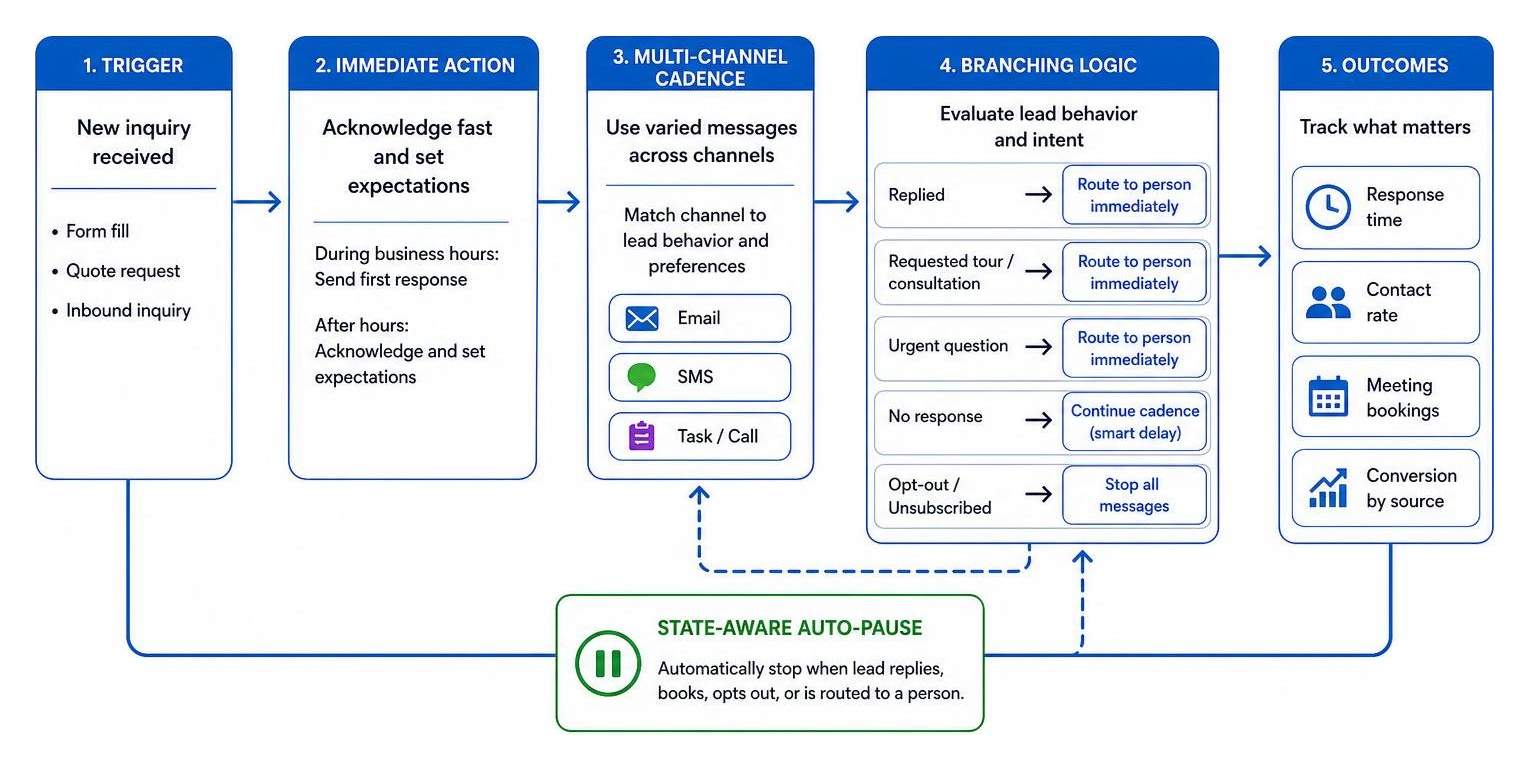
- Send a fast first response during business hours, or acknowledge the inquiry and set expectations after hours.
- Use several touchpoints with different messages, not repeated "just checking in" notes.
- Match the channel to the lead's behavior and communication preference.
- Route replies, tour requests, and urgent questions to a person immediately.
- Track response time, contact rate, meeting bookings, and conversion by source.
The goal is not to send more messages. It is to send the right message at the right time, then stop when human attention is needed. Done well, automation closes the follow-up gap while giving your team a clear view of what is producing booked tours and qualified conversations.
Why Automated Lead Follow Up Fails (And the Science of Precision)
Most sales leaders realize that 80% of successful sales require five or more touchpoints, yet nearly half of all sales representatives stop after just two outreach attempts. While automated tools are designed to solve this gap, traditional nurture setups often fail because they treat automation as a blunt instrument rather than a precision system.
When cadences rely on rigid, one-size-fits-all drip emails sent at fixed 24-hour intervals, prospective buyers tune out. Generic messages trigger fatigue, damage sender reputation, and lead to high unsubscribe rates. Conversely, failing to respond within minutes of an initial inquiry causes conversion potential to plummet; sales teams that follow up within an hour are seven times more likely to hold meaningful conversations than those who wait.
Precision in lead engagement shares a direct parallel with high-stakes engineering and medical applications. In advanced therapies like boron neutron capture therapy (BNCT), millimeter-level patient positioning is vital. Research shows that positional deviations can cause dosimetric variations of up to 5% across source-to-surface distance orientations. Even tiny misalignments reduce treatment efficacy. Similarly, small timing or messaging errors in your lead nurture workflows produce severe drops in conversion efficiency. If an automated message delivers the wrong tone or misses the buyer's peak moment of intent, the prospect disengages.
To eliminate these missteps, modern workflows require stage conditions and behavioral safeguards. An effective nurture engine must verify the following core parameters:
- Immediate Event Triggers: Acknowledging form fills, quote requests, or direct inbound inquiries within sixty seconds.
- Dynamic Channel Selection: Alternating across email, SMS, and task-driven outreach based on explicit prospect preferences.
- Smart Delays: Respecting regional time zones, local business hours, and engagement habits.
- Global Frequency Caps: Limiting automated contacts to prevent over-messaging and spam flags.
- State-Aware Auto-Pause: Instantly halting automated workflows the moment a prospect replies, books a consultation, or requests opt-out.
Building this level of precision requires a robust email marketing automation architecture that bridges raw lead data with responsive, rule-based execution.
Core Architecture of an Adaptive Follow-Up Engine
An enterprise-ready follow-up architecture cannot rely on linear lists. It functions as an adaptive, multi-channel engine capable of evaluating inbound behavior and dynamically altering its paths. Modern platforms deploy event-driven webhooks, continuous CRM synchronization, and multi-channel orchestration to move prospects smoothly through qualifying stages.
Step 1: Trigger-Based Cadences and Dynamic Channels
The foundation of modern lead management is real-time ingestion. Whether an inquiry originates from paid search, social campaigns, or an organic landing page, webhooks immediately parse contact details, segment criteria, and submission metadata.
Once ingested, the system determines the optimal channel based on past engagement history and conversion pathways. While B2B buyers frequently respond to structured email sequences and calendar invites, service inquiries often convert via instant SMS confirmation. Teams can automate drip sequences, auto-dial reminders, and stage-based workflow triggers that ensure no inquiry goes unaddressed.
For international or cross-border operations, multi-channel capabilities can deliver rich media, brochures, and automated voice callbacks in coordinated sequences.
Step 2: Applying Semi-Supervised Feedback to Automated Lead Follow Up
Advanced automation draws heavily on principles from program transformation synthesis. In software engineering, feedback-driven semi-supervised synthesis allows algorithms to learn generalized code transformations using minimal examples combined with continuous user corrections. Techniques like anti-unification align disparate data structures, using reward functions and feedback oracles to achieve over 99% recall without requiring hundreds of manually curated datasets.
In follow-up automation, semi-supervised logic continuously refines how workflows respond to inbound messages. When a sales representative edits an automated draft, updates an objection label, or adjusts appointment parameters, the system captures this implicit feedback. By analyzing operator corrections, the engine updates its natural language intent classification models.
This enables automated lead follow up systems to adapt tone, refine objection-handling responses, and deliver human-like personalization while scaling interactions reliably.
Step 3: Closed-Loop Validation and Anti-Overfitting Controls
A major challenge in sales automation is overfitting—designing workflows that operate perfectly in controlled testing environments but break down when faced with unexpected edge cases. In program repair research, over 60% of automated patches initially fail outside test suites because they lack semantic constraints.
To prevent broken logic from alienating real buyers, follow-up workflows should incorporate automated validation protocols:
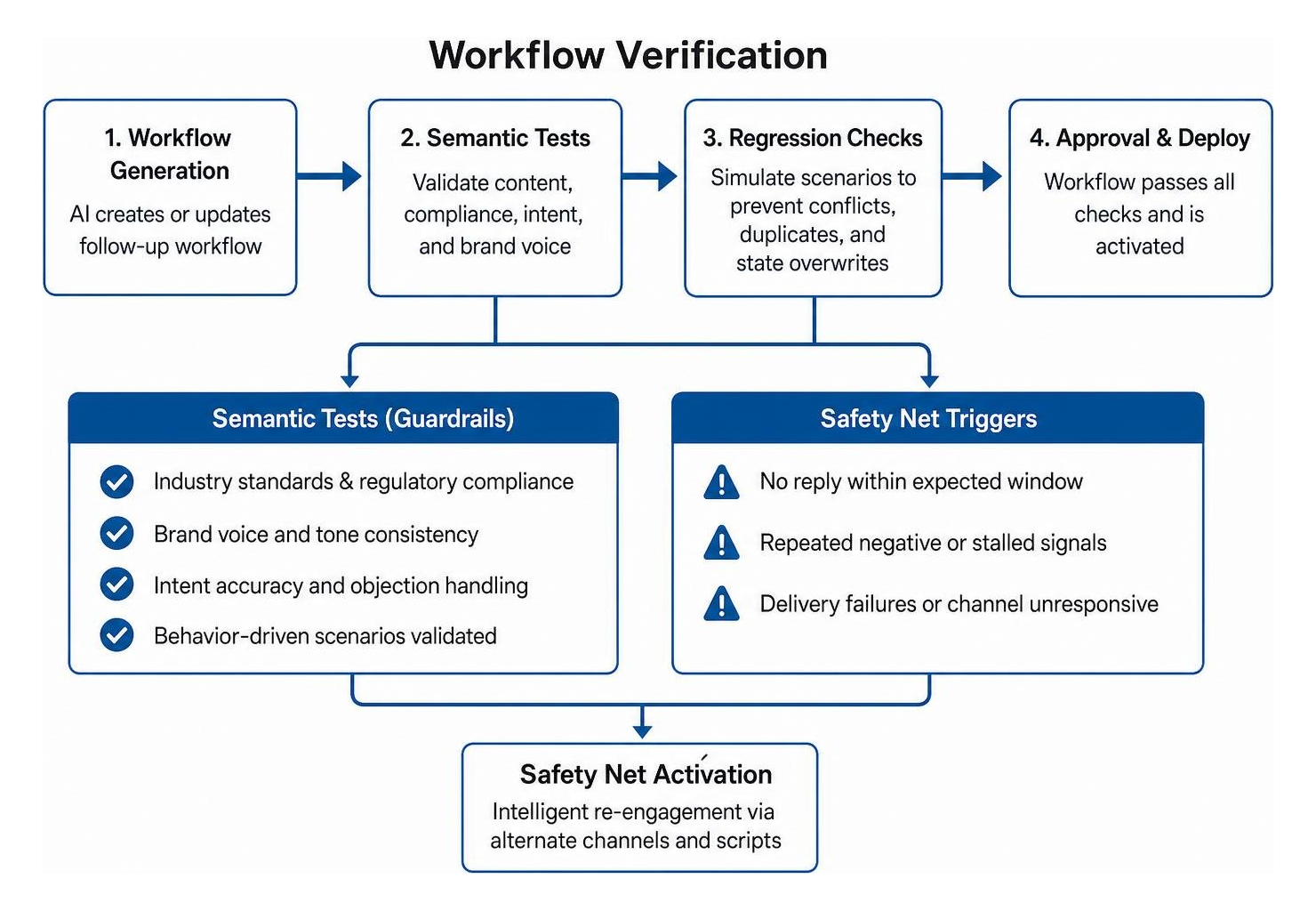
- Semantic Guardrails: Ensuring every AI-drafted email or message complies with industry standards, regulatory mandates, and brand voice guidelines.
- Behavior-Driven Development (BDD): Formulating nurture sequences using clear behavioral scenarios (e.g., Given an unread email after 48 hours, When an inbound call occurs, Then pause outbound SMS).
- CI/CD Regression Testing: Running simulation pipelines to verify that newly created cadence branches do not overwrite existing contact states or trigger duplicate messages.
- Safety Net Activation: Monitoring stalled pipelines and re-engaging unresponsive leads through intelligent conversational scripts when standard channels produce no contact.
Step-by-Step Implementation: Building a Multi-Channel Cadence
Constructing an effective cadence requires pacing touchpoints across distinct channels rather than bombarding a lead through a single medium. Multi-channel sequences that blend email, two-way SMS, voice follow-ups, and social touches consistently achieve 30% to 50% higher response rates than email-only campaigns.
| Feature / Metric | Single-Channel Email Drip | Multi-Channel Adaptive Cadence |
|---|---|---|
| Channel Variety | Email only | Email, SMS, Voice Reminders, WhatsApp |
| Average Response Rate | 8% – 12% | 25% – 38% |
| Reply Detection | Manual rep pause required | Instant state-based auto-pause |
| Adaptability | Fixed timeline | Dynamic branching based on prospect engagement |
| Deliverability Risk | High domain fatigue risk | Distributed risk across multiple verified channels |
Organizations can maintain domain health via native inbox connections while deploying intelligent branching logic.
Designing High-Converting Touchpoints Across SMS, Voice, and Email
Every touchpoint in an automated sequence must serve a distinct purpose. Rather than sending repetitive check-in notes, structure your outreach to deliver incremental value at each stage:
- Touchpoint 1 (Minute 0 - 5): Rapid Acknowledgment & Resource Delivery (SMS / Email) Confirm receipt of the inquiry instantly. Provide the exact asset requested (e.g., pricing overview, brochure, or availability calendar) and include a direct booking link.
- Touchpoint 2 (Day 1): Specific Value-Add & Clarification (Email) Follow up with a concrete case study or an answer to the most common question asked by prospects at this stage. Keep the call-to-action low friction.
- Touchpoint 3 (Day 3): Conversational Pulse Check (Two-Way SMS) Send a brief, human-style text asking if they are still reviewing options or need assistance navigating specific requirements.
- Touchpoint 4 (Day 6): Objection Playbook & Video Walkthrough (Email) Address standard hesitations, such as implementation timelines or pricing structures, and provide an interactive video or virtual tour link.
- Touchpoint 5 (Day 10): Voice Touch / Automated Task Reminder Trigger an internal notification for a senior team member to execute a brief consultation call, backed by an automated SMS follow-up if unanswered.
- Touchpoint 6 (Day 16): Soft Check-In & Alternate Contact Angle (Email) Introduce an alternate perspective, such as inviting the prospect to an upcoming informational session or sharing a relevant industry breakdown.
- Touchpoint 7 (Day 24): The Clean-Up / Permission to Close File (Email & SMS) Politely ask if this project is no longer a priority. Paradoxically, clean-up messages often generate the highest response rates by removing sales pressure.

Scaling Automated Lead Follow Up in High-Value Sectors
In complex, high-ticket industries, the sales cycle involves emotional stakes and multiple decision-makers. Generic e-commerce blasts do not work here.
For example, when optimizing digital marketing senior living workflows, inquiries often come from adult children searching for care options for their parents. Automations must prioritize empathy, clarity, and rapid consultation scheduling. Sequence triggers should provide clear floor plans, virtual tour options, and direct access to care coordinators.
Similarly, database reactivation workflows can breathe new life into dormant records. By running historical CRM databases through semi-supervised intent models, organizations can identify unclosed inquiries from the past year and trigger targeted, multi-touch reactivation sequences, turning forgotten leads into active pipeline revenue.
Key Metrics and KPIs to Measure Follow-Up Performance
To optimize workflows and avoid flying blind, marketing and sales teams must measure both top-line conversions and underlying pipeline health. Tracking these figures through a modern digital marketing agency analytics setup ensures complete visibility.
Key performance indicators to track include:
- Speed-to-Lead: The elapsed time between inquiry submission and first automated contact. Aim for sub-five-minute execution.
- Contact Rate: The percentage of total inbound leads that engage in a two-way interaction across any channel.
- Meeting Booking Rate: The proportion of inquiries that convert directly into scheduled consultations or site tours.
- Cadence Recall and Precision: Precision measures whether an automated action was appropriate (avoiding false-positive outreach after an unlogged phone call), while recall measures whether all qualified leads received the required follow-up.
- Channel-Specific Reply Rates: Monitoring how SMS compares to email and voice outreach across distinct buyer segments to adjust channel weightings.
- Pipeline Velocity: The speed at which an inbound inquiry progresses from initial capture to a qualified opportunity.
Frequently Asked Questions About Automated Lead Follow-Up Workflows
How many touchpoints should an automated cadence include to optimize booking rates?
A high-performing cadence typically incorporates between five and twelve touchpoints distributed across 21 to 30 days. Contact attempts should be front-loaded—with three to four interactions occurring within the first week—and spaced progressively wider thereafter. Spreading touches across email, SMS, and direct calls prevents communication fatigue while ensuring consistent visibility.
How does automated follow-up handle prospect objections and inbound replies?
Modern engines utilize real-time natural language processing to evaluate incoming replies. The moment an inbound response is detected, the automated sequence pauses immediately to prevent awkward or conflicting messages. The system classifies the intent (e.g., pricing query, request for callback, or objection regarding timing), notifies the assigned representative, and suggests an appropriate response template or routes the conversation into an escalation queue.
How do engineering and QA testing frameworks improve follow-up reliability?
Integrating testing frameworks into CRM architecture ensures that complex branching conditions execute without flaws. By generating automated edge-case scenarios and validating semantic rules, QA testing eliminates broken links, faulty merge tags, duplicate outreach, and incorrect timezone calculations before workflows go live.
Conclusion
Maximizing sales pipeline efficiency requires moving beyond static nurture emails. By implementing precision-engineered, multi-channel cadences that adapt to user behavior and pause automatically upon response, businesses can eliminate follow-up gaps and consistently double their meeting booking rates.
At SJ2 Digital, we operate on an agile "anti-agency" model. We skip long-term lock-in contracts and vanity metrics, focusing instead on transparent live dashboards and hands-on, senior-level marketing execution that directly drives pipeline revenue.
Ready to transform your sales pipeline? Discover how our comprehensive email automations can accelerate your meeting bookings and revenue growth today. You can also reach out through our Contact page to speak directly with our senior team.