
Digital Marketing for Multi Location Businesses Starts With Local Relevance

To drive qualified leads and sales at every location, multi-location businesses need one shared marketing system with local execution. Start by:
- Creating a unique, useful page and Google Business Profile for each location.
- Keeping names, addresses, phone numbers, hours, and services accurate everywhere online.
- Running location-based search and social ads with local offers, landing pages, and call tracking.
- Tracking leads, calls, tours, visits, and cost per acquisition by location - then shifting budget toward what performs.
That is the core of digital marketing for multi location businesses: protect the brand centrally while giving each market a reason to choose its nearby location.
Local visibility matters because people often search when they are ready to act. Research commonly cited in multi-location SEO guidance estimates that 46% of Google searches have local intent, while 28% of local searches can result in a purchase the same day. For senior-living operators, that can mean a family searches for care options nearby, compares reviews and services, then calls or requests a tour.
The challenge is scale. A campaign that looks polished at the corporate level can still fail if location information is wrong, reviews go unanswered, or ads send prospects to generic pages. The strongest approach combines consistent brand standards with location-level content, targeting, reputation management, and transparent reporting.
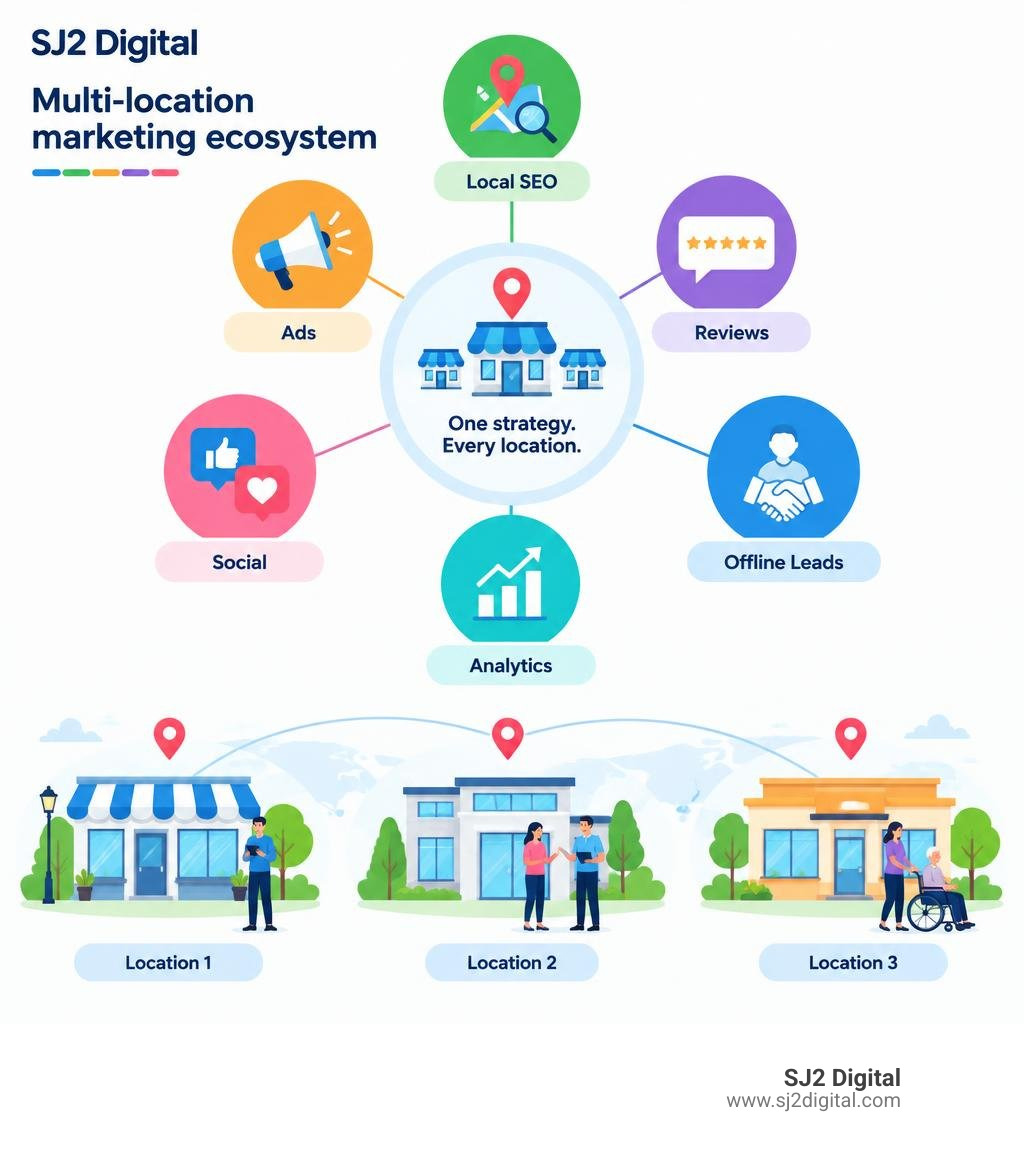
Core Foundations of Digital Marketing for Multi Location Businesses
Managing digital marketing across multiple branches requires a balance between corporate governance and localized execution. If head office maintains total control without listening to individual community needs, campaigns become sterile and disconnected from local audiences. Conversely, if individual branch managers run their own independent marketing efforts without central oversight, brand consistency fractures, name-address-phone (NAP) data gets garbled across online directories, and budgets get wasted.

A winning structure relies on clear governance. Corporate leadership defines core branding, messaging, approved design assets, and overall budget allocation frameworks. Local teams provide the ground-level context: localized photos, community event updates, team member highlights, and direct customer feedback.
| Operational Factor | Centralized Corporate Marketing | Decentralized Local Execution | Hybrid Governance Model (Best Practice) |
|---|---|---|---|
| Brand Identity | Complete uniformity, low local nuance | High brand drift, conflicting messaging | Unified brand standards with customizable local modules |
| NAP & Citation Health | High consistency via central directory tools | Inconsistent phone numbers and addresses | Centrally locked core data, branch-editable hours/events |
| Speed to Market | Slower approvals for local promotions | Fast but prone to non-compliant errors | Pre-approved templates deployed rapidly by local teams |
| Budget Efficiency | High scale and media buying leverage | Fragmented spend, bidding against internal units | Unified programmatic buying with geo-fenced local allocation |
| Customer Engagement | Generic corporate tone in review replies | Authentic local voice, risks delayed follow-ups | Centralized monitoring inbox with localized response guidelines |
Partnering with a strategic digital marketing agency that uses an agile anti-agency model helps organizations set up this infrastructure without bloated retainers, giving leadership real-time visibility into branch performance while supporting local operators.
Structuring Digital Marketing for Multi Location Businesses Across Regions
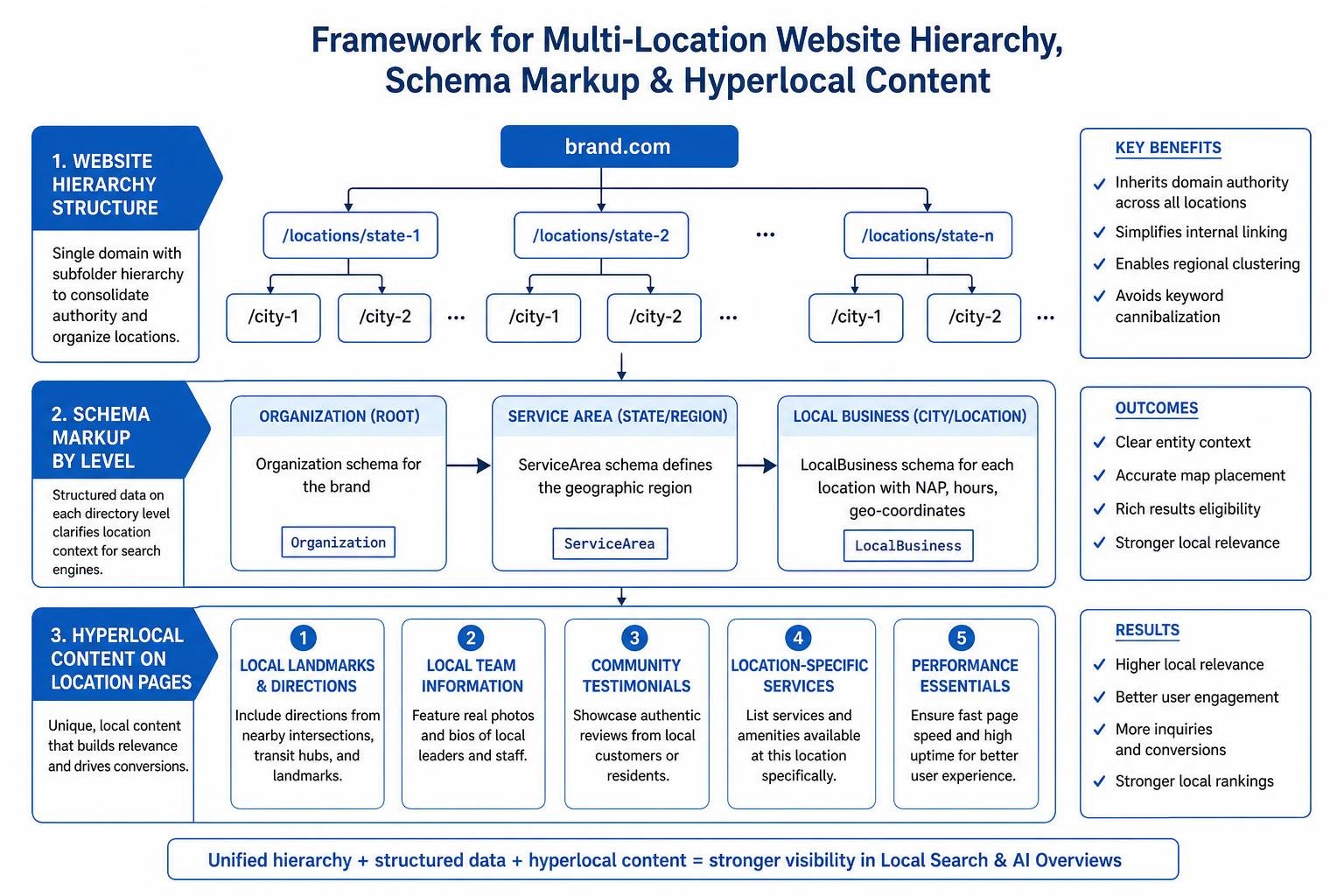
Website architecture is the technical foundation of multi-location discoverability. Using separate domain names for every single location dilutes domain authority, increases hosting overhead, and creates administrative chaos. The gold standard for multi-unit brands is a structured subfolder hierarchy on a single root domain:
brand.com/locations/[state-or-region]/[city-or-neighborhood]
This setup allows every location page to inherit the parent domain's accrued domain authority, backlinks, and brand equity. Subfolders also allow you to group physical locations into regional clusters. For multi-site operators, this structure simplifies internal linking loops—connecting regional hubs to specific community pages, and cross-linking relevant nearby locations without triggering keyword cannibalization.
Implementing structured data across these subfolders tells search engine algorithms exactly where each entity exists in the real world. By deploying specific schema markup on each directory level, you provide clear contextual boundaries that help search engines understand service areas, operating hours, and geo-coordinates.
Scalable Content and Localized Landing Pages
A common mistake multi-location brands make is creating thin, templated location pages where only the city name is swapped out. Search algorithms easily recognize duplicate text, and visitors quickly bounce when they encounter generic corporate boilerplate.
Every individual location page needs genuinely unique, hyperlocal content to convert visitors into inquiries:
- Specific Neighborhood Landmarks: Mention driving directions from prominent local intersections, transit hubs, or landmarks.
- Local Team Information: Feature real photography and short bios of local executive directors, coordinators, or branch leadership.
- Community-Specific Testimonials: Showcase authentic reviews from customers or residents tied directly to that physical address.
- Detailed Service Offerings: Clarify exactly which services or amenities are available at that specific facility versus sister properties.
Fast page speed and maximum uptime are essential to keep bounce rates low when local prospects click your links. Ensuring your web ecosystem is backed by robust website server management prevents localized traffic surges from slowing down page responsiveness.
Dominating Local Search and Google AI Visibility at Scale
Local search is the primary driver of high-intent discovery. When a user conducts a query like "assisted living near me" or "memory care in [city]," the search engine surfaces the Local 3-Pack along with conversational summaries generated by AI. Securing high placement across both features requires optimizing entity signals, citations, and customer reputation across every location.

According to comprehensive guides like Multi-Location SEO: The Complete Strategy Guide, building sustainable visibility requires continuous maintenance of your business footprint across third-party directories rather than treating listings as a one-time setup. Implementing tailored search engine optimization ensures your brand maintains directory accuracy while continuously earning algorithmic trust.
Managing Google Business Profiles and Review Sentiment
Your Google Business Profile (GBP) is often the digital front door for each facility. Claiming and verifying profiles in bulk through an enterprise dashboard is only step one. Maintaining high local pack rankings requires systematic, ongoing profile engagement:
- Review Velocity and Recency: Having 50 reviews from three years ago won't help you outrank a competitor who gains 3 to 5 authentic reviews every month. Fresh review signals carry substantial weight in local ranking calculations.
- Rapid Response Workflows: Establish a system to respond to both positive and negative reviews within 24 to 48 hours. Constructive, empathetic replies to critical feedback demonstrate accountability to prospective families reading your reviews.
- Active Visual Content: Regularly upload high-resolution, geo-tagged photos of each property. Profiles that consistently upload new photos receive significantly more interaction and direction requests.
- Bi-Monthly Updates and Posts: Share news about local community events, new staff introductions, seasonal health tips, and educational workshops directly via the Google Updates feature.
Centralized tools such as a Franchise & Multi-Location Marketing Platform allow corporate teams to monitor review feeds and schedule listing updates across dozens of locations simultaneously, preventing regional managers from becoming overwhelmed.
Entity Signals and AI Recommendation Engines
Modern search tools no longer just rank web pages—they act as recommendation engines. Features like AI Overviews and Google Ask Maps pull data from diverse sources using Retrieval-Augmented Generation (RAG) to deliver conversational answers to user prompts.
As outlined in Multi-Location SEO: How To Win Google & AI Search Visibility At Scale, brands must feed large language models structured, unambiguous data to ensure their properties are recommended when AI synthesizes options for users.
To optimize your brand entities for AI search visibility:
- Embed LocalBusiness JSON-LD: Include specific geo-coordinates, complete NAP information, accepted payment methods, opening hours, and unique service catalog entries.
- Utilize
sameAsSchema Tags: Link individual location pages directly to their verified social media profiles, local chamber of commerce listings, and relevant industry accreditation directories. - Monitor Sentiment Across Third-Party Sites: AI assistants scan Yelp, Facebook reviews, and specialized niche directories to evaluate sentiment. Inconsistent details or poor sentiment across unmanaged secondary listings can lower recommendation confidence in conversational search results.
Omnichannel Paid Acquisition and Lead Generation
While organic local search builds long-term authority, paid media delivers immediate, predictable lead generation for individual locations. The secret to profitable multi-location advertising lies in granular geographic targeting and personalized creative.
Broad, national paid search campaigns often waste spend by showing generic ads to users searching outside realistic travel radiuses. Structuring separate ad campaigns for each physical location allows you to deploy geo-fencing, adjust radius bidding based on drive times, and customize ad copy with local neighborhood terminology.
High-ROI Paid Advertising and Digital Marketing for Multi Location Businesses
An efficient paid multi-location strategy combines search intent with targeted programmatic display to reach prospective customers at every stage of their decision journey:
- Intent-Driven Paid Search: Setting up targeted pay per click campaigns allows you to capture high-intent keyword searches within precise mileage radiuses of each property. Local ad extensions—such as call assets, location assets, and sitelinks to specific pricing guides—dramatically increase click-through rates.
- Dynamic Retargeting and Geo-Fencing: Utilizing programmatic advertising solutions lets you serve banner and native ads to individuals who have visited competitor locations or researched related topics within your market area.
- Dynamic Keyword Insertion: Tailor your ad headlines to automatically reflect the user's specific suburb or metropolitan area, driving up ad relevance scores and reducing overall cost per click (CPC).
Localized Social Media and Automated Nurturing
Social platforms are crucial for community storytelling and building local trust. Multi-location brands should maintain parent brand social pages while enabling location-specific Facebook and LinkedIn pages for individual communities.
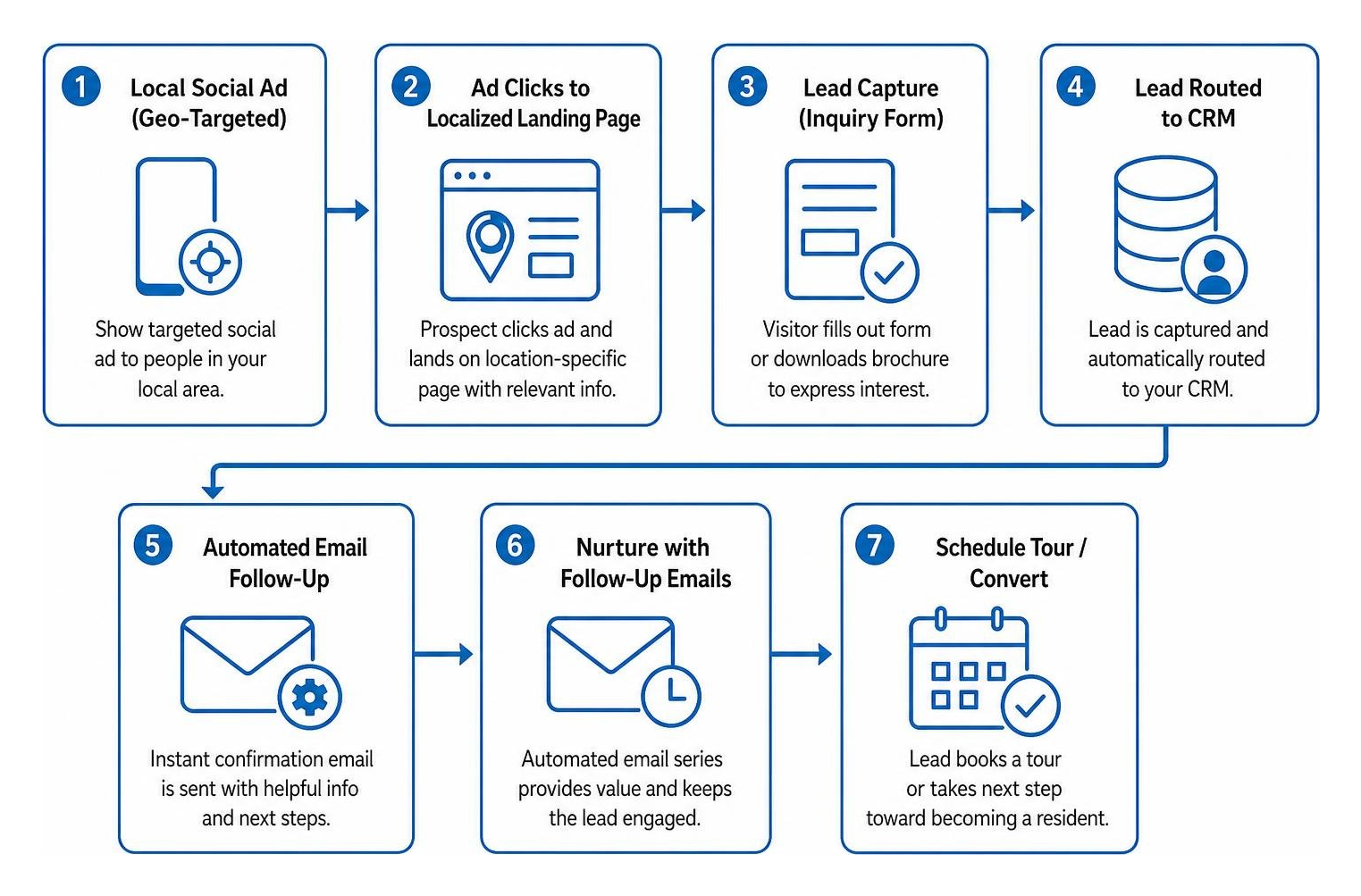
Deploying localized social marketing allows individual properties to showcase life inside their communities—celebrating resident birthdays, sharing behind-the-scenes staff highlights, and advertising open house events to nearby families.
Once a prospective customer fills out an inquiry form or downloads a brochure, immediate automated follow-up is vital. Implementing automated email workflows ensures that the lead receives an instant confirmation containing the local director's direct contact info, a virtual video tour, and an invitation to schedule an in-person visit. Integrating these workflows into your central CRM ensures no lead falls through the cracks between central intake and local tour guides.
Performance Measurement, Attribution, and Offline Integration
For multi-location enterprises, aggregate marketing metrics can be deceiving. A campaign showing a healthy average conversion rate across 20 locations might be hiding three locations driving 80% of the volume while five locations receive zero qualified leads.
Effective multi-unit reporting requires granular attribution that ties digital clicks directly to offline business results, such as scheduled facility tours, phone inquiries, and move-ins.
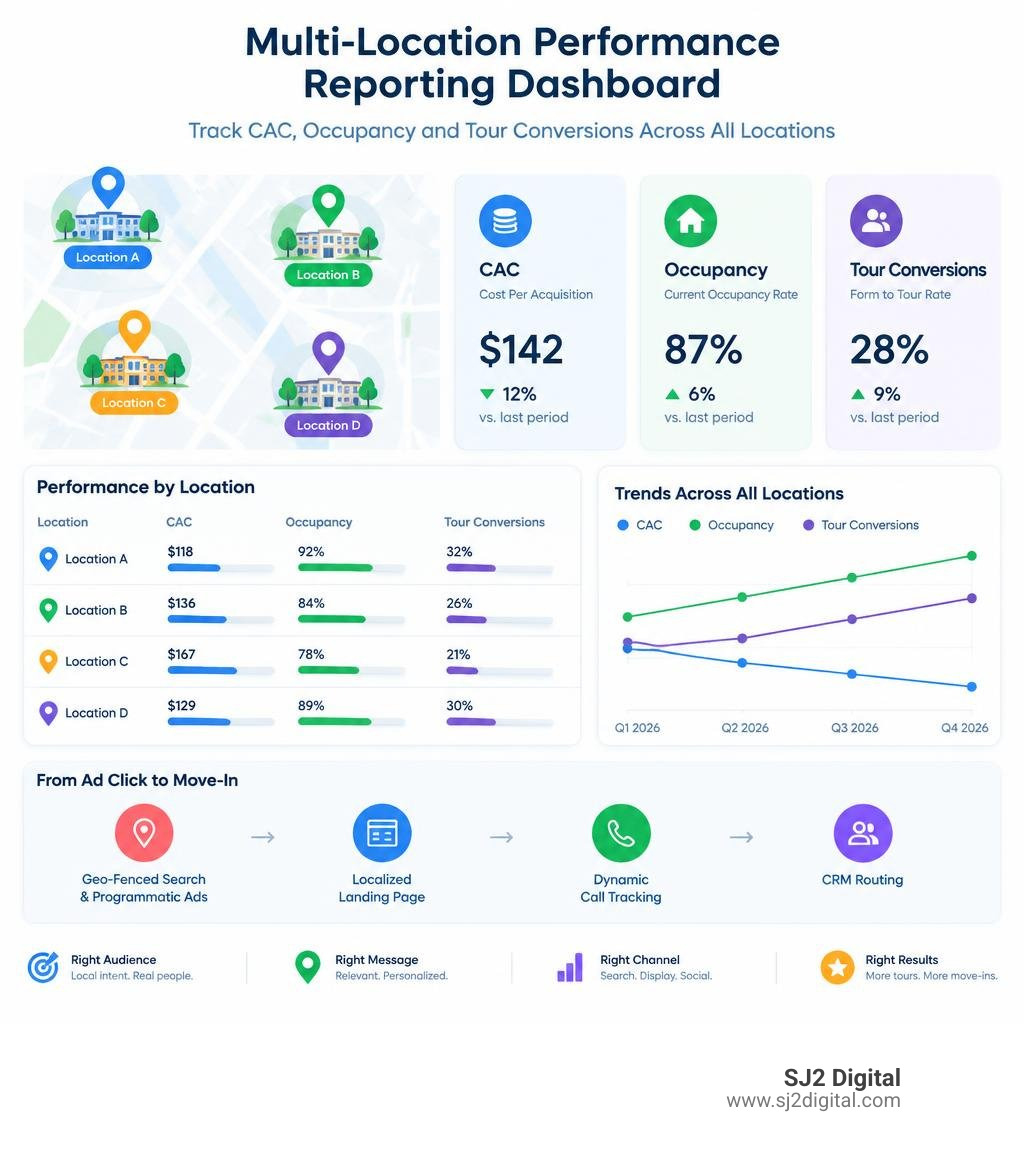
To maintain clarity, organizations need unified dashboards tracking location-specific Key Performance Indicators (KPIs):
- Cost Per Acquisition (CAC) by Branch: Measure the exact media spend required to generate a signed agreement or move-in at each site.
- Dynamic Call Tracking: Assign unique, localized forwarding numbers to each paid channel and Google Business Profile to track phone call volume, duration, and conversion outcomes by source.
- Foot Traffic and Tour Conversions: Measure the transition rate from online direction requests or scheduled form submissions to physical facility walk-ins.
- Cost-to-Income Monitoring: Evaluate marketing spend as a percentage of branch revenue, ensuring marketing investments align with localized financial performance and occupancy targets.
Deploying specialized senior living marketing strategies helps operators connect digital touchpoints with high-touch human interactions, providing families with a seamless experience from their first Google search to their move-in day.
Multi-Location Attribution and Budget Optimization
Marketing budgets should not be distributed equally across all branches. Locations operate in distinct competitive landscapes with differing baseline occupancies, local demographic trends, and revenue potentials.
We recommend using a flexible budget allocation model:
- Baseline Maintenance Spend: Provide every location with a foundational budget to maintain core local SEO, citation health, and essential brand-search PPC protection.
- Growth and Fill Budgets: Allocate supplementary paid search, social, and programmatic budgets dynamically toward locations experiencing lower occupancy or opening new units.
- Macroeconomic Adjustments: Review regional economic indicators, housing market velocity, and local competitor density quarterly to adjust spend caps where the return on investment is highest.
Frequently Asked Questions About Multi-Location Marketing
How do multi-location brands prevent keyword cannibalization across city pages?
Keyword cannibalization occurs when multiple location pages on your website compete against each other for the same search queries, confusing search engines and splitting your ranking power. To prevent this:
- Use Granular Geographic Targets: Ensure each page's title tag, H1 heading, and meta description specifically mention its primary neighborhood or municipality rather than broad state-level terms.
- Delineate Service Areas in Schema: Use structured data to clearly define the exact zip codes or geographical boundary served by that specific location.
- Canonicalize Carefully: If you must display overlapping service offerings, ensure each page has enough unique local copy, FAQs, and staff bios that search engine crawlers recognize each URL as an independent, valuable entity.
What is the most effective way to balance corporate brand control with local branch needs?
The best approach is a tiered governance framework supported by role-based access controls:
- Corporate Level: Maintains master control over brand guidelines, core website architecture, enterprise ad spend, and baseline citation accuracy.
- Regional/Local Level: Granted access to view local analytics dashboards, upload authentic photos, respond to customer reviews using approved talking points, and request targeted local ad pushes for upcoming community events.
This structure protects the integrity of the parent brand while empowering local team members to engage authentically with their immediate community.
How do modern AI search engines evaluate multi-location businesses?
Modern AI search tools and Large Language Models evaluate businesses based on entity authority, consistency, and holistic web sentiment:
- Data Accuracy: Consistent NAP information across high-authority mapping ecosystems, state registries, and industry directories signals legitimacy.
- Review Sentiment: AI algorithms analyze customer review text across Google, Yelp, and industry portals to understand specific strengths (e.g., "friendly staff," "clean facilities," "excellent memory care program").
- Structured Entity Relationships: Rich JSON-LD schema markup helps machine learning models map the relationship between your parent brand, regional branches, executive directors, and specific medical or care services.
Conclusion
Scaling digital marketing across multiple locations doesn't require managing dozens of disconnected agencies or accepting rigid, one-size-fits-all contracts. By building a unified foundation of structured local SEO, unique community landing pages, geo-targeted paid acquisition, and transparent closed-loop analytics, multi-unit operators can dominate their local markets and maintain strong occupancy across every property.
At SJ2 Digital, we operate on a transparent "anti-agency" model designed for growing brands. We eliminate bloated overhead and rigid long-term retainers, providing hands-on senior marketing leadership, live custom performance dashboards, and data-driven execution tailored to your specific budget.
Ready to increase qualified tours and dominate local search across all your communities? Explore our comprehensive marketing services to discover how our senior team can accelerate your multi-location growth today.