
Key Traits to Look for in a Top-Tier PPC Management Agency
Core Criteria for Evaluating a PPC Management Agency

Choosing a partner to run your paid campaigns requires looking past polished sales decks. A top-tier team approaches your budget as an investment that must return measurable profit. Whether you are driving qualified leads or selling products, partner evaluation begins with how an agency structures campaigns, optimizes bids, and measures financial return.
Many agencies rely on vanity metrics that look impressive on paper while masking underlying account decline. A reliable performance marketing agency focuses instead on commercial growth metrics that directly affect your bottom line. For a broader view of how paid search fits into digital advertising, the pay-per-click model is a useful reference point.
| Metric Type | Vanity Metrics (What Weak Agencies Highlight) | High-Impact Metrics (What Elite Agencies Focus On) |
|---|---|---|
| Revenue & Efficiency | Raw Impressions, Ad Clicks, Isolated ACoS | TACoS (Total ACoS), Blended CPA, Net Contribution Margin |
| Account Health | Top-level spend pacing, CTR without conversion context | Listing/Landing page conversion rate, Organic rank lift |
| Search Hygiene | Total keywords targeted | Negative keyword coverage, Query isolation, Search term match rate |
| Data Visibility | Monthly PDF summary with blended averages | Live dashboards, Search term reports, Transparent changelogs |
Holistic Profit Metrics: Prioritizing TACoS Over Isolated ACoS
One of the most critical metrics to understand is TACoS (Total Advertising Cost of Sales). While traditional ACoS (Advertising Cost of Sales) measures ad spend strictly against ad-attributed revenue, TACoS measures ad spend against your total business revenue (paid plus organic).
Why does this matter? Looking only at ACoS creates a dangerous blind spot. An agency can show an acceptable 20% ACoS simply by bidding aggressively on brand names or high-intent search terms. However, if paid ads are merely cannibalizing traffic that would have converted organically, your overall profit drops.
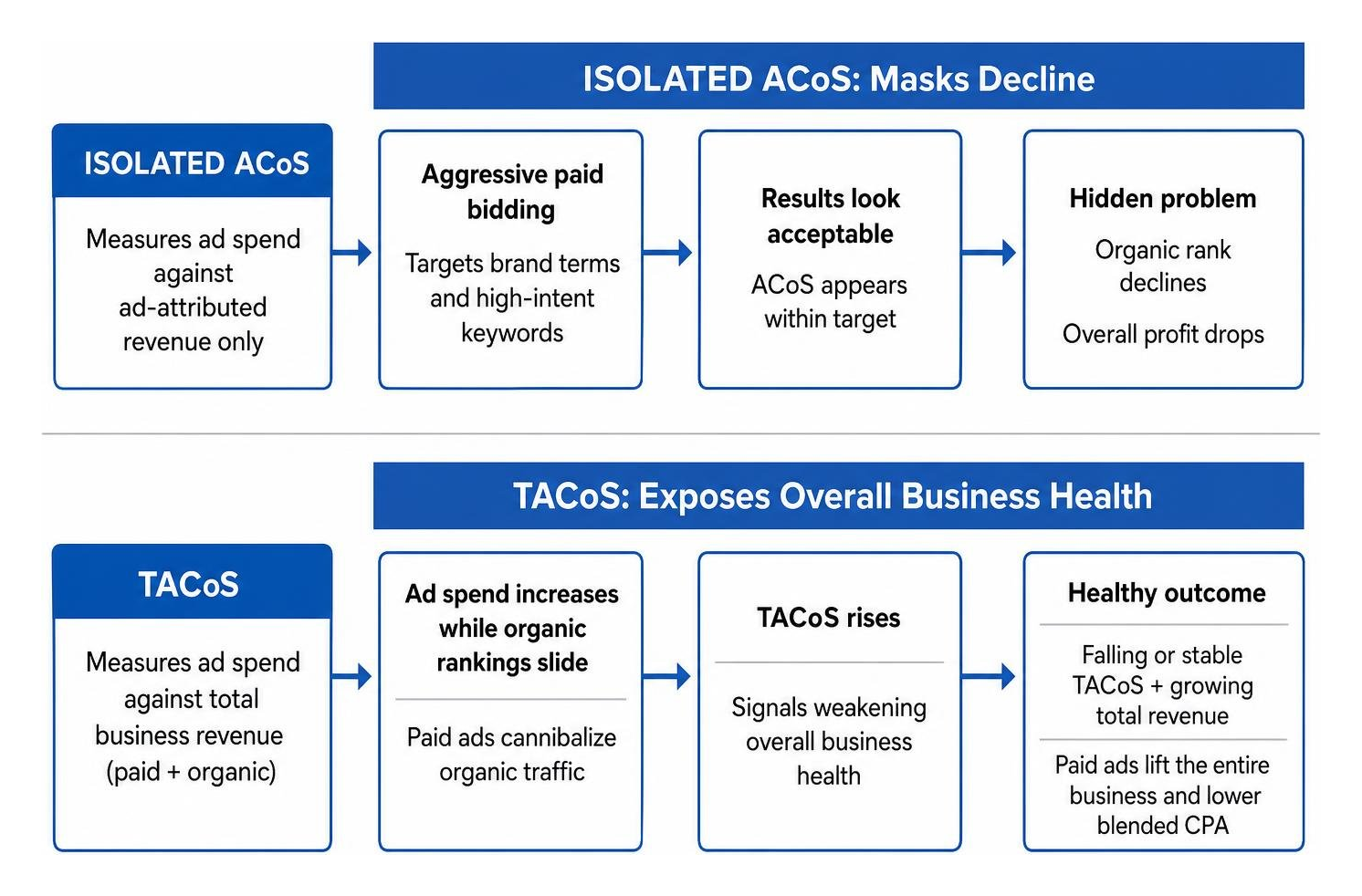
When ad spend increases while organic rankings slide, TACoS rises. A falling or stable TACoS alongside growing total revenue proves paid advertising is lifting the entire business by improving organic discoverability and lowering blended cost-per-acquisition (CPA).
Granular Campaign Architecture: The Isolated Keyword Structure
How an agency builds campaigns determines whether you have actual budget control or are wasting ad spend. Many low-touch agencies bundle multiple keywords, product targets, or ASINs into a single campaign or ad group. This hides poor performance, as high-converting search terms subsidize waste from irrelevant queries.
We advocate for granular campaign segmentation, such as the 1-1-1-1 structure (one campaign, one ad group, one target keyword/match type, one landing asset/ASIN):
- Isolated Budget Allocation: High-intent keywords receive dedicated funding without being starved by broad terms.
- Accurate Bid Optimization: Bids are calibrated based on exact historical performance rather than blended ad group averages.
- Search Intent Alignment: Creative copy, landing pages, and extensions match specific user search intent.
- Cleaner Negative Hygiene: Negative keywords can be applied without accidentally blocking relevant traffic in neighboring ad groups.
Real-Time Optimization Cadence vs. Stale Weekly Adjustments
Paid search auctions fluctuate continuously. Competitor bids shift, inventory levels change, and search volume peaks at specific times of the day.
Agencies that optimize on a weekly or bi-weekly cadence are essentially operating on stale data. By the time a weekly adjustment is made, your budget may have already absorbed days of irrelevant clicks on non-converting search terms. Top-tier practitioners execute daily reviews to manage query pruning, bid adjustments, dayparting, and budget pacing.
Agency Structure, Senior Ownership, and Operational Transparency
Beyond campaign architecture, the operational structure of the agency determines the quality of execution you receive every week.

When partnering with an experienced digital marketing agency, you should know exactly who is working inside your account and have direct access to unfiltered performance data.
Boutique vs. Large PPC Management Agency Models
Large holding-company agencies often rely on a traditional model: seasoned executives pitch the business, but day-to-day execution is handed off to junior coordinators managing dozens of accounts simultaneously.
| Dimension | Boutique / Owner-Led Model | Large Full-Service Agency |
|---|---|---|
| Day-to-Day Execution | Senior strategists and hands-on specialists | Junior account coordinators / entry-level buyers |
| Strategist Account Load | 5 to 10 accounts per senior specialist | 25 to 50+ accounts per manager |
| Agility & Communication | Direct access to practitioners; rapid adjustments | Layered account management; slow turnaround |
| Contract Terms | Flexible, month-to-month accountability | 6 to 12-month lock-in agreements |
| Ideal Fit | Growth-stage brands, mid-market operators | Massive enterprise brands requiring broad corporate coverage |
For growth-focused businesses, boutique and senior-led teams provide the dedicated focus and domain knowledge required to outmaneuver competitors.
Transparent Dashboards and Listing-Level Conversion Reporting
You should never have to wait for an end-of-month PDF report or sit through a confusing call just to understand whether your campaigns are working.
Transparent agencies provide live, cloud-based dashboards that integrate:
- Spend pacing and real-time conversion volume
- Blended cost-per-lead and listing-level conversion rates
- Organic search rank trajectory alongside paid volume
- Raw search-term query reports and detailed negative keyword additions
Flexible Month-to-Month Contracts vs. Long-Term Lock-Ins
Long-term lock-in contracts often protect the agency rather than the client. When an agency insists on a rigid 12-month agreement before demonstrating results, it removes their commercial incentive to optimize daily.
Agencies that operate on month-to-month retainers stake their revenue on continuous performance. If your campaigns do not generate tangible returns, you retain the freedom to pivot without financial penalties.
Identifying Warning Signs and Navigating PPC Pricing Models
Knowing what to avoid is just as valuable as knowing what to seek. Understanding typical fee structures helps ensure you pay for strategic execution rather than automated overhead.

Whether you run an e-commerce brand or oversee digital marketing for senior living, watching for structural warning signs keeps your budget secure.
Red Flags That Signal an Underperforming PPC Management Agency
If you notice any of these warning signs, your current paid search management may be failing:
- Frequent Account Manager Churn: If you are introduced to a new point of contact every few months, your account lacks strategic continuity.
- Blended or Opaque Reporting: Reports that only show top-level metrics (like total clicks or blended CTR) without revealing search term queries, conversion rates, or landing page behavior.
- Generic Audits Before Onboarding: Proposals filled with automated checklist scores rather than custom analyses of your commercial bottlenecks.
- Stagnant Search Query Hygiene: If search query reports reveal thousands of dollars spent on irrelevant broad queries without negative keyword additions, the account is being neglected.
- No Discussion of Organic Interaction: An agency that ignores your organic positioning cannot optimize for overall business profitability.
For specialized operators, working with a dedicated senior living PPC agency prevents common pitfalls like bidding on non-local searchers or low-intent informational keywords.
Realistic Cost Expectations and Management Pricing Structures
PPC management fees typically fall into three standard pricing structures:
- Flat Monthly Retainer: A predictable monthly fee (commonly ranging from $1,500 to $10,000+ per month depending on catalog complexity and active channels). This aligns incentives around profitability rather than encouraging unnecessary ad spend.
- Percentage of Ad Spend: The agency charges a variable fee (typically 10% to 20% of gross media spend). While accessible, it can create a conflict of interest if the agency encourages higher spend without proportional return.
- Hybrid Base Retainer + Performance Incentive: A smaller base fee combined with performance bonuses tied to revenue growth, tour bookings, or TACoS reduction milestones.
Frequently Asked Questions About PPC Management Agencies
What is the difference between TACoS and ACoS when measuring agency performance?
ACoS measures ad spend divided by ad-attributed revenue. While useful for checking immediate campaign efficiency, it ignores organic sales.
TACoS measures ad spend divided by total revenue (both paid and organic). TACoS shows whether paid ads are helping your entire business grow or simply cannibalizing organic traffic you would have received anyway. A declining or steady TACoS with growing revenue indicates healthy, profitable scaling.
How often should a dedicated paid search team optimize campaigns?
A dedicated team should monitor and optimize accounts daily. Search auctions, competitor bids, and inventory availability change hour by hour. Daily reviews ensure negative search queries are added before wasting budget, bids are paced accurately, and sudden drop-offs in conversion rate are caught immediately.
What pricing models do PPC agencies typically use?
Most agencies utilize flat monthly retainers ($1,500 to $10,000/month), a percentage of ad spend (10% to 20%), or hybrid tiers combining a base fee with performance targets. Flat retainers or hybrid models generally offer the clearest alignment between agency work and client profitability.
Conclusion
Choosing the right partner comes down to finding senior expertise, granular execution, and complete reporting transparency. At SJ2 Digital, we operate under an anti-agency model: our senior strategists work directly inside your accounts with no long-term contracts, daily hands-on optimization, and live dashboards that clearly show your real return.
If you are ready to scale inquiries and lower your acquisition costs, explore our specialized approach to senior living pay per click advertising and discover how direct, transparent management turns ad spend into sustainable growth.