
How Senior Living Geofencing Supports Safer, More Open Communities
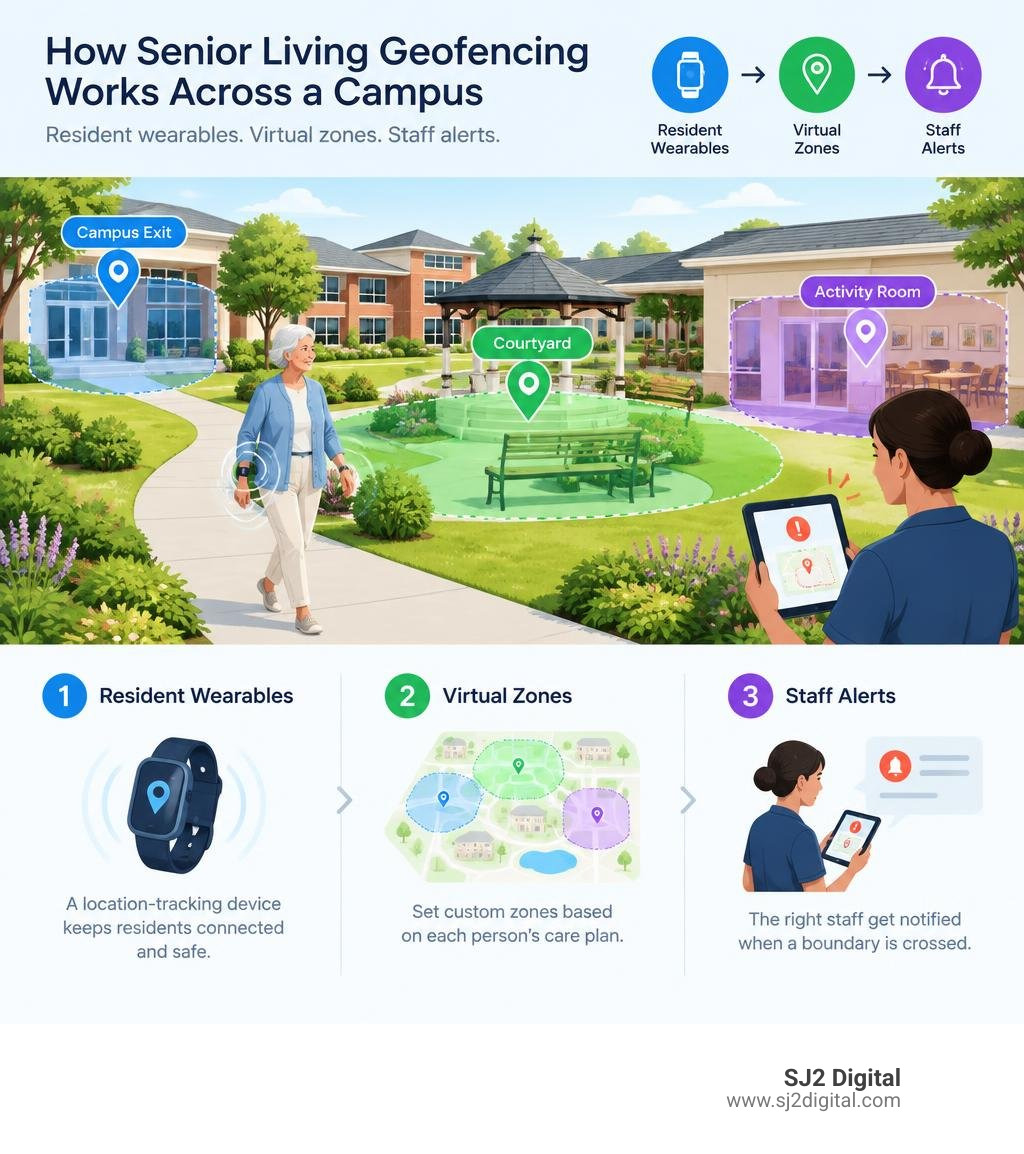
Senior living geofencing lets a community set virtual boundaries around places such as courtyards, activity rooms, and campus exits. To put it to work, choose a location-tracking device residents can wear, set zones based on each person's care plan, and decide which staff members receive alerts when a boundary is crossed.
An estimated six in ten people living with dementia will wander at least once. Geofencing can help staff spot a risk sooner without limiting every resident to a locked area. It adds to door security and staff supervision; it does not replace them.
What Is Senior Living Geofencing and How Does It Work?
Senior living geofencing establishes invisible digital perimeters across physical spaces using radio frequency, satellite, or network signals. Instead of relying purely on physical barriers or static door alarms, operators can map out custom indoor and outdoor zones that dynamically track movement.
Traditional wander management systems are largely reactive. For decades, memory care units relied heavily on door-mounted magnetic sensors or basic radio frequency identification (RFID) bands that shrieked only when a resident breached an exit doorway. By that point, an elopement event was already underway.
Geofencing transforms this paradigm from reactive panic to proactive prevention. By establishing multi-tiered zones—such as warning corridors, transition zones, and safe perimeters—care teams receive early alerts long before a resident reaches an exterior exit.
| Technology | Primary Environment | Typical Accuracy | Battery Longevity | Infrastructure Footprint |
|---|---|---|---|---|
| Bluetooth Low Energy (BLE) | Indoor wings & common rooms | Sub-meter to room-level | Several months to 2+ years | Low (plug-in gateways/beacons) |
| GPS (Global Positioning System) | Outdoor grounds & trails | 3 to 10 meters | 24 to 72 hours (rechargeable) | None on-site (uses satellites/cellular) |
| Wi-Fi Triangulation | Indoor community spaces | 3 to 5 meters | Moderate (higher power draw) | Uses existing access points |
Core Tracking Technologies in Senior Living Geofencing
Modern community setups frequently employ hybrid location tracking to achieve continuous visibility across varied environments:
- Bluetooth Low Energy (BLE): Uses discreet wall beacons and lightweight tags to deliver room-level and sub-meter indoor precision with minimal power consumption.
- GPS: Engages when residents step into large outdoor courtyards, walking paths, or memory gardens, tracking broad geographic movements via satellite and cellular connectivity.
- Wi-Fi Triangulation: Leverages the facility's existing network infrastructure to provide secondary positioning references when residents move through administrative or dining wings.
Equipping residents with purposeful resident safety technology—such as wristbands, watch-style bands, or discreet pendants—ensures consistent tracking across all of these protocols without stigmatizing the individual.
Indoor Zone Monitoring vs. Campus Perimeter Security
Geofencing systems allow community managers to create highly granular operational boundaries:
- Indoor Zone Monitoring: Assigns safe movement zones tailored to specific care levels. If an assisted living resident enters a restricted service corridor or kitchen, staff receive an instant update.
- Outdoor Campus Perimeters: Encompasses secure landscaped courtyards, patio areas, and walking paths. Residents enjoy fresh air freely while staff are alerted if someone wanders toward an outer gate or vehicle bay.
- Temporary Activity Geofences: Care coordinators can establish time-limited virtual zones around multipurpose rooms, art studios, or dining halls during scheduled programming. When the event finishes, the zone automatically deactivates.
Just as a modern location-based advertising agency uses geographic coordinates to target digital messages accurately, senior care operators use precise spatial boundaries to protect residents and streamline movement.
Protecting Resident Dignity While Mitigating Elopement Risks
When an older adult experiences cognitive changes, physical confinement behind locked doors can induce anxiety, agitation, and frustration. Six in ten people living with dementia will wander, but that wandering is often an expression of unmet needs, curiosity, or a desire for physical exercise.
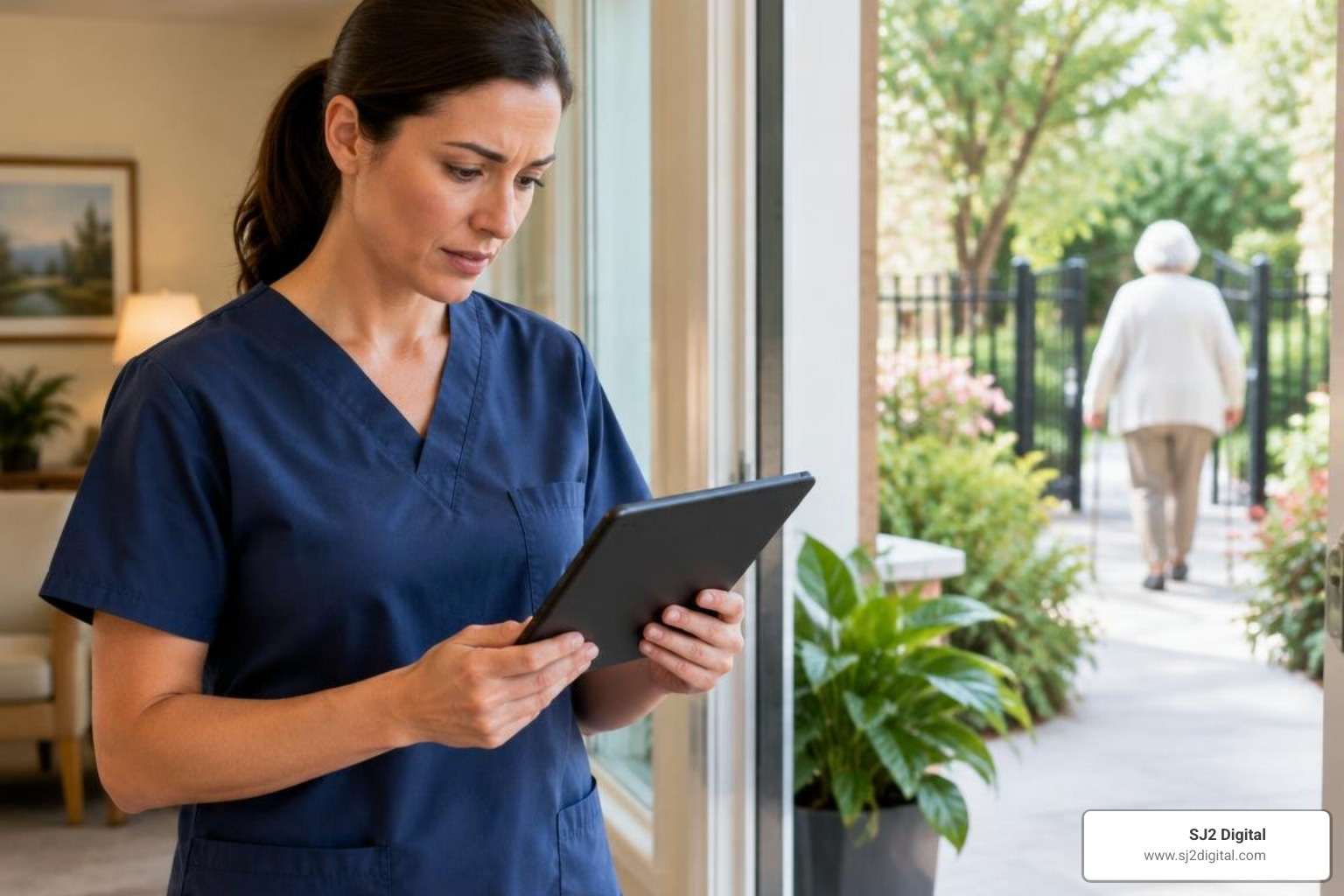
Geofencing offers a dignity-first framework. Instead of locking down entire wings, communities can establish safe navigational paths that empower individuals to explore secure open spaces.
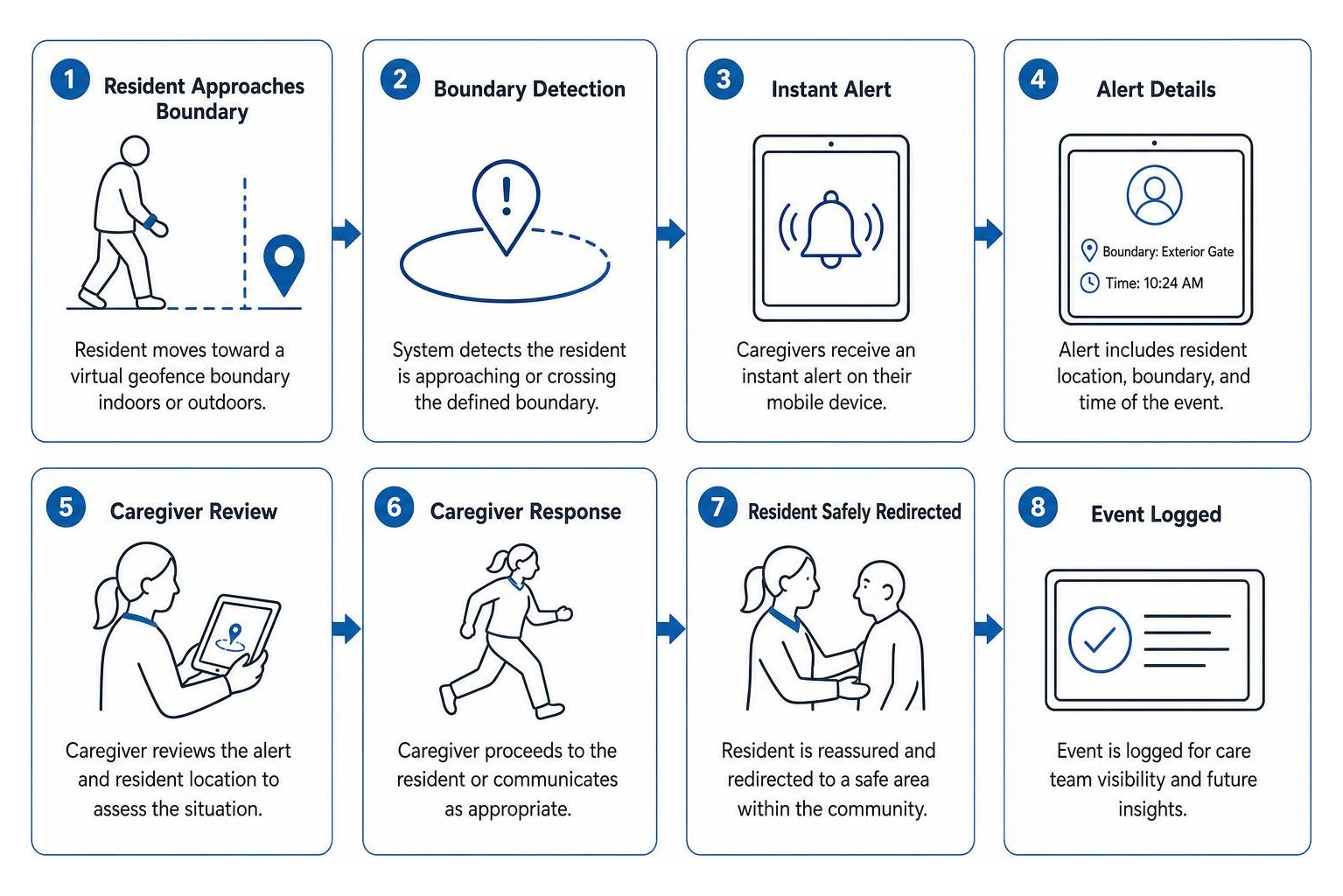
By monitoring behavioral baselines—such as typical pacing rhythms, frequent rest spots, and regular activity hours—the system detects unusual deviations before an elopement attempt occurs.
Key Operational Benefits of Senior Living Geofencing
Implementing intelligent virtual boundaries directly enhances day-to-day community operations:
- Accelerated Response Times: Staff receive precise location data on mobile devices, directing them straight to the resident rather than searching hallway by hallway.
- Reduced Caregiver Burden: Automated monitoring relieves caregivers from constant line-of-sight supervision, allowing them to focus on direct care.
- Regulatory Compliance & Audit Readiness: Systems record detailed timestamp logs showing exact movement trails, incident timelines, and staff response intervals for state licensing and Centers for Medicare & Medicaid Services (CMS) audits.
- Workforce Optimization: Synchronizing security data alongside time and attendance integration platforms ensures shifts maintain required staffing ratios across designated high-acuity wings.
Real-Time Location Systems (RTLS) Integration
Standalone geofencing is powerful, but full real-time location systems (RTLS) elevate campus operations across multiple touchpoints:
- Nurse Call & E-Call Integration: When a resident presses their emergency pendant, the RTLS broadcasts their live location to the nearest caregiver's handset.
- Electronic Health Records (EHR): Location histories sync with resident care plans, updating clinical charts on wandering tendencies and daily activity levels.
- Access Control Coordination: Door locks can dynamically engage only when an at-risk resident approaches, leaving access unrestricted for staff, visitors, and independent residents.
- Automated Fall Detection & Two-Way Voice: Built-in accelerometers identify sudden falls, while integrated two-way voice enables immediate reassurance from care teams.
Communities can review aggregated movement trends through a centralized senior living data dashboard to identify operational bottlenecks and adjust care staffing accordingly.
Evaluating Geofencing Solutions and Total Cost of Ownership
Selecting the right geofencing infrastructure requires balancing technical capabilities against long-term maintenance and resident comfort.

Technical Criteria and Hardware Selection
When evaluating vendor offerings, prioritize these core architectural standards:
- Wearable Form Factors: Ensure devices are lightweight, hypoallergenic, and tamper-resistant (such as cut-resistant wristbands or secure watch closures) to prevent intentional removal.
- Battery Life and Charging Infrastructure: Indoor BLE tags should offer 12 to 24 months of continuous life without charging, while high-draw GPS cellular units should feature intuitive wireless drop-in charging docks.
- Waterproof Ratings: Hardware must carry at least an IPX7 waterproof certification so residents can safely wear devices in showers, baths, and wet environments.
- On-Premise vs. Cloud Infrastructure: On-premise local servers offer continued alert processing even during internet outages, while secure cloud networks simplify multi-campus software updates.
- Mesh Network Reliability: Wireless mesh networks automatically route signals around obstructions, ensuring zero blind spots across complex architectural designs.
Implementation Costs and Operational ROI
Evaluating total cost of ownership (TCO) involves examining both upfront capital expenses and ongoing operational savings:
- Hardware & Infrastructure: Wearable beacons, BLE gateways, door controllers, and centralized server hubs.
- Software Licensing & Monitoring: Cloud software subscriptions, automated firmware updates, and mobile caregiver application licenses.
- Onboarding & Staff Training: Comprehensive education programs to teach caregivers alert protocols and minimize false-alarm fatigue.
- Tangible ROI Realization: Facilities see direct cost reductions through lower liability insurance premiums, fewer emergency transports, and decreased staff turnover resulting from reduced supervision stress.
Integrating modern safety infrastructure alongside cutting-edge digital marketing for senior living elevates community reputation, reassuring prospective families of institutional excellence.
Aligning Campus Safety Systems with Strategic Community Marketing
Investing in sophisticated safety infrastructure is not just an operational upgrade; it is a major differentiator for family decision-makers. When adult children tour communities for their aging parents, safety and freedom of movement are top concerns.
Demonstrating live geofencing maps during facility walkthroughs transforms a standard tour into an impressive showcase of modern care. Families see that their loved ones will not be confined behind institutional locked doors, but protected by intelligent, invisible safeguards.
To communicate this technological standard to prospective residents, operators partner with our team for comprehensive senior living marketing services.
Highlighting advanced wander management alongside strategic competitor geofencing allows forward-thinking operators to stand out in crowded regional senior care markets.
Frequently Asked Questions About Geofencing in Senior Living
What is the difference between geofencing and traditional wander management?
Traditional wander management relies primarily on reactive perimeter alarms triggered at exterior doorways. Geofencing utilizes continuous real-time mapping across both indoor and outdoor spaces, creating dynamic zones that notify staff well before a resident reaches an unsecured boundary.
Can geofencing replace physical locks in memory care communities?
No. Geofencing is designed as an intelligent safety layer that complements physical access controls, secured doors, and staff supervision. It provides early awareness and broadens safe movement areas, but does not eliminate necessary physical barriers.
How accurate is indoor geofencing tracking for resident safety?
Indoor systems utilizing Bluetooth Low Energy (BLE) and real-time mesh networks achieve sub-meter to room-level precision. This level of accuracy allows staff to distinguish between a resident sitting in their bedroom versus walking into an adjacent restricted hallway.
Conclusion
At SJ2 Digital, we partner with progressive operators who understand that modern senior living demands both operational excellence and dignified, resident-centered care. Geofencing technology bridges the gap between resident autonomy and uncompromising safety, delivering peace of mind to caregivers, residents, and families alike.
By pairing modern community safeguards with data-driven outreach, communities can build thriving, high-occupancy environments. Explore how our specialized programmatic advertising for senior living can help you share your community's safety and care advantages with the families who need them most.