
Why B2B Teams Rely on Lead Nurturing Services

Reliable B2B lead nurturing services provide signal-driven, multi-channel workflows that combine automated lead scoring, dynamic content personalization, and CRM integration to convert stalled pipeline into sales-ready opportunities. Instead of relying on manual follow-up, these systems trigger context-aware outreach when prospects show buying intent, then route qualified leads to sales with complete behavioral context.
Generating interest at the top of the funnel is only half the battle. In modern B2B markets, the real bottleneck happens right after the first touchpoint. An estimated 79% of marketing leads never convert into sales without proper nurturing, and 80% of new inquiries slip through the cracks due to ineffective management.
Most sales opportunities are lost not from a lack of interest, but from follow-up fatigue. Closing a complex B2B deal typically requires at least five follow-up touches, yet 44% of sales reps abandon outreach after a single attempt. In fact, only 8% of sales reps consistently carry out enough touches to win the deal. The reality is that 44% of sales reps report being too overwhelmed with daily tasks to follow up with every lead, while 71% of SDRs spend disproportionate time on manual data entry rather than having meaningful sales conversations.
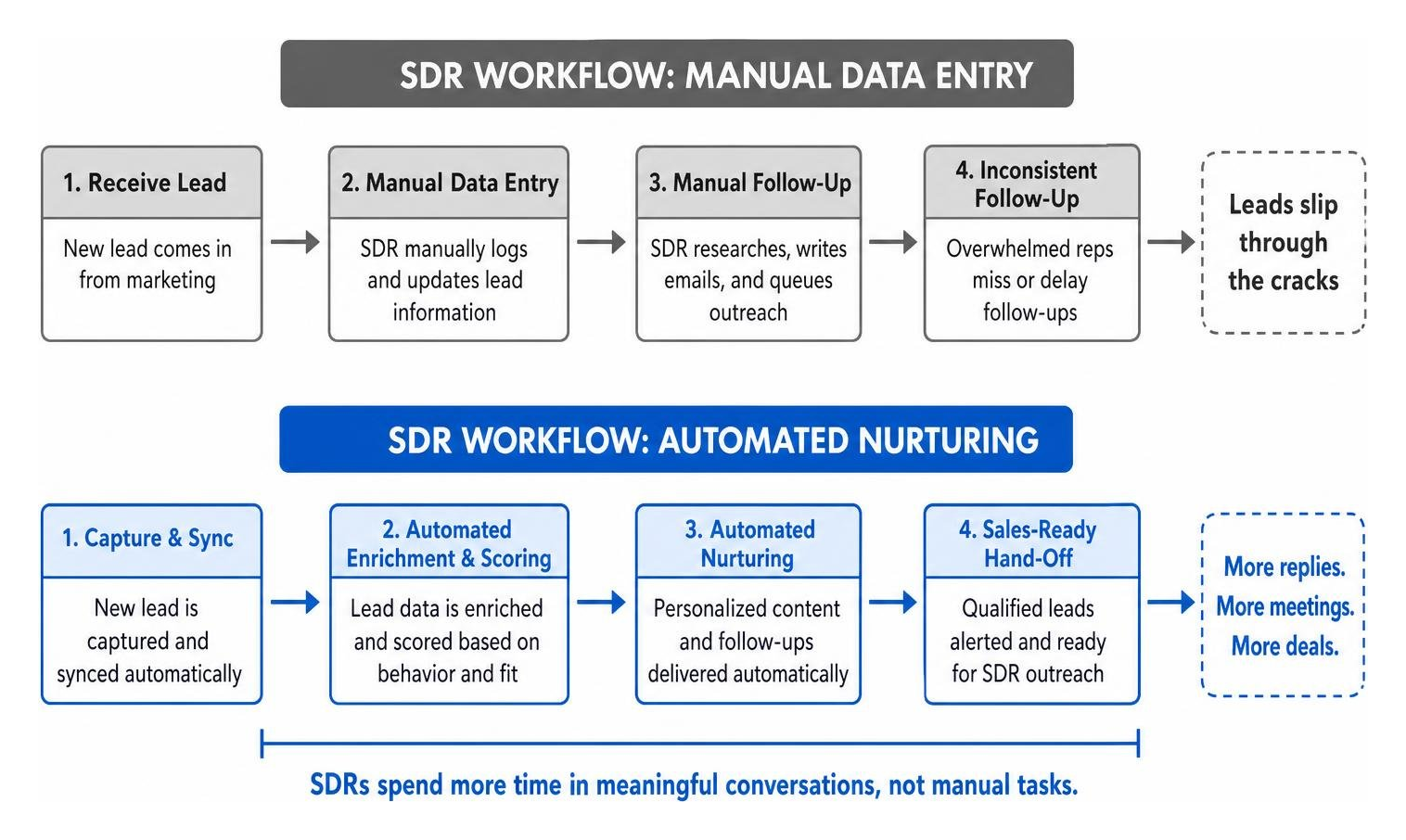
This disconnect is why high-performing teams partner with specialized providers for their lead nurturing initiatives. When you implement structured, automated lead management, the business impact is immediate and measurable:
- Lower Acquisition Costs and Higher Volume: Companies with disciplined nurturing systems produce 50% more sales-ready leads at a 33% lower cost per lead.
- Larger Deal Sizes: Educated, nurtured buyers make purchasing decisions with greater confidence, yielding deal sizes that are 47% larger on average than non-nurtured prospects.
- Compressed Sales Cycles: Consistent, relevant touchpoints keep deals moving forward, shortening average sales cycle lengths by 23%.
- Expanded Pipeline Yield: Marketing automation software drives an average 451% increase in qualified leads while generating a 20% overall increase in active sales opportunities.
- Reactivating Dormant Pipeline: Structured re-engagement workflows bring dormant leads back into active buying cycles, often adding 30% more pipeline value without increasing ad spend.
Even with these proven advantages, only 35% of companies maintain an active, structured nurture process. Deploying an intelligent system—as detailed in our CRM marketing automation guide—allows organizations to bridge the divide between initial marketing interest and booked sales revenue. For broader context on how these systems fit into the modern buying journey, Forrester's research on B2B buying behavior highlights why persistent, context-rich follow-up has become essential for revenue teams.
Core Capabilities to Evaluate in B2B Lead Nurturing Services
Selecting an external partner or dedicated workflow solution requires looking past surface-level email sequences. High-performing nurture systems combine behavioral intelligence, dynamic data sanitation, and cross-channel timing to deliver the right message at the right moment.
When vetting potential providers, evaluate whether their operational framework includes these fundamental capabilities:
- Intent Data and Signal Tracking: Modern nurturing goes far beyond rigid calendar schedules. Reliable systems track real-time behavioral signals across web visits, document re-engagement, and content downloads to trigger context-aware outreach.
- Automated Data Hygiene and Contact Verification: High bounce rates ruin sender reputations. Leading solutions continuously verify email addresses and contact information at every touchpoint, maintaining 95%+ data accuracy across long-term sequences.
- Dynamic Content Personalization: Generic templates yield declining returns. Personalized calls-to-action convert 202% better than standard static variations. Your nurture workflows must dynamically pull prospect industry pain points, previous touchpoint data, and company context into every email or text message.
- Multi-Channel Orchestration: Modern decision-makers do not live solely in their email inboxes. Advanced services orchestrate cohesive touchpoints across email, SMS, LinkedIn outreach, and programmatic retargeting.
| Capability | Traditional Static Drips | Signal-Triggered Nurture Services |
|---|---|---|
| Outreach Timing | Fixed calendar days (e.g., Day 1, Day 4, Day 8) | Dynamic triggers based on real-time prospect activity |
| Contextual Relevance | Generic, one-size-fits-all product messaging | Tailored responses referencing specific page visits or asset views |
| Data Hygiene | Static contact lists with gradual data decay | Continuous real-time verification at every touchpoint |
| Sales Alignment | Manual handoffs with minimal context | Instant automated routing with complete behavioral timelines |
| Average Engagement | Declining open and click-through rates | Up to 3x higher reply and meeting conversion rates |
Signal-Driven Automation vs. Static Drips
Traditional email drips operate on rigid, arbitrary calendars. A lead receives Email #1 on Monday, Email #2 on Thursday, and Email #3 the following week, regardless of whether they visited your pricing page three times over the weekend or haven't opened an email in months.
Signal-driven automation upends this static model. Instead of relying on guesswork, workflows activate when a prospect exhibits specific buying intent:
- Content Re-engagement: A dormant contact suddenly re-opens a case study or proposal they received a month ago.
- High-Intent Web Visits: A prospect returns directly to your service comparison or pricing page.
- Organizational Milestones: An account announces new funding, key executive hires, or organizational expansion.
- Direct Channel Interaction: A prospect engages with an SMS prompt, social post, or webinar replay.
Triggering outreach based on real behavioral signals rather than rigid dates produces up to 3x higher reply rates. By acknowledging exactly where the prospect is in their research process, your messaging delivers timely value instead of appearing as unwanted inbox clutter.
Predictive AI Lead Scoring and Sales Handoff
Lead nurturing should not aim to keep leads trapped in endless email loops; its primary goal is driving qualified, warm sales conversations. That requires clear, objective criteria for when a prospect is ready for direct human sales outreach.
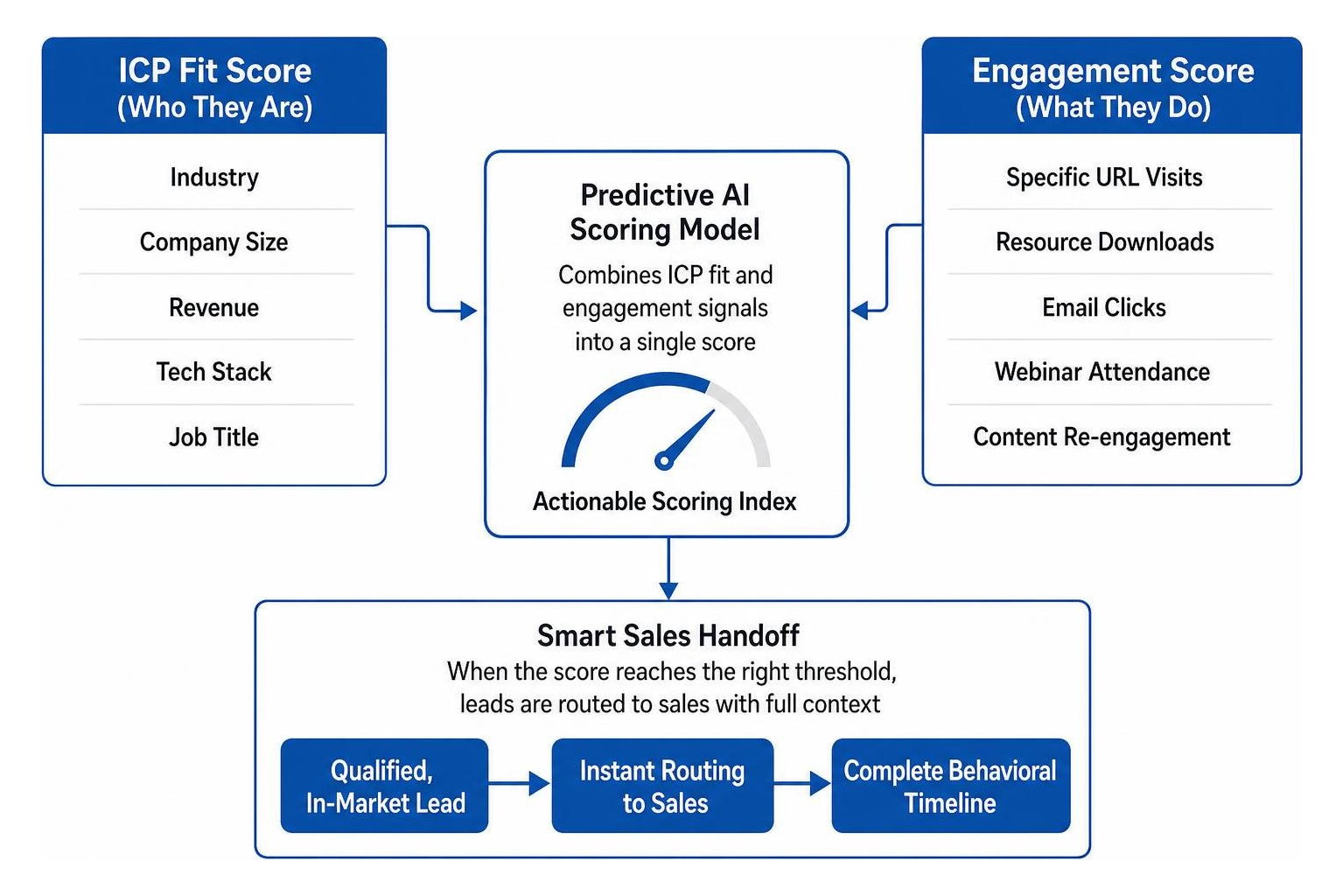
Leading systems leverage two-dimensional scoring models:
- Ideal Customer Profile (ICP) Fit: Evaluates objective firmographic criteria (industry, company size, revenue, tech stack, job title).
- Intent and Engagement Score: Evaluates real-time behavioral intensity (specific URL visits, resource downloads, email clicks, webinar attendance).
Combining these dimensions creates an actionable scoring index:
When a prospect crosses your predefined sales-readiness threshold, the system triggers instant sales routing. Rather than passing along a cold contact name, the sales team receives a full contextual brief detailing what topics the prospect researched, which assets they opened, and what pain points they prioritized. Integrating these capabilities into your marketing automation for lead generation workflows eliminates friction between marketing qualified leads (MQLs) and sales accepted opportunities.
Service Delivery Models: Selecting the Best Fit for Your Team
Determining how to execute your lead nurturing strategy comes down to evaluating internal bandwidth, technical maturity, and operational resources.
Fully Managed Lead Nurturing Services vs. Self-Service Automation Platforms
Organizations typically choose between two primary operational paths:
1. Self-Service Automation Platforms (DIY Software)
- Best Suited For: Teams with dedicated in-house marketing operations managers, copywriters, and CRM technical specialists who can build workflows from scratch.
- The Reality: While software subscriptions carry lower entry prices, implementation often stalls. Approximately 63% of CRM and software deployments fail to deliver projected returns due to internal adoption issues and resource bottlenecks. Without ongoing maintenance, static workflows quickly grow obsolete.
2. Fully Managed Lead Nurturing Services
- Best Suited For: Growth-focused B2B teams, healthcare providers, and senior-living operators who want an end-to-end conversion engine without adding internal administrative overhead.
- The Reality: A managed agency or specialized service takes complete ownership of workflow architecture, technical CRM integration, mid-funnel asset mapping, copy personalization, and live data management. Working with a specialized customer acquisition agency allows your internal sales team to focus entirely on closing deals rather than troubleshooting workflow triggers.
By delegating operational management to an experienced partner, internal teams regularly save 10 to 15 hours per week on manual lead tracking, list sorting, and follow-up composition.
If you are exploring dedicated email workflows, reviewing our foundational breakdown of email marketing automation illustrates how end-to-end sequence design frees up critical internal resources.
Pricing Models and ROI Benchmarks for Lead Nurturing Services
Pricing structures for nurturing solutions vary depending on technical complexity, lead volume, and level of service management:
- Self-Service Software Licenses: Ranging from $40/month for basic automated messaging tools to $1,500+/month for enterprise-grade automation platforms. These tiers require complete internal setup and ongoing campaign management.
- Fully Managed Agency Retainers: Typically ranging from $1,900 to $4,500+ per month. These turnkey arrangements cover strategy, copywriting, technical integration, multi-channel execution, and continuous optimization.
- Hybrid / Performance Tiers: Blended retainers that pair standard workflow management with milestone-based qualification incentives.
Return on Investment (ROI) Expectations
Because effective nurturing converts leads that your team has already paid to generate, the ROI timeline is often much faster than net-new outbound prospecting:
- Cost Per Lead Reduction: Typically decreases by 25% to 30% within 90 to 120 days as lost pipeline is systematically recovered.
- Sales Productivity Gains: Eliminating manual data entry and routine follow-up drafting recovers 12 to 15 hours of selling time per rep each week.
- Direct Pipeline Acceleration: Organizations routinely see a 1.5x to 2.5x return on investment across their first 12 months of systematic lifecycle management.
Frequently Asked Questions About B2B Lead Nurturing
How do lead nurturing services differ from standard CRM software?
A standard CRM serves as a central database—a digital address book that logs contact data, pipeline stages, and communication histories. However, a CRM on its own does not automatically nurture your leads.
Dedicated lead nurturing systems and managed agency services layer intelligent behavioral automation on top of that database. They actively monitor real-time prospect interactions, score intent, write context-aware outreach, verify deliverability, and trigger multi-channel touchpoints automatically when prospects show interest.
What timeline should B2B companies expect to see measurable ROI?
While top-of-funnel lead generation campaigns can require months of audience testing, lead nurturing works directly with your existing, stalled pipeline.
Most organizations observe measurable improvements in initial engagement metrics—such as email reply rates and re-engagement visits—within the first 30 to 45 days. Tangible revenue impacts, such as shorter sales cycle lengths and higher lead-to-opportunity conversion rates, typically become clear within 60 to 90 days as prospects progress through educational touchpoints.
How are existing content assets utilized in automated nurturing?
You rarely need to write an entirely new library of marketing content to launch an effective lead nurture workflow. High-performing nurture sequences systematically repurpose and distribute your existing marketing assets, including:
- Educational PDF guides and whitepapers mapped to early awareness stages.
- Product comparison sheets and technical breakdowns delivered during evaluation phases.
- Customer case studies and recorded client testimonials deployed just before direct sales handoffs.
Structuring your existing content into an automated, signal-triggered sequence delivers educational value without requiring your team to create new marketing collateral from scratch.
Conclusion
Closing modern B2B buyers requires persistent, context-rich follow-up. Relying on manual outreach or generic email blasts leaves revenue on the table, burns out sales representatives, and lengthens your deal cycles.
Implementing an intelligent, signal-driven nurture strategy transforms stagnant lists into predictable sales opportunities. Whether you operate in specialized B2B services or senior living, automating timely follow-ups helps your team build trust at scale and guide buyers toward confident purchasing decisions.
At SJ2 Digital, we reject rigid, one-size-fits-all agency contracts. Our agile "anti-agency" model pairs you directly with hands-on, senior-level growth specialists who build and manage customized lifecycle systems within your marketing budget. With transparent dashboards and no long-term contract lock-ins, we focus entirely on driving measurable pipeline acceleration.
Ready to turn missed follow-ups into closed revenue? Discover how our tailored email automations and nurture strategies can optimize your sales pipeline today.