
How to Start Programmatic Advertising for Healthcare
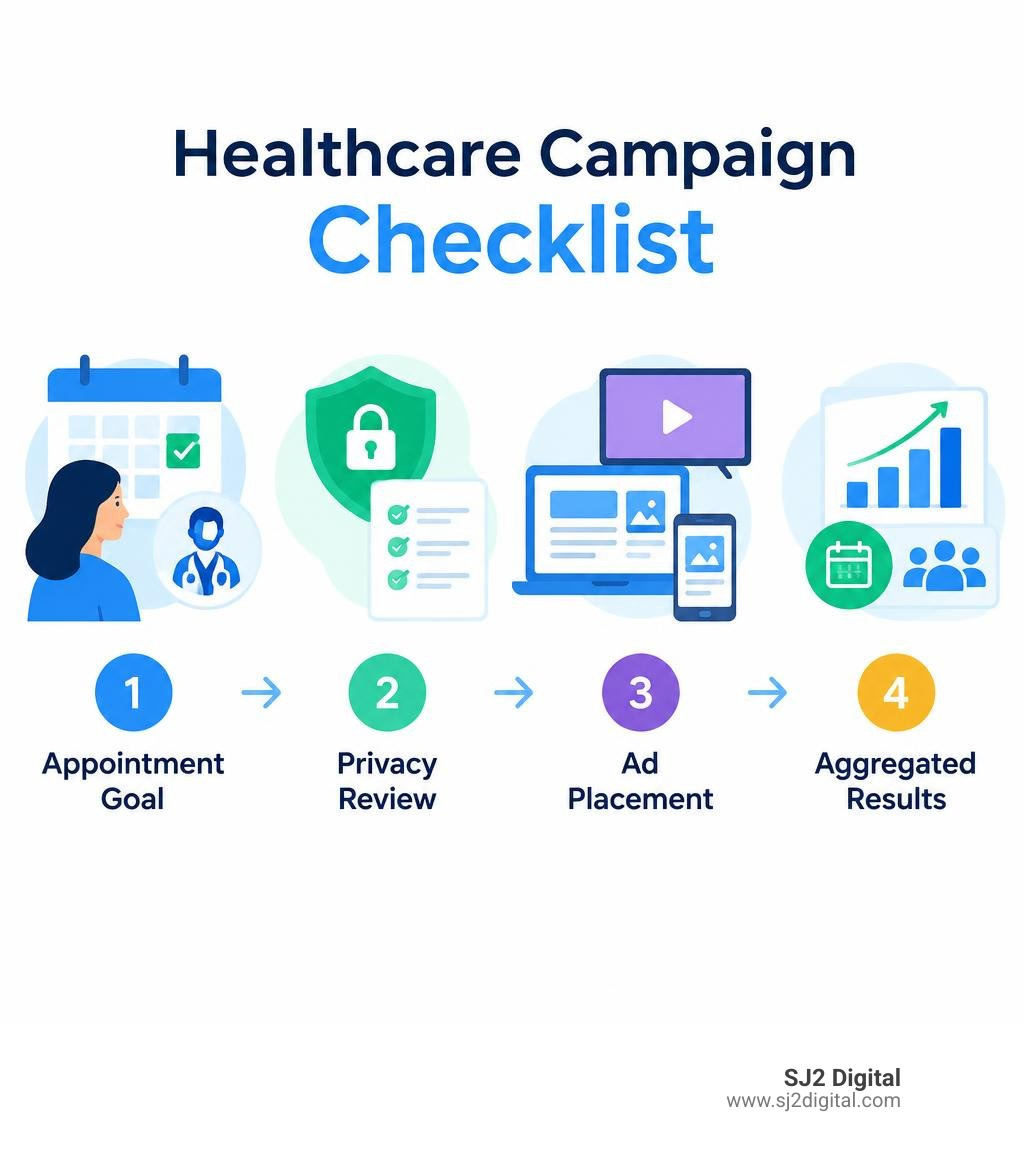
To run programmatic advertising for healthcare, start with an appointment goal. Choose where your ads will appear, use contextual or privacy-reviewed audience targeting, and check every tracking tool before launch. Keep protected health information out of ad bids. Then measure results with aggregated appointment data, not patient-level reports.
Automated buying can help you reach people across websites, apps, and streaming TV. It does not make a campaign HIPAA-compliant on its own. The data, vendors, ads, and measurement plan all need review.
The healthcare industry moves fast, but patient privacy regulations move just as decisively. Reaching prospective patients, caregivers, and healthcare providers (HCPs) in 2026 demands a media strategy that balances pinpoint precision with strict legal guardrails. We know navigating compliance while scaling appointment volume can feel like walking a tightrope. This guide lays out how to build, launch, and measure high-performing programmatic campaigns that protect patient confidentiality every step of the way.
How Programmatic Advertising for Healthcare Works in 2026
At its core, programmatic advertising is the automated buying and selling of digital ad inventory using sophisticated software algorithms rather than manual insertion orders, phone negotiations, and spreadsheets.
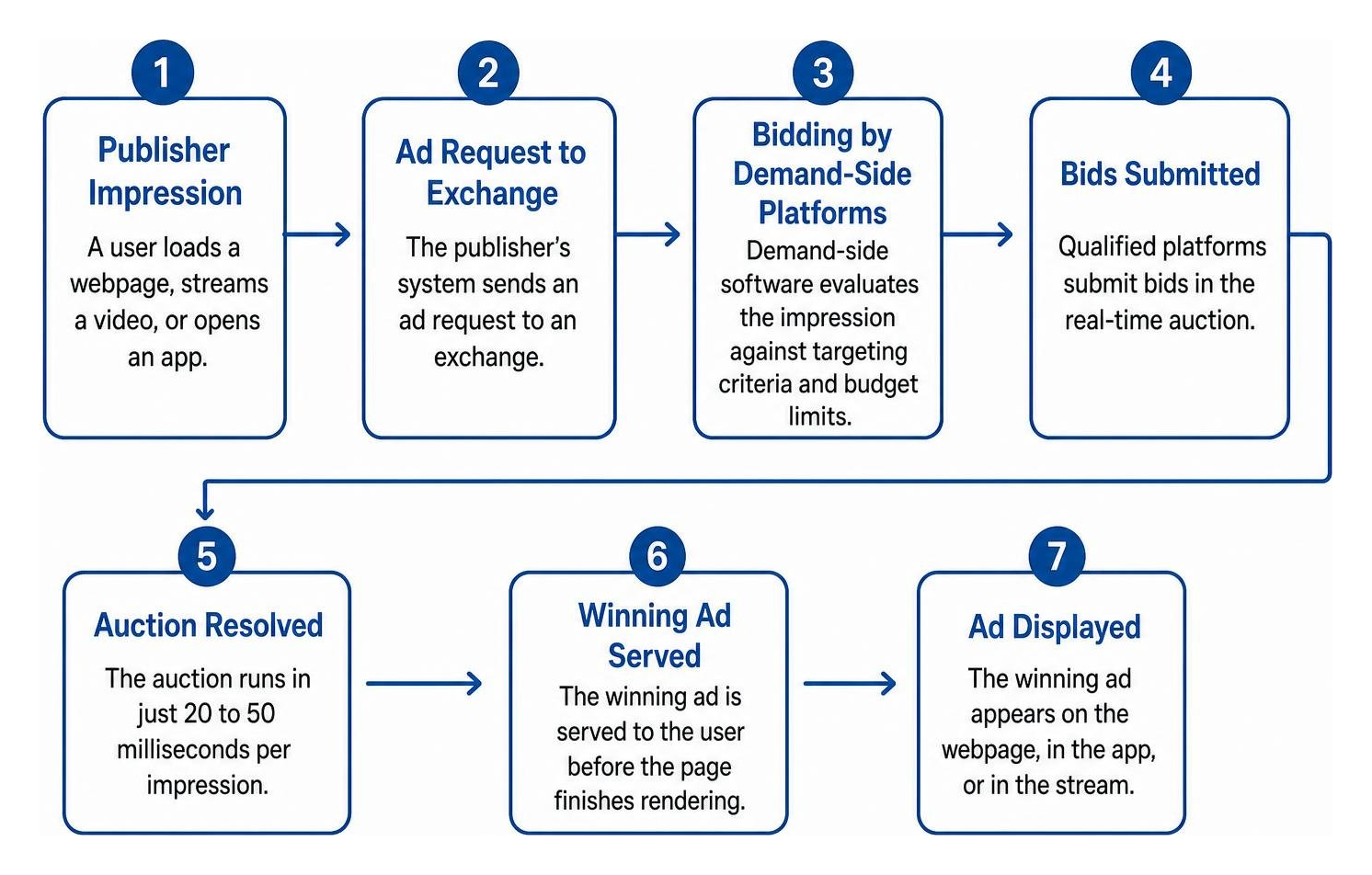
Instead of securing static ad placements weeks in advance, campaigns participate in real-time bidding (RTB) auctions that resolve in just 20 to 50 milliseconds per impression. When a user loads a webpage, streams a video, or opens an app, the publisher’s system sends an ad request to an exchange. Demand-side software evaluates the impression against targeting criteria and budget limits, submits a bid, and serves the winning ad—all before the page finishes rendering.
For health organizations, implementing modern programmatic digital advertising strategies allows media spend to adjust dynamically based on real-time market conditions, localized appointment availability, and audience engagement patterns.
Key Technologies Powering Programmatic Advertising for Healthcare
A complete programmatic ecosystem relies on integrated technologies working together securely:
- Demand-Side Platforms (DSPs): Marketer-facing software used to set bidding parameters, upload creative assets, target specific segments, and purchase ad inventory across thousands of publishers.
- Supply-Side Platforms (SSPs): Publisher-facing tools that aggregate and manage available ad space, maximizing revenue for content creators.
- Ad Exchanges: Digital marketplaces connecting DSPs and SSPs where real-time auctions take place.
- Cookieless Identifiers & Household ID Mapping: Privacy-safe alternatives to third-party cookies that match devices at the household level without collecting personal identifying information.
- Data Clean Rooms: Secure data collaboration environments where healthcare brands can cross-reference anonymized audience data against publisher media exposure without either party viewing raw, identifiable records.
Endemic vs. Non-Endemic Media Inventory
Effective healthcare campaigns balance two primary types of publisher inventory:
- Endemic Inventory: Sites directly focused on health, medical conditions, and clinical research (e.g., peer-reviewed medical journals, specialized condition portals, disease-specific forums).
- Non-Endemic Inventory: General consumer websites (e.g., news outlets, lifestyle publications, weather portals, recipe hubs) paired with contextual filters or location-based digital targeting to reach relevant local populations.
| Media Characteristic | Endemic Inventory | Non-Endemic Inventory |
|---|---|---|
| Audience Mindset | High health intent, actively researching conditions | Daily routine browsing, lifestyle engagement |
| Target Audience | Condition-specific patients, caregivers, specialized HCPs | Broad local patient populations, family decision-makers |
| Inventory Cost (CPM) | Higher due to context exclusivity | Lower and more scalable across broad networks |
| Contextual Relevance | Direct medical alignment | Indirect alignment using contextual topics |
| Primary Use Case | Rare disease awareness, clinical therapy adoption | General appointment bookings, facility discovery |
Navigating HIPAA Compliance and Patient Data Privacy
Patient data protection is central to every programmatic healthcare strategy. The Health Insurance Portability and Accountability Act (HIPAA) mandates that covered entities and their business associates protect Protected Health Information (PHI). Digital health campaigns must align with guidance from the Office for Civil Rights (OCR) alongside strict Federal Trade Commission (FTC) enforcement regarding health data privacy.
For official regulatory frameworks, healthcare teams should regularly review the Use of Online Tracking Technologies by HIPAA Covered Entities and Business Associates | HH.
Protecting Protected Health Information and Managing Tracking Pixels
Standard web tracking pixels frequently expose health organizations to compliance risk because they can transmit IP addresses, device identifiers, and specific URL paths (like /cardiology/appointment-confirmation) to commercial platforms without patient consent.

To protect patient privacy, we implement specific infrastructure safeguards:
- Auditing and Disabling Uncontrolled Pixels: Remove client-side pixels from all authenticated patient portals, condition education pages, and appointment request funnels.
- Server-Side Tracking: Route web events through a secure, private cloud server that strips away IP addresses, unique device fingerprints, and sensitive URL query strings before sending aggregated event notifications to ad platforms.
- Strict Access Control & Audit Logs: Maintain detailed logs of all audience lists and media purchases with role-based administrative permissions.
Zero-Knowledge Architecture and De-Identified Data Strategies
Reaching individuals who may benefit from specific care does not require tracking individual medical charts. Instead, privacy-forward campaigns rely on de-identified health data structured according to HIPAA's Expert Determination or Safe Harbor standards.
By utilizing Privacy-Safe Patient Audience Research, organizations can model longitudinal patient journeys using tokenization and federated data architectures. This allows marketing systems to identify macro-level trends and condition propensity without ingesting or exposing an individual's identifying medical history.
Strategic Benefits and Patient Journey Targeting
Programmatic advertising gives healthcare organizations precision and speed that traditional print, direct mail, or fixed digital sponsorships cannot match.
Core Benefits of Programmatic Advertising for Healthcare Providers
Deploying programmatic technology offers clear operational and financial advantages:
- Elimination of Ad Waste: Budgets focus on verified geographical service areas and contextually relevant digital environments.
- Real-Time Optimization: Bids, channels, and creative variations adjust automatically based on real-time engagement and scheduling demand.
- Reaching "No-See" Clinicians: Over 50% of healthcare professionals now restrict in-person pharmaceutical and vendor sales visits. Programmatic channels reach these providers across their daily professional reading habits.
- Scalable Patient Growth: Applying data-driven digital marketing for patient acquisition creates predictable appointment pipelines across specific clinical service lines.
Engaging Patients and Healthcare Professionals Across Channels
Coordinating messages across multiple touchpoints increases engagement and follow-through across the care journey.
- Connected TV (CTV): High-impact video storytelling on living room screens. Healthcare studies show that advertising on CTV increases HCP appointments for mental health treatments by 20%.
- Programmatic Audio: Reaching listeners during daily commutes and exercise routines via podcasts and music streaming services.
- Digital Out-of-Home (DOOH): Contextual screen placements near medical office buildings, pharmacies, and high-density community hubs.
- Mobile and Desktop Display: Educational creative placed alongside relevant lifestyle and health articles.
Omnichannel programmatic efforts also support care continuity. Deploying privacy-safe predictive journey models has been shown to increase therapy adherence by 29% year-over-year by proactively delivering educational support before treatment lapses occur.
Privacy-First Campaign Measurement and Optimization
Measurement in healthcare marketing must quantify patient acquisition and appointment lift without relying on user-level tracking.

Modern campaign performance relies on aggregated, privacy-preserving attribution models:
- Geo-Lift Testing: Comparing appointment volume in targeted geographic markets against unexposed control markets to determine incremental lift.
- Media Mix Modeling (MMM): Statistical modeling evaluating aggregate media spend across channels against historical appointment volumes.
- Holdout Experiments: Measuring baseline conversion volume among an unexposed audience sample to isolate true ad impact.
Measuring Appointment Lift and Incremental Conversions Without PHI
Healthcare systems can measure booking intent and verified arrivals without collecting sensitive patient information. Pairing programmatic exposure data with compliant PPC lead generation campaigns allows providers to assess appointment scheduling intent and secure phone inquiries using call tracking solutions that redact audio and strip caller PHI.
For specialty pharmaceutical campaigns, ad platforms can match aggregated, de-identified media exposure data against third-party NPI-level prescribing data to verify new therapy starts and clinical adoption.
Responsible AI and Dynamic Creative Optimization
Artificial intelligence and machine learning improve creative delivery when paired with strong data governance. Dynamic Creative Optimization (DCO) configures ad headlines, visual assets, and calls-to-action in real time based on non-personal signals such as local weather, time of day, device type, and publisher context.
In one notable deployment documented in the ViiV Healthcare AI Case Study, privacy-forward dynamic creative optimization generated a CTR of 0.14%—40% above industry benchmarks—and produced a website conversion rate of 5.81%, which was 151% higher than the baseline goal.
Selecting the Right Programmatic Advertising Partner
Executing compliant healthcare campaigns requires working with partners who understand both ad technology and healthcare privacy laws.
Essential Vendor Diligence: BAAs, Certifications, and Data Governance
When evaluating media partners or a specialized healthcare performance marketing agency, verify these essential compliance and technical standards:
- Signed Business Associate Agreements (BAAs): Any vendor touching platforms processing patient data must sign a formal BAA.
- Third-Party Security Certifications: Look for SOC 2 Type II attestations and HITRUST certifications to validate security infrastructure.
- Transparent Media Dashboards: Real-time visibility into placement-level performance, site lists, and cost breakdowns without hidden markup.
- Data Ownership: Clear contract terms confirming your organization retains total ownership of its data assets and campaign learnings.
Open Exchanges vs. Private Marketplaces
While open ad exchanges provide broad inventory scale, they carry higher risks of ad misplacement and data leakage.
Private Marketplaces (PMPs) and Programmatic Guaranteed deals offer pre-negotiated, direct relationships with verified publishers. Research shows that running campaigns through private marketplaces can reduce data exposure risks by up to 40% compared to open-exchange auctions while guaranteeing premium, brand-safe ad placements.
Frequently Asked Questions About Healthcare Programmatic Advertising
What makes a programmatic advertising platform HIPAA-compliant?
A programmatic advertising platform is HIPAA-compliant when it enforces strict administrative, physical, and technical safeguards under a signed Business Associate Agreement (BAA). This includes end-to-end encryption, role-based access management, total exclusion of Protected Health Information (PHI) from bidstreams, and verified third-party security audits like SOC 2 Type II or HITRUST.
How can healthcare brands target specific medical conditions without using cookies?
Healthcare brands target conditions without cookies by using contextual advertising (placing ads on web pages discussing specific health topics), de-identified longitudinal claims data modeled at the zip-code or household cluster level, and predictive AI modeling that identifies condition propensity without individual-level tracking.
What channels deliver the highest conversion rates for healthcare campaigns?
Connected TV (CTV) and high-intent programmatic search deliver some of the highest conversion rates for healthcare campaigns. CTV builds trust and condition awareness in household settings, while search and premium contextual display capture active care-seeking intent.
Building Privacy-First Campaigns That Perform
Modern healthcare marketing does not require choosing between strict patient privacy and high-performing patient acquisition. By pairing de-identified audience modeling, private marketplace media buys, and server-side tracking infrastructure, health organizations can build sustainable, compliant campaigns that reliably drive appointments.
At SJ2 Digital, we operate on an anti-agency model designed for complete transparency. We deliver senior-level expertise, direct access to live performance dashboards, and flexible engagements without long-term contract lock-ins. Whether you are scaling a regional healthcare clinic or exploring specialized programmatic advertising for senior living communities, our team ensures your campaigns remain secure, compliant, and focused on real-world occupancy and appointment outcomes.