
How to Audit a Senior Living Google Ads Agency Before You Hire

Before hiring a senior living Google Ads agency, ask to see how it tracks qualified inquiries, scheduled tours, and move-ins. Clicks alone cannot tell you whether your ad spend is helping fill rooms.
Watch for five red flags: reports focused on clicks, the same keywords used for every care level, weak privacy safeguards, ads that overlook family decision-makers, and paid search that runs apart from your other marketing. A good agency should be able to show what it measures, explain where your budget goes, and tell you what it will change when leads are not turning into tours.
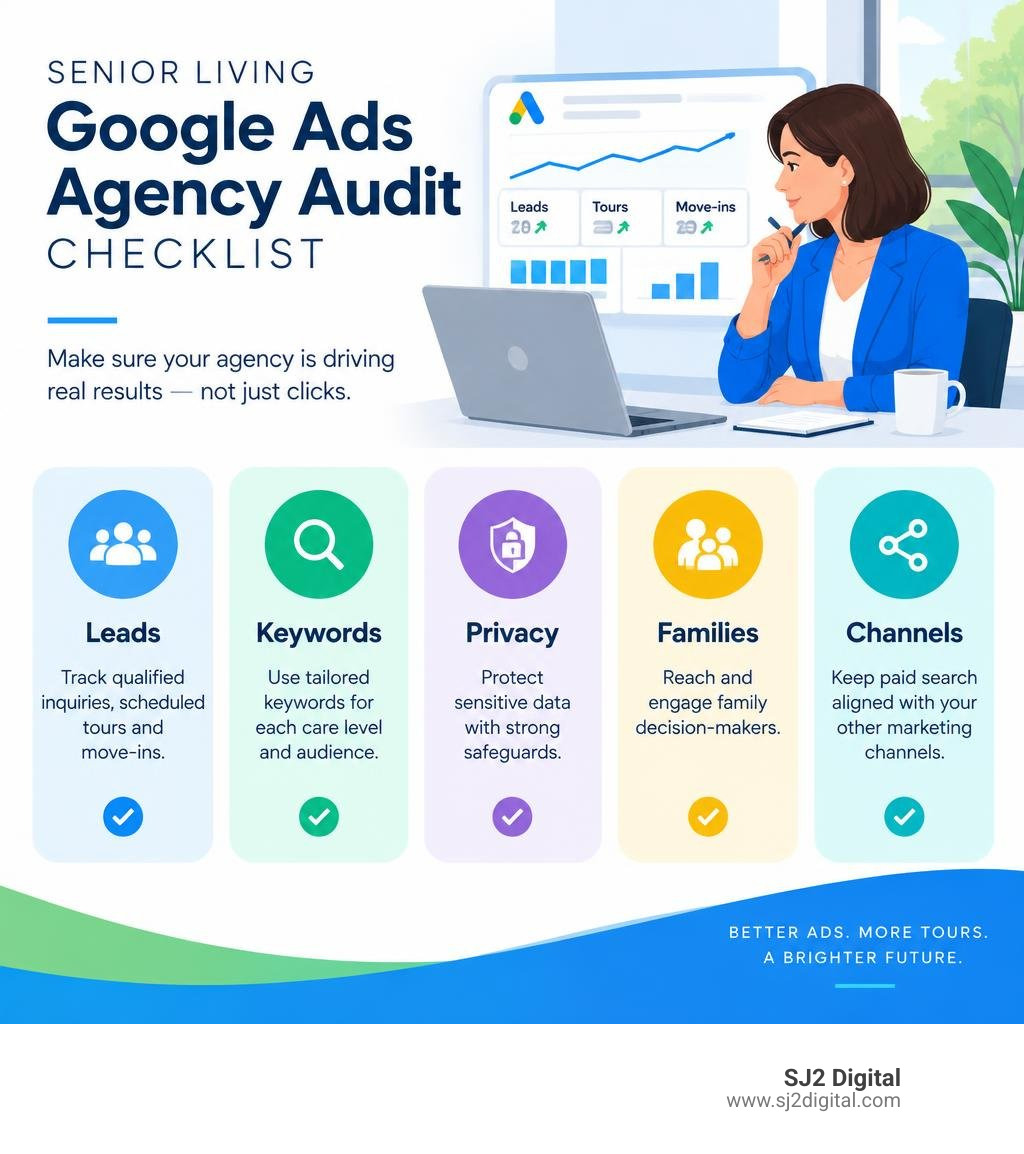
5 Red Flags Your Senior Living Google Ads Campaign Is Underperforming
Across the senior housing sector, digital marketing budgets are substantial. The industry spends well over $1.2 billion annually on digital advertising, with Google Ads capturing a major portion of those resources. When paid search operates effectively, it acts as a direct, predictable pipeline connecting families in crisis or active research with your leasing team.
However, approximately 65% of communities use paid search, creating competitive local auctions where mistakes drain budgets fast. If your cost-per-acquisition keeps climbing while your sales team complains about empty tour slots, your paid search account is likely showing signs of fatigue, mismanagement, or structural neglect.

To spot issues early, compare how top-tier accounts run against low-performing campaigns:
| High-Performing Campaigns | Underperforming Campaigns |
|---|---|
| Focuses on scheduled tours, verified calls, and move-ins | Focuses primarily on impressions, total clicks, and raw traffic |
| Segmented campaigns for Independent Living, Assisted Living, and Memory Care | Single campaigns mixing multiple care levels into generic ad groups |
| Extensive negative keyword libraries pruned weekly | Little to no search query filtering, causing budget waste on job seekers |
| Full alignment with healthcare privacy guidelines | Unchecked tracking pixels and potential policy violation flags |
| Coordinated seamlessly with SEO, social ads, and local listings | Managed in an isolated silo without cross-channel insights |
Proper performance begins with verified data capture. If your team cannot follow a click directly to a phone inquiry or tour form, review how to Set up conversion tracking - Google Ads Help before spending another dollar.
Let us explore the five critical red flags you must address.
Red Flag 1: Reporting Vanity Clicks Instead of Scheduled Tours and Move-Ins
The most widespread issue in senior housing advertising is the vanity metric report. If your agency hands you a monthly report highlighting impressions, generic click-through rates, and total site visits without showing you what happened after the click, they are hiding behind surface-level activity.
In senior living, a click is merely an expense; an inquiry is an opportunity, and a tour is an asset. Top campaigns achieve an average click-through rate (CTR) of 3.5% (roughly 50% higher than broader healthcare benchmarks) and maintain a median cost-per-click (CPC) around $4.50. Yet, if those clicks convert into unqualified calls or immediate website bounces, high traffic numbers mean very little.
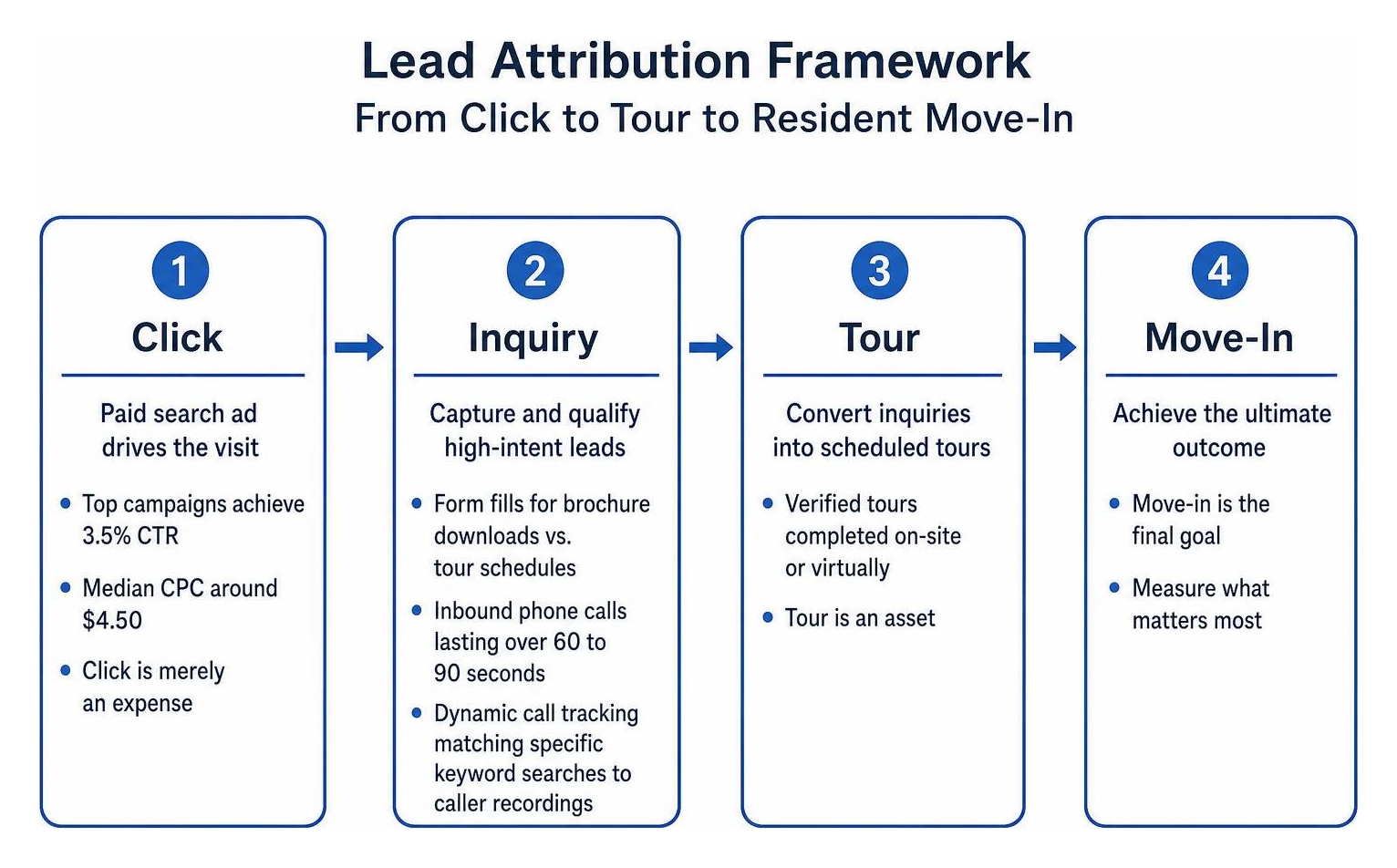
Your paid search partner should track:
- Form fills for brochure downloads vs. tour schedules
- Inbound phone calls lasting over 60 to 90 seconds
- Dynamic call tracking matching specific keyword searches to caller recordings
- Verified tours completed on-site or virtually
- Final move-in attribution matched back to initial ad clicks
When you partner with a dedicated PPC lead generation agency, reporting centers on cost-per-tour and cost-per-move-in rather than hollow click totals.
Red Flag 2: Generic Keyword Bidding Without Care-Level Segmentation
Senior care is not one-size-fits-all. A family seeking a vibrant, maintenance-free lifestyle in an active independent living community has vastly different needs, questions, and budgets than an adult child navigating an urgent memory care placement for an aging parent with advanced dementia.
When an agency bundles terms like "senior apartments," "assisted living facilities," and "memory care homes" into one catch-all campaign, your budget leaks into mismatched searches. Someone searching for "cheap retirement homes" should never land on your luxury assisted living landing page.
Well-structured, targeted senior living pay-per-click campaigns build distinct campaign architectures for every level of care offered:
- Independent Living: Focuses on community lifestyle, amenities, social engagement, and freedom from home upkeep.
- Assisted Living: Emphasizes personalized daily assistance, medication management, wellness support, and peace of mind.
- Memory Care: Concentrates on safety, specialized cognitive programming, compassionate 24/7 staff, and caregiver relief.
Furthermore, an unmanaged account will waste thousands of dollars on irrelevant terms. Without strict negative keyword lists, your ads will trigger for searches like "senior living jobs near me," "assisted living caregiver certification," "subsidized senior housing vouchers," or "free nursing home equipment." Regular search term audits keep your spend focused on genuine prospective residents.
Red Flag 3: Ignoring Healthcare Privacy and Local Ad Compliance Policies
Digital advertising in healthcare and senior services requires careful navigation of privacy policies and strict platform guidelines. Google continuously updates its personalized advertising frameworks, especially regarding sensitive health conditions, physical limitations, and personalized medical services.
If your agency uses improper remarketing setups or collects sensitive health data through insecure tracking scripts, your ad accounts risk sudden suspension. Furthermore, non-compliance with health data privacy regulations can expose your community to legal risks.
A knowledgeable agency ensures that:
- Ad copy avoids restricted claims, diagnostic assumptions, or non-compliant healthcare guarantees.
- Landing page lead forms respect user privacy and state disclaimers without capturing unauthorized protected health information.
- Remarketing efforts rely on compliant programmatic audiences, contextual targeting, and engagement lists rather than sensitive clinical attributes.
- Local ad assets and extensions accurately display licensed operating names, local addresses, and verified accreditations.
Red Flag 4: Failing to Target Adult Child Decision-Makers and Caregivers
A common misstep in senior living paid media is directing all ad copy and targeting toward the senior resident. While independent living communities often engage older adults directly, assisted living and memory care decisions are overwhelmingly driven by adult children—most often daughters aged 40 to 65 who balance careers, children, and aging parents.
These family decision-makers search with distinct emotional urgency, frequently on mobile devices late at night after a caregiving incident:

If your agency does not adjust device bid modifiers, dayparting schedules, and geographic radiuses to reach family caregivers, you miss your most important audience. For instance, adult children often search from their own suburban neighborhoods or office locations rather than the immediate town where their parents currently reside. Your targeting strategy must account for multi-location search patterns and mobile-first responsive landing pages.
Red Flag 5: Managing Paid Search in Isolation from Other Marketing Channels
Paid search performs best as part of an integrated marketing mix. If your Google Ads team works in a bubble without coordinating with your broader marketing efforts, you end up paying repeatedly for leads that could have been nurtured at lower costs.
Search ads capture active, high-intent demand. However, families often take weeks or months to make a final decision. Paid search insights should actively inform your senior living SEO keyword strategy, uncovering high-converting search queries that deserve long-term organic content assets.
Simultaneously, pairing search traffic with senior living social marketing ensures that visitors who click your Google ad are continually engaged with warm community stories, resident spotlights, and event invitations across social feeds. Adding targeted programmatic advertising for senior living expands your reach across connected TV and premium digital publications, reinforcing brand authority throughout the entire evaluation journey.
Why Partnering with a Specialized Senior Living Google Ads Agency Drives Higher ROAS
Managing paid search across multiple care levels and competitive regional markets requires nuanced industry expertise. Generalist agencies that juggle auto dealerships, retail shops, and dental clinics often struggle with the extended sales cycle, emotional sensitivity, and complex care distinctions unique to senior living.
Data shows that communities working with a specialized senior living Google Ads agency achieve a 40% higher return on ad spend (ROAS) compared to those managing campaigns in-house or relying on broad-scope marketing firms. An experienced senior living pay-per-click team understands community occupancy dynamics, inquiry-to-tour ratios, and how to lower cost-per-move-in.
Instead of locking communities into rigid long-term agreements, flexible models like outsourced PPC management provide on-demand, senior-level expertise. Working with a dedicated senior housing marketing agency ensures every dollar allocated directly supports community census goals.
What to Expect from a Full-Service Senior Living Google Ads Agency
A comprehensive paid search partnership covers every step of the conversion funnel:
- Strategic Account Architecture: Clean separation of campaigns by care type, geographic radius, and user intent (research vs. immediate placement).
- Dedicated, High-Converting Landing Pages: Fast-loading, accessible pages featuring transparent pricing ranges, virtual tour previews, clear call-to-action buttons, and prominent phone numbers.
- Dynamic Call Tracking Integration: Seamless call attribution that connects phone leads directly back to specific ad groups and search keywords.
- Active Negative Keyword Management: Continuous filtering of non-prospect search queries, such as job seekers and unrelated government services.
- Bid Optimization and Smart Bidding Oversight: Balancing automated bidding algorithms with manual oversight to ensure cost efficiency.
- Transparent Reporting: Clear reporting dashboards that track cost-per-tour and cost-per-move-in rather than isolated vanity metrics.
When you work with a full-service PPC management agency, you gain a proactive marketing ally that continuously refines your pipeline.
Essential Metrics and Benchmarks for Senior Housing PPC Success
To determine whether your paid search strategy is healthy, evaluate your performance against standard industry benchmarks:
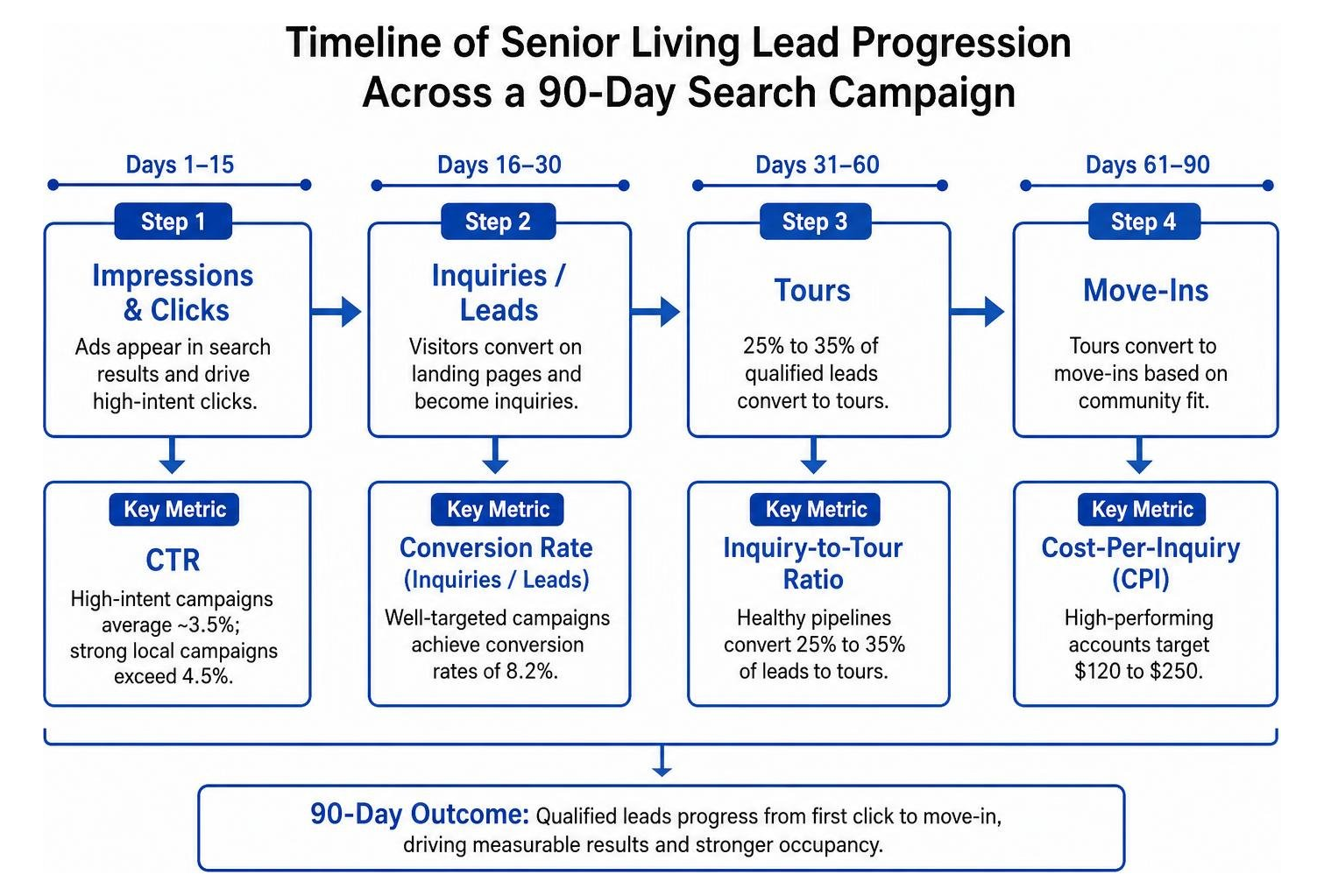
- Click-Through Rate (CTR): High-intent senior housing campaigns average around 3.5%, with strong local campaigns exceeding 4.5%.
- Median Cost-Per-Click (CPC): National averages hover near $4.50, though competitive metropolitan markets for memory care may see higher rates.
- Conversion Rate (Inquiries / Leads): Well-targeted campaigns targeting terms like "assisted living near me" regularly achieve conversion rates of 8.2%, outperforming generic terms.
- Cost-Per-Inquiry (CPI): High-performing accounts generally aim for an inquiry cost between $120 and $250, depending on care level and local market density.
- Inquiry-to-Tour Ratio: Healthy pipelines convert 25% to 35% of qualified paid search leads into on-site or personalized virtual tours.
By tracking these figures alongside comprehensive, integrated senior living marketing services, leadership teams gain clear visibility into real marketing ROI.
How to Budget, Scale, and Measure Results from Paid Search
Setting a paid search budget requires working backward from your community's occupancy goals, current unit turnover, and local market competitiveness.
A reliable formula for establishing your paid search budget is:
Target Move-Ins Needed = Desired Occupancy Units - Current Occupied Units
Required Inquiries = Target Move-Ins / Overall Lead-to-Move-In Conversion Rate
Estimated Monthly Ad Budget = Required Inquiries × Target Cost-Per-Inquiry
For example, if a community needs 4 move-ins per month, maintains a 2% lead-to-move-in close rate, and has an average cost-per-inquiry of $150:
- Required Inquiries: 4 / 0.02 = 200 inquiries
- Estimated Ad Budget: 200 × $150 = $30,000 across targeted channels
Technical performance directly impacts these costs. Slow-loading websites increase bounce rates and drive up your Google Ads Quality Score costs. Ensuring strong website server management keeps landing pages fast, mobile-friendly, and fully accessible for older adults and busy families. Integrating search with omnichannel digital marketing for senior living helps capture leads at every stage of their evaluation.
How to Choose the Right Senior Living Google Ads Agency for Your Community
When evaluating potential agency partners, look for transparency, flexibility, and genuine senior living experience. Use this checklist during discovery calls:
- Contract Flexibility: Do they lock you into rigid 12-month agreements, or do they offer month-to-month flexibility based on performance?
- Account Ownership: Will you own your Google Ads account, data, and landing pages, or does the agency hold them inside proprietary, inaccessible portals?
- Transparent Live Dashboards: Do you receive 24/7 access to real-time performance data, or only curated monthly PDF summaries?
- Senior-Level Attention: Will your campaigns be managed directly by seasoned paid search specialists, or handed off to junior account coordinators?
- Industry Depth: Does the team understand the differences in resident journeys between independent living, assisted living, and memory care?
Choosing a dedicated senior living PPC agency that checks every box ensures your marketing investment directly supports your occupancy goals.
Frequently Asked Questions About Senior Living Google Ads
How much should a senior living community budget for Google Ads management?
Most single senior living communities allocate between $2,500 and $7,500 per month in direct Google Ads media spend, depending on local competition, geographic market size, and available inventory. Agency management fees typically range from a flat monthly retainer ($1,500 to $3,500) or 12% to 20% of total ad spend. Multi-community operators or communities filling newly constructed wings often scale budgets higher to accelerate lease-up timelines.
How long does it take to see results from a senior living Google Ads campaign?
Initial phone inquiries and form submissions typically begin within the first 7 to 14 days after campaign launch. However, a full performance baseline requires approximately 30 to 90 days. This ramp-up window allows Google's smart bidding algorithms to gather sufficient conversion data, enables your agency to prune negative keywords, and aligns with the typical 30-to-90-day senior housing decision cycle from initial search to final lease signing.
What is an average conversion rate for senior living Google Ads?
While standard healthcare search campaigns average around 3% to 4% conversion rates, well-optimized senior living campaigns regularly achieve higher numbers. High-intent local searches—such as "assisted living near me" or "memory care facilities in [City]"—frequently achieve conversion rates of 8.2% or higher when paired with fast, mobile-responsive landing pages featuring prominent click-to-call buttons and easy tour scheduling forms.
Conclusion
Auditing your paid search performance protects your marketing investment and keeps your sales team supplied with qualified tour opportunities. If your current agency relies on vanity click metrics, mixes all care levels into generic ad groups, ignores healthcare privacy standards, or operates in a silo, it is time to reassess your partnership.
At SJ2 Digital, we operate on an "anti-agency" model designed to give senior housing operators complete transparency and peace of mind. We eliminate rigid long-term contracts, provide transparent live reporting dashboards, and ensure your account is managed directly by experienced, hands-on senior specialists who understand your occupancy challenges.
Ready to uncover wasted spend and accelerate move-ins? Discover how our team can help you scale occupancy with optimized senior living pay-per-click management today.